Physics has a specific failure mode that other self-taught subjects do not share as sharply: it is entirely possible to watch dozens of hours of excellent conceptual physics content — the kind that makes you feel like you finally understand relativity or quantum mechanics — and still be unable to set up and solve a single force diagram. Conceptual intuition and calculational fluency are separate skills, and the best physics YouTube channels split cleanly along that line.
This guide is a staged roadmap that uses both halves deliberately: conceptual channels to build the intuition that makes formulas feel like they mean something, and a structured, calculus-based course sequence to build the problem-solving fluency that physics exams actually test.
For the full review of every major physics channel with detailed sub-topic breakdowns, see best YouTube channels for physics — this guide focuses on sequencing rather than channel-by-channel depth.
Stage 0: Confirm Your Math Is Ready
Physics beyond the introductory conceptual level is calculus, applied. Mechanics needs derivatives and integrals; electromagnetism needs vector calculus; nothing past the first few weeks of a real physics course avoids this. Trying to learn calculus-based physics without solid calculus is the single most common reason self-learners stall out and conclude physics is "too hard," when the actual gap is upstream.
Before starting a structured mechanics course, confirm you are comfortable with derivatives, basic integration, and vector operations (dot products, cross products). If any of these feel shaky, how to learn calculus from YouTube covers the full roadmap — Stage 1 of that guide is sufficient preparation to start physics.
Stage 1: Conceptual Foundations — Build Intuition Before Formulas
Veritasium (Derek Muller) is the best starting point precisely because Muller's PhD is in physics education — his videos are designed around correcting the specific misconceptions students form, not just presenting correct information. Watch his videos on the topics you are about to study formally, before your course or self-study plan reaches them. This is not passive entertainment; it is priming your intuition so the formal treatment has something to attach to.
MinutePhysics is useful for fast orientation — a 3-6 minute video that tells you what a concept is about before you spend hours on the formal derivation. Use it as a preview, not a primary source.
Sixty Symbols adds something the scripted channels above cannot: working physicists explaining concepts in their own words, unscripted. This is valuable for building the kind of intuition that comes from hearing how physicists actually think about a problem, not just how a textbook presents the finished result.
The trap to avoid at this stage: watching Veritasium, PBS Space Time, and similar channels can create a false sense of mastery. You will genuinely understand why certain things are true at a conceptual level — and still be unable to solve the corresponding problem set. This is normal and expected. Conceptual channels are Stage 1, not the whole roadmap.
Stage 2: Mechanics — The Calculus-Based Course
MIT OpenCourseWare 8.01 (Classical Mechanics), taught in its most famous recorded form by Walter Lewin, is the single best free resource for building real calculus-based mechanics fluency. Lewin's lectures are complete, rigorous, and include the full problem sets and exams that let you self-assess against an actual MIT standard — not a simplified version of the course.
How to use it: watch each lecture with a notebook, working through every derivation by hand as Lewin presents it rather than just watching. Pause before he sets up a problem and attempt to set it up yourself first. After each lecture, do the corresponding problem set from OCW before moving to the next lecture — mechanics is cumulative, and gaps compound quickly if you watch ahead of your problem-solving.
Key milestones for Stage 2: Can you set up and solve a force-diagram problem involving friction and multiple objects? Can you apply conservation of energy and momentum to a collision problem? Can you set up and solve a rotational dynamics problem (torque, moment of inertia, angular momentum)?
Stage 3: Electricity and Magnetism
MIT OpenCourseWare 8.02 continues the same lecture-course model into electromagnetism — electric fields, Gauss's law, circuits, magnetic fields, and Maxwell's equations. This is where vector calculus (gradient, divergence, curl) becomes essential; if Stage 0's math check did not cover vector calculus specifically, revisit it before Stage 3, since E&M leans on it far more heavily than mechanics does.
PBS Space Time is a strong conceptual supplement here — its treatment of electromagnetic fields and the transition toward relativistic electrodynamics helps connect the E&M formalism to the deeper structure of physics that mechanics alone does not reveal.
Key milestones for Stage 3: Can you apply Gauss's law to calculate the electric field of a symmetric charge distribution? Can you analyze a circuit with resistors and capacitors using Kirchhoff's laws? Do you understand what Maxwell's equations are saying physically, not just how to manipulate them?
Stage 4: Choosing a Direction — Quantum, Relativity, or Applied Physics
Once mechanics and E&M are solid, the roadmap branches based on your goals.
For quantum mechanics and modern physics: PBS Space Time becomes a primary resource rather than a supplement — its archive covers quantum field theory, general relativity, and cosmology at a level that assumes the foundation you have just built. MIT OCW's 8.04 (Quantum Physics I) provides the calculus-based rigor to go with PBS Space Time's conceptual framing.
For engineering-adjacent applied physics: MIT OCW's thermodynamics and statistical mechanics courses, plus continued mechanics work in fluid dynamics and waves, build directly toward engineering coursework.
For students heading toward medicine (MCAT) or a general science requirement: you likely do not need to go past algebra-based mechanics, waves, and circuits — see how to study for the MCAT using YouTube for the specific, narrower physics scope that exam actually tests.
How to Take Notes on Physics Videos That Actually Help Later
The failure mode specific to physics note-taking is copying down a finished derivation without engaging with why each step follows from the last. When Lewin or an OCW lecturer writes an equation on the board, pause and predict the next line before revealing it. If your prediction is wrong, that gap is exactly where your understanding needs work — note it explicitly rather than just correcting your notes and moving on.
For conceptual videos, write down the mental model in your own words, not the formula. "Why does the derivative of position give velocity" is a more useful note than restating the definition you already had access to in the video.
For the general system of converting video content into durable study material, see the AI study notes complete guide and active recall techniques for applying retrieval practice specifically to derivation-heavy content.
How Long Does This Roadmap Take?
For 10-12 hours per week: conceptual foundations (Stage 1) run alongside the rest of the roadmap rather than as a separate block — budget 2-3 hours per week throughout. Mechanics (Stage 2) takes 10-12 weeks to reach real problem-solving fluency. Electricity and magnetism (Stage 3) takes another 10-12 weeks, assuming vector calculus is already solid. A first pass at Stage 4 content (quantum mechanics or applied physics) takes an additional 10-14 weeks depending on direction.
Total: roughly seven to nine months of consistent study to go from conceptual physics literacy to a working calculus-based foundation across mechanics, E&M, and one advanced direction — comparable to the first three semesters of a university physics sequence.
Physics rewards the students who treat conceptual understanding and calculational fluency as two skills that need separate, deliberate practice — not two names for the same thing. Walter Lewin's lectures and Veritasium's conceptual framing, used together rather than as substitutes for each other, build both.
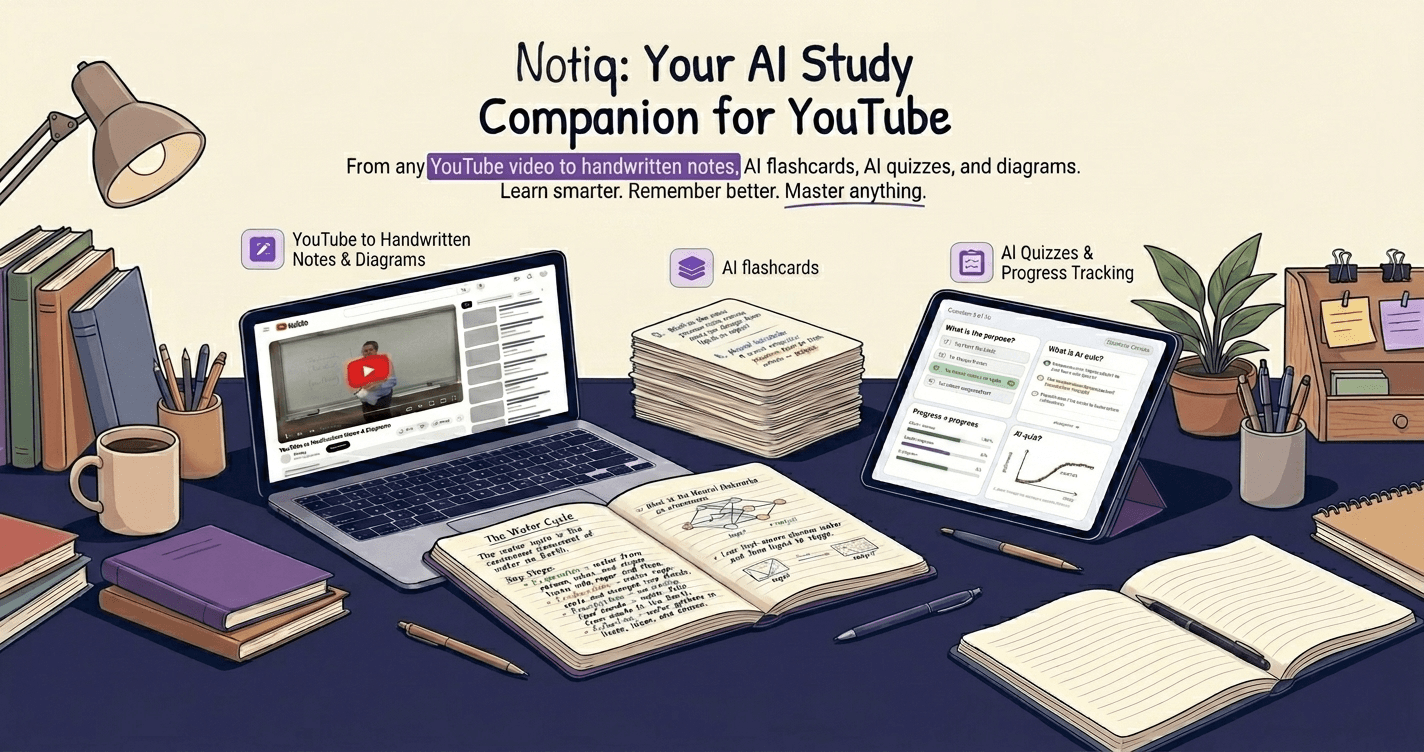
Turn your physics lecture notes into structured study material and flashcards automatically. Try Notiq free at notiq.study — import any YouTube physics lecture and get organized notes plus exam-ready flashcards in minutes.