Active recall studying is not a technique that most students discover on their own. It is counterintuitive. It feels harder than re-reading. It produces more errors and more discomfort. And it is, by a significant margin, the most effective study method available for producing long-term retention.
If you have been re-reading notes, highlighting textbooks, or rewatching lectures as your primary revision strategy, this guide will explain exactly why that approach produces mediocre results — and how to replace it with a method backed by more evidence than almost any other intervention in educational psychology.
What Active Recall Actually Is
Active recall is the practice of retrieving information from memory without looking at the source. That is the entire definition. Everything that follows is a method of doing that in specific ways for specific types of material.
The opposite of active recall is passive review: reading notes, watching lectures, listening to audio recordings, or looking at highlighted passages. Passive review feels like studying because the material is present and familiar. It is not the same as being able to recall the material independently.
The research distinction is critical. When you re-read a passage and it feels familiar, your brain is doing pattern recognition — matching the text against a stored representation. This produces a feeling of knowing that is not the same as the ability to retrieve. Jeffrey Karpicke at Purdue calls this the "illusion of knowing." Students who re-read consistently overestimate how much they will be able to recall under test conditions, precisely because re-reading produces fluency without recall.
Active recall bypasses this by requiring retrieval. When you close your notes and try to write down everything you know about a topic, you immediately discover what you actually know versus what merely felt familiar.
The Retrieval Practice Effect: What the Research Shows
The evidence for active recall — technically called the "testing effect" or "retrieval practice effect" — is among the most replicated findings in cognitive psychology.
Karpicke and Roediger (2008). This landmark study tested four study conditions: study once, study four times (repeated re-reading), study then test once, study then test four times. One week later, the group that studied once and tested four times dramatically outperformed the group that studied four times with no testing. Their retention was more than double. The conclusion: the act of retrieving information from memory strengthens the memory trace more than any amount of additional study does.
Karpicke (2011). A follow-up study in Science compared elaborative studying (concept mapping — a cognitively active method) against retrieval practice. Despite the fact that concept mapping involves active processing and organisation, retrieval practice still produced significantly better long-term retention. This is a remarkable result because it shows that active processing alone is insufficient — it is specifically the retrieval demand that drives durable learning.
Bjork on desirable difficulties. Robert Bjork at UCLA framed active recall within a broader framework of "desirable difficulties" — study conditions that reduce performance during practice but increase long-term retention. Active recall is the prototypical desirable difficulty. Because retrieval is harder than re-reading, students underestimate its effectiveness and tend to prefer easier passive methods. The perception of difficulty is inversely correlated with actual learning when it comes to retrieval practice.
Sweller's cognitive load implications. John Sweller's cognitive load theory helps explain why active recall works neurologically. Retrieval practice engages the germane cognitive load — the productive mental work of connecting new information to existing schemas. Re-reading, by contrast, primarily activates the extraneous load of processing familiar text without meaningful cognitive transformation. The effortful nature of retrieval is not a bug — it is the mechanism.
This is a rare case in education research where the evidence points unambiguously in one direction. Active recall works better than passive review. The difficulty it creates is the reason it works, not a reason to avoid it.
How Does Active Recall Differ from Just Doing Practice Tests?
Practice tests are one form of active recall. But active recall is broader — it is any activity that requires you to generate information from memory rather than recognise it. This includes:
- Flashcard recall: covering the answer and trying to recall it before checking
- Free recall: closing all notes and writing down everything you know about a topic
- The blank page technique: writing a complete explanation of a concept from scratch on a blank page
- Feynman technique: explaining a concept as if teaching it to someone with no background
- Practice questions: answering exam-style questions from memory
- Elaborative interrogation: generating explanations for why facts are true
The common thread: you produce the information rather than encountering it. The direction of information flow goes from your memory outward, not from the page inward.
The Six Most Effective Active Recall Techniques
1. Flashcard Retrieval with Spaced Repetition
The most systematic active recall method. You write a question on one side and an answer on the other. During review, you read the question, attempt the answer from memory, then check.
The power multiplies when combined with spaced repetition: a scheduling algorithm that shows you each card at the optimal interval to prevent forgetting. Anki and RemNote both implement this. For a comparison of available tools, see Anki vs RemNote and AI alternatives.
For maximum retrieval benefit, the key discipline is: do not flip the card before you have genuinely attempted an answer. The temptation when you do not know is to skip the retrieval attempt and look. Resisting this is what produces the learning. Even a partial, wrong answer creates a better retrieval path than no attempt at all.
The science behind effective flashcard design — including cloze deletion, image occlusion, and the minimum information principle — is covered in how to make flashcards that actually stick.
2. Free Recall (the "Brain Dump")
Open a blank document or a blank piece of paper. Write the topic at the top. Close everything else. Write down everything you know about that topic from memory.
Do not stop when you think you are done. Push for an additional 5 minutes after the first natural stopping point. The material that comes out in that extension is often the most important — it is what requires the most effort to retrieve and therefore benefits the most from practice.
After the brain dump, check your notes and identify the gaps. What did you forget? What did you recall incorrectly? Those gaps become your priority study targets.
Free recall is particularly effective for topics with complex interconnections: history, literature, systems biology, economics. Subjects where isolated facts are less useful than the relationships between them.
3. The Feynman Technique
Explain the concept as if you are teaching a 12-year-old who has never heard of it. Use simple words. Avoid jargon (unless the jargon is itself what you are learning). Work through one example.
When you get stuck — when you reach a point where you cannot explain without falling back on the original text — you have identified a gap. Go back to the source, understand that specific gap, then return to the explanation attempt.
The Feynman technique is most powerful for conceptual understanding: mathematical proofs, scientific mechanisms, causal chains in history or economics. It forces you to convert declarative knowledge ("I know the definition") into functional knowledge ("I can use this to explain and predict").
For subjects where note-taking from video is part of your workflow, see how to take notes from a YouTube lecture for how to capture content in a format that supports Feynman-style review.
4. Practice Questions and Past Papers
Working through exam-style questions is the most direct form of active recall for exam preparation. It retrieves information, applies it to novel scenarios, and creates meta-awareness about which question types you struggle with.
The discipline that most students miss: treat every wrong answer as a learning event. Do not skim the explanation of a missed question — read it carefully, identify exactly where your understanding broke down, and make a note or flashcard capturing the specific gap.
Students who work through past papers and check their answers against the mark scheme without internalising the corrections are doing active recall with no feedback loop. The retrieval attempt is half the process. The correction is the other half.
5. Elaborative Interrogation
For every fact you are trying to learn, ask "why is this true?" and generate an explanation from memory.
Example: instead of just memorising "osmosis moves water from low to high solute concentration," ask yourself: why does water move in that direction? What drives it? What would happen if the membrane were not semi-permeable? What happens to a cell placed in a hypertonic solution?
Elaborative interrogation works because it connects each new fact to existing knowledge. The more connections a memory has to other memories, the more retrieval pathways exist for accessing it. A fact with no connections can only be retrieved via its exact surface form. A fact embedded in a web of explanatory relationships can be retrieved from many starting points.
6. The Cornell Method's Retrieval Column
The Cornell note-taking format includes a narrow left column specifically for retrieval practice: after writing notes in the main column, you write a question or cue in the left column that the note answers. During review, you cover the right column and answer each question from memory.
This transforms your note-reviewing habit into an active recall habit with minimal additional work. The note-taking format itself builds the retrieval structure into every review session. For more on the Cornell method and how AI tools augment it, see the Cornell method with AI.
How Often Should You Do Active Recall?
The research consensus, based on Ebbinghaus's forgetting curve and subsequent spaced practice studies, is that multiple spaced retrievals produce dramatically better retention than massed (same-day) retrieval.
Practical schedule for a topic encountered in a lecture:
- Day 0 (after the lecture): First free recall or flashcard review of the new material. This is the most important retrieval attempt — it happens while the memory trace is still fresh enough to strengthen, but soon enough that some forgetting has begun.
- Day 2–3: Second retrieval pass. Focus on gaps identified in Day 0.
- Day 7: Third retrieval pass. Much of what you did not review will have faded; this is the point where re-learning after forgetting produces the strongest consolidation benefit.
- Week 3–4: Fourth retrieval pass. By this point, material reviewed in all previous sessions should be consolidated into long-term storage.
If this sounds like a lot of overhead, spaced repetition software automates it. You study each card when the algorithm determines you are on the edge of forgetting it. The schedule is computed for you. You just do the reviews.
Active Recall Under Exam Conditions: Is It Different?
When you have 24 hours before an exam, the spacing cannot work at its full power — there is not enough time between sessions for consolidation. But active recall is still your best tool within that constraint.
Within a cramming session, massed retrieval is better than massed re-reading. Running through your flashcard deck three times in one day with genuine recall attempts produces better same-day retention than re-reading notes three times, even though the spacing benefit is absent.
The how to cram for an exam in 24 hours guide covers how to allocate time within a 24-hour session for maximum retrieval practice — including how to use past papers as a diagnostic tool and how to prioritise what to retrieve based on exam weight.
What Active Recall Cannot Do
Active recall is extraordinarily effective for learning facts, definitions, mechanisms, procedures, and relationships between concepts. It is less effective as the sole method for developing skills that require practice — solving novel problems, writing arguments, performing calculations under time pressure.
Those skills require practice in the specific skill: writing timed essays, solving unseen problems, performing calculations. Active recall prepares the declarative knowledge needed for those skills, but the skill practice itself is separate.
The honest framing: active recall is the best method for building the knowledge base that underlies performance. It does not replace the performance practice itself for subjects like mathematics, foreign language, or essay-writing. Both are necessary.
Building Active Recall into a Weekly Study Habit
The most effective students do not treat active recall as a separate revision activity — they build it into their normal note workflow.
During lectures: use the Cornell format. Write cues in the left column as you go. Cover and recall before every new section.
After lectures: spend 10 minutes doing a free recall brain dump. Write everything you remember from the session on a blank page. Check your notes for gaps.
Daily: 20 minutes of flashcard review using a spaced repetition app. Treat this as a non-negotiable minimum, like brushing your teeth.
Weekly: one 45-minute session of practice questions or past papers for your most exam-critical subject.
Before exams: the retrieval practice you have been doing all semester makes cramming largely unnecessary. A final review week is a consolidation exercise, not a scramble. See how to make flashcards that actually stick for how to build the card deck that supports this habit.
For students who use YouTube lectures and educational videos as their primary learning source, the YouTube to notes complete guide covers how to pair video learning with active recall note formats. And for understanding why most students fail to make this switch despite knowing it works, why most students take notes wrong is a useful read.
Re-reading feels safe and familiar. Active recall feels difficult and exposes how much you do not know. That exposure is the point. Every retrieval failure is not evidence that you are bad at the subject — it is a targeted signal about exactly what needs more work. Use it.
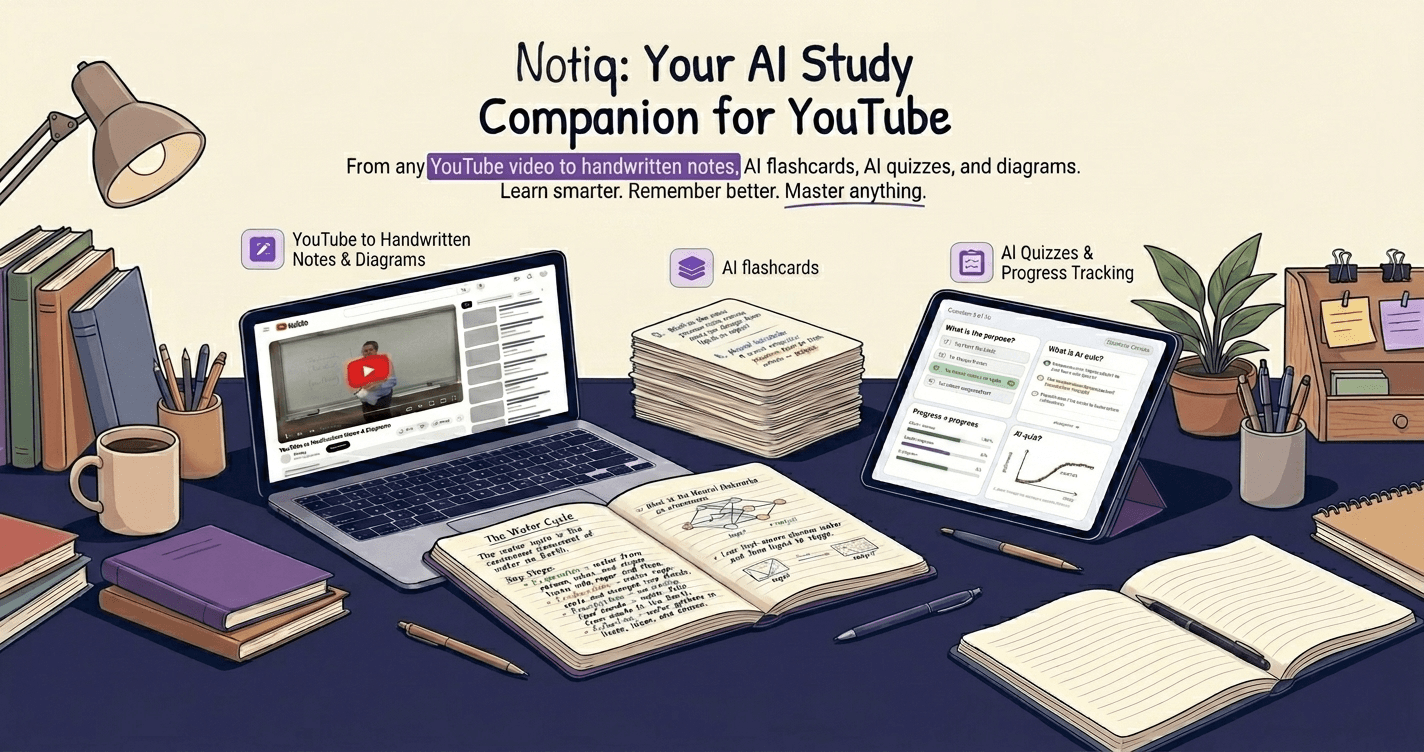
Want your lecture notes turned into active recall flashcards automatically? Try Notiq free at notiq.study — import any YouTube lecture or document and get exam-ready cards in under two minutes.