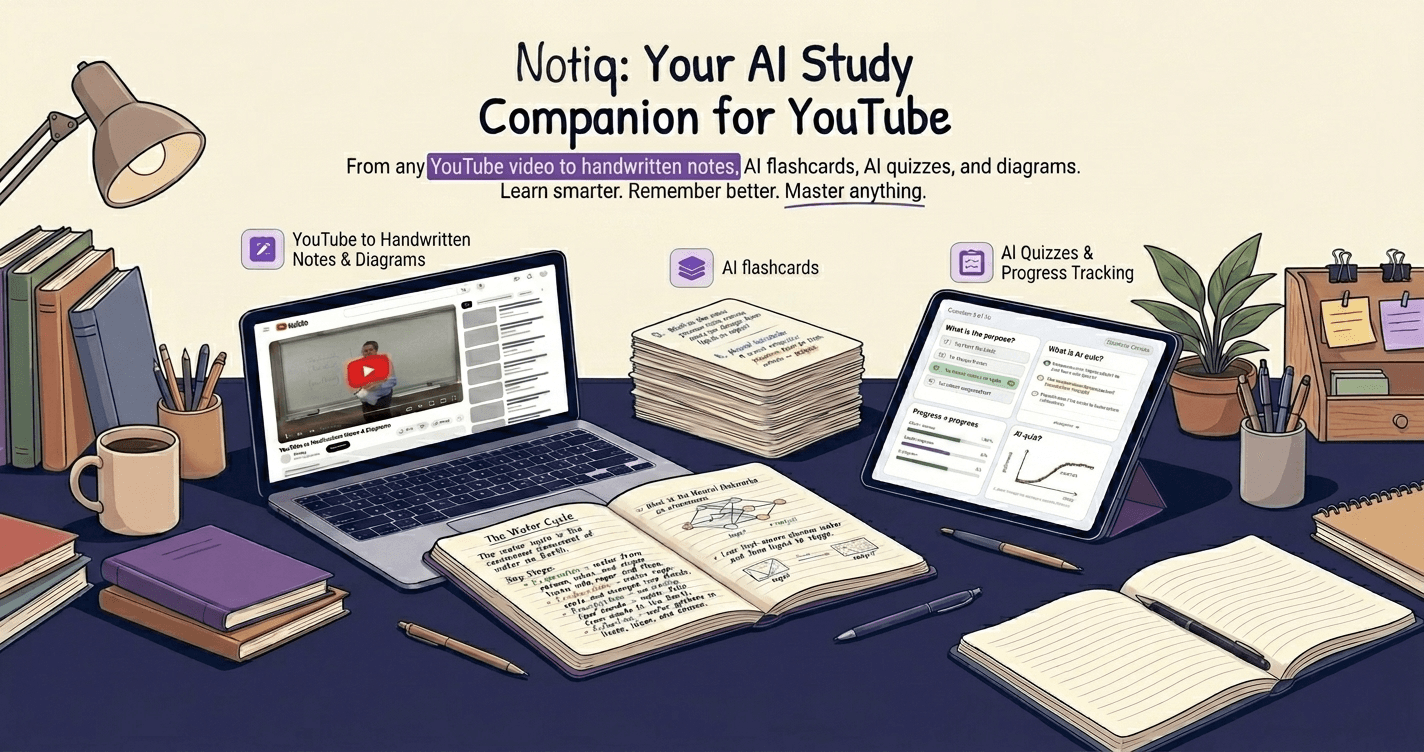
AI study notes have gone from novelty to necessity in a single academic year. Students who know how to use AI-assisted note-taking aren't just saving time — they're outperforming peers on retention tests, finishing courses faster, and spending less of their study hours on mechanical tasks like transcription and reformatting.
This guide covers everything: the science behind why AI notes work, the best tools available, how to integrate them into different learning workflows, and the mistakes that undermine the whole approach.
Watch this before you read further — it frames why traditional learning is breaking down and what AI-augmented study looks like in practice:
How AI is Changing Education — MIT Media Lab
Ready to see it in action? Convert any YouTube lecture to handwritten-style notes with Notiq — free to try, results in under 60 seconds.
What Are AI Study Notes, Exactly?
AI study notes are notes generated, structured, or enhanced with the help of artificial intelligence — typically large language models (LLMs) like GPT-4o, Claude 3.5, or Gemini 1.5. They can be produced from:
- Video transcripts (YouTube lectures, Zoom recordings, course content)
- PDFs and textbooks (uploaded and summarized)
- Audio recordings (voice memos, live lectures)
- Raw rough notes (AI cleans up and restructures them)
The output can range from bullet-point summaries to structured Cornell-style notes, flashcard decks, concept maps, or full-length outlines with highlighted definitions and examples.
What they are not is a replacement for thinking. The research is clear: you still need to actively engage with the material. AI note-taking works best as a scaffold, not a substitute.
The Cognitive Science Case for AI-Assisted Notes
Before diving into tools, it's worth understanding why this approach works when done right — and why it fails when done wrong.
The encoding problem with passive note-taking: Most students take notes by copying. They transcribe what they hear or read, which feels productive but produces shallow encoding. When you copy text, your brain processes it at a surface level. You recognize the words but don't connect them to what you already know.
What AI fixes: When you use AI to generate a structured summary and then review, question, and annotate that summary, you shift from passive transcription to active comparison. You're asking: "Does this capture what I understood? What did the AI miss? What would I add?" That interrogation is cognitively demanding — in exactly the right way.
A landmark 2014 study by Mueller and Oppenheimer at Princeton showed that students who typed notes verbatim performed worse on conceptual questions than students who wrote longhand — because longhand forces paraphrasing, which requires processing. AI note-taking, used correctly, forces the same kind of processing at a higher level of abstraction.
For a deeper look at the research, see our article on AI vs human-written notes and which actually works better.
The 5 Main Workflows for AI Study Notes
There is no single "right way" to use AI for notes. Here are the five most effective patterns, each suited to different content types and learning goals.
1. Transcript-to-Notes (YouTube / Video Lectures)
This is the most popular use case. You feed a video transcript — or use a tool that handles the transcript extraction automatically — and get structured notes out the other side.
Best for: Online courses, YouTube lectures, recorded seminars, conference talks.
Workflow:
- Find the video (YouTube lectures from MIT, Stanford, Coursera are ideal)
- Run it through a transcript-to-notes tool
- Get structured output (outline, definitions, key arguments)
- Review and annotate — add your own questions in the margins
- Generate flashcards from the key terms
Tools like Notiq, Otter.ai, and whisper-based pipelines all handle step 2-3. The differentiator is what the structured output looks like and how well it preserves the logical flow of the lecture.
2. PDF/Reading Comprehension Notes
Upload a paper, chapter, or textbook section and ask the AI to produce a reading guide: main argument, supporting evidence, methodology, key terms, and critical questions.
Best for: Academic papers, textbooks, technical documentation.
Workflow:
- Upload PDF
- Request structured summary in a specific format (e.g., Cornell or outline)
- Compare AI summary to your own reading notes
- Identify gaps — what did you miss?
The comparison step is crucial. Don't just accept the AI summary. Use it as a diagnostic tool.
3. Voice-to-Notes (Live Lecture Capture)
Record your in-person lecture on your phone, upload the audio, and get transcribed, structured notes within minutes of leaving the classroom.
Best for: Live lectures, office hours, study group discussions.
The accuracy depends heavily on audio quality and the speaker's clarity. Specialized academic tools handle domain-specific vocabulary better than general-purpose speech-to-text.
4. Rough-Notes Refinement
You take scrappy notes during a lecture — arrows, abbreviations, incomplete sentences — and then pass them through an AI to produce a clean, structured version. Think of it as having an editor clean up your drafts.
Best for: Students who already take notes but want to spend less time on post-processing.
This workflow preserves your own encoding (you did the work of active listening) while offloading the mechanical cleanup.
5. Interleaved AI-Assisted Review
The most advanced workflow: after generating AI notes, you use an AI assistant in conversation mode to quiz yourself. You cover the notes, answer questions the AI poses, then reveal your answers and get feedback.
Best for: Exam preparation, deep conceptual mastery.
This is the workflow that produces the highest retention gains because it combines spaced repetition triggers with immediate corrective feedback.
Which AI Tools Are Worth Using in 2026?
The market has fragmented. There are general-purpose LLMs, specialized study tools, and hybrid platforms. Here's an honest breakdown:
General-purpose LLMs (ChatGPT, Claude, Gemini)
These are powerful but require you to do the setup work — pasting transcripts, crafting prompts, managing the output format. They produce excellent notes when prompted well. The failure mode is lazy prompting that yields generic summaries.
See our detailed comparison: ChatGPT vs Claude vs Gemini for studying — honest 2026 comparison.
Specialized Study Tools
- Notiq: Designed specifically for YouTube-to-notes workflows. Produces handwritten-style visual notes that many students find more memorable. Strong at preserving the logical flow of lectures.
- Otter.ai: Best for live lecture transcription.
- Elicit: Built for academic paper analysis.
- NotebookLM (Google): Excellent for multi-source synthesis.
Flashcard-Focused Tools
If your end goal is exam preparation, tools that generate Anki-compatible flashcard decks from your notes have a clear advantage. The AI study notes themselves are a means to an end; the flashcards are the retention mechanism.
For a wider list, see our roundup of 10 free AI tools every student should use in 2026.
How to Write Good AI Prompts for Study Notes
This is where most students leave value on the table. A generic prompt like "summarize this lecture" produces generic output. Here are prompts that produce study-grade notes:
For lectures and videos:
"You are a studious note-taker. Given the following transcript, produce structured notes with: (1) main thesis in one sentence, (2) 5-7 key concepts with definitions, (3) supporting evidence or examples for each concept, (4) 3 questions I should be able to answer after studying this material. Format as outlined Cornell notes."
For academic papers:
"Summarize this paper for a graduate student who is not a specialist. Include: research question, methodology, main findings, limitations, and how this connects to [broader field/concept]. Flag any claims that seem contested or require citations."
For creating flashcards:
"From the notes below, generate 20 Anki-style flashcards. Each card should test a single concept. Avoid yes/no questions. Prefer 'What is the difference between X and Y?' style prompts that require explanatory answers."
The pattern is: specify the output format, the audience level, and the intended use case. The more context you give, the better the output.
Does AI Note-Taking Actually Work? What the Evidence Shows
The honest answer is: yes, with important caveats.
Studies on AI-assisted learning (several published since 2023) consistently show that students who use AI tools for note processing — not just note generation — outperform control groups on delayed retention tests. The critical variable is engagement: students who receive AI notes passively and don't interact with them show no significant improvement.
The sweet spot is what researchers call the "generation effect": when you have to produce or manipulate information yourself, you remember it better. AI notes support this by:
- Giving you a structured scaffold to react to
- Freeing you from mechanical transcription so you can spend cognitive energy on understanding
- Making it easier to identify gaps (you see what the AI highlighted; you notice what it missed)
Where AI notes consistently fall short: generating novel insight, capturing the instructor's emphasis and personality, and making connections to your personal knowledge network. Those gaps are why you can't skip the review step.
Is This Academic Dishonesty?
The question comes up constantly, so let's address it directly.
Using AI to generate notes from material you're studying is not cheating. Notes are a study tool, not an assessment artifact. Taking notes using AI is functionally equivalent to using a highlighter more aggressively or asking a tutor to explain a concept.
Where it becomes a problem:
- Submitting AI-generated notes as your own written work for assessment
- Using AI to complete take-home exams or papers
- Violating your institution's specific academic integrity policy (which varies considerably)
Always check your institution's current policy. Some prohibit any use of generative AI. Most allow it for personal studying. When in doubt, ask.
For a nuanced breakdown of how to use AI productively without undermining your own learning, see how to use AI for studying without cheating yourself.
Integrating AI Notes Into a Full Study System
AI note-taking is most powerful as one component of a broader system. Here's a workflow that combines AI tools with proven study-science techniques:
Step 1: First Pass — AI-Assisted Capture
Watch the lecture or read the material. Use AI to generate structured notes. This handles the low-level work of transcription and organization.
Step 2: Active Review — Annotate and Question
Read the AI notes. Add your own comments, questions, connections to other material. Mark concepts you don't fully understand. This is where your cognitive work happens.
Step 3: Flashcard Generation
From the annotated notes, generate flashcards for testable concepts — definitions, distinctions, cause-and-effect relationships, formulas. Use a spaced repetition tool (Anki, RemNote, or built-in tools) to schedule reviews.
Step 4: Practice Retrieval
Before the next session, retrieve from memory what you covered in the last one — without looking at notes. Then review your notes to check and correct.
Step 5: Synthesis
At the end of a week or a module, synthesize across sessions: how do the pieces fit together? What are the big-picture arguments? Use AI to help with this synthesis if needed, then write your own summary in your own words.
This five-step loop — capture, annotate, flashcard, retrieve, synthesize — is what separates students who feel productive from students who are actually learning.
For more on building a reliable flashcard system from your AI notes, see the science behind AI-generated flashcards and spaced repetition.
The Most Common Mistakes Students Make with AI Notes
Mistake 1: Treating AI output as ground truth
AI models hallucinate. They confidently produce plausible-sounding but incorrect information, especially for specific statistics, citations, and technical details. Always verify factual claims against the source material.
Mistake 2: Skipping the review step
Reading AI-generated notes passively provides almost no learning benefit. The notes are a starting point, not an endpoint.
Mistake 3: Note-taking without a retrieval plan
Notes are not studying. The purpose of notes is to support later retrieval practice. If you're generating notes but never testing yourself, you're doing the less important half of the work.
Mistake 4: Using one-size-fits-all prompts
A prompt that works for a philosophy lecture will produce mediocre output for a statistics tutorial. Calibrate your approach to the content type.
Mistake 5: Ignoring visual and structural variety
Students who use the same note format for everything — plain bullet points, always — retain less than those who vary structure with concept maps, tables, and diagrams. AI tools can produce these formats on request; use them.
Comparing AI Notes Across Different Study Contexts
| Context | Best AI Approach | Pitfall to Avoid |
|---|---|---|
| STEM coursework | Step-by-step worked examples + formula extraction | AI skipping derivation steps |
| Humanities | Argument mapping + counterargument identification | Oversimplifying nuanced positions |
| Language learning | Vocabulary lists + usage examples + pronunciation notes | Missing pragmatic context |
| Professional certification | Domain-specific prompts + practice question generation | Outdated information in training data |
| Research reading | Evidence extraction + methodology critique | Conflating author claims with established fact |
What's Next: Building on Your AI Study System
This guide is the foundation. From here:
- If you're comparing AI tools, read our ChatGPT vs Claude vs Gemini comparison
- If you want to understand the research behind retention, read the science behind AI flashcards and spaced repetition
- If you're taking notes from YouTube lectures specifically, see our YouTube-to-notes complete guide
- If you're evaluating your overall note-taking method, compare every major note-taking method
The most important thing: AI tools amplify good habits and bad ones equally. Build the habit of active engagement first. Then use AI to accelerate the parts that don't require your cognition.
The fastest way to see what this looks like in practice is to try it. Take any YouTube lecture and generate AI study notes with Notiq — no signup required, results in under 60 seconds. See if the output is good enough to change how you study.