The MCAT is unusual among standardized tests in that its single best free resource is not a random creator — it is the test maker itself. The AAMC partnered with Khan Academy to produce over 1,100 free videos and 3,000 practice questions mapped directly to the official MCAT content outline. Most pre-meds do not use this fully, either because they do not know it exists in this form or because they treat it as background videos rather than a structured course.
This guide covers how to actually use free YouTube content for MCAT prep: the official Khan Academy MCAT collection, which channels are worth adding for each of the four sections, and — the part most study plans skip — how to convert video review into the retrieval practice that the MCAT actually rewards.
What the MCAT Actually Tests
Before picking resources, it helps to be precise about what you are studying for. The MCAT has four sections, each scored 118–132 (total range 472–528):
- Chemical and Physical Foundations of Biological Systems — general chemistry, organic chemistry, and physics, applied to biological systems
- Critical Analysis and Reasoning Skills (CARS) — passage-based reading comprehension with no science content at all
- Biological and Biochemical Foundations of Living Systems — biology and biochemistry, the most content-heavy section
- Psychological, Social, and Biological Foundations of Behavior — psychology, sociology, and the biological basis of behavior
The test runs roughly 7.5 hours including breaks. The content is broad rather than deep — you need reliable recall across an enormous syllabus, not expert-level depth on any single topic. This shapes the right study strategy: breadth-first content review, then heavy, sustained practice with full-length passages.
The Free Khan Academy MCAT Collection
Khan Academy's MCAT content exists because AAMC funded its production specifically to give students without expensive prep courses a genuine path to a competitive score. The official Khan Academy MCAT playlist and the Khan Academy MCAT channel organize content by the same foundational concepts the AAMC content outline uses, which means you can study directly against the real test blueprint instead of a third party's guess at what matters.
Why this matters more than it sounds: most for-profit MCAT prep courses build their content around the same AAMC outline, then charge 2,500 for the packaging. The underlying content coverage is not meaningfully different from what Khan Academy already provides for free. What you are paying for in a paid course is mostly structure, accountability, and practice exams — not unique content.
How to use it: work through the content review videos section by section, matching your pace to whatever course or timeline you are studying alongside (many students use it during their prerequisite coursework, reviewing the relevant Khan Academy section right after finishing the equivalent college course unit). Do not binge-watch it as passive review — the section below covers why that fails and what to do instead.
Section-by-Section Resources Beyond Khan Academy
Chem/Phys section — organic chemistry gaps: if organic chemistry mechanisms are your weak point, Khan Academy's organic chemistry coverage is thinner than its general chemistry and physics content. Supplement with Professor Dave Explains' organic chemistry series — see the best YouTube channels for chemistry guide for the full channel breakdown, including which channels handle mechanisms versus survey coverage.
Chem/Phys section — physics: for physics content, Khan Academy's physics library is comprehensive on its own for MCAT-level depth (you do not need calculus-based physics for the MCAT, only algebra-based mechanics, waves, electricity, and fluids).
Bio/Biochem section — the highest-yield section to over-prepare: this section has the most raw content volume. Crash Course Biology and Crash Course Anatomy & Physiology (both free, YouTube-native) are useful for building the survey-level map of a topic before drilling Khan Academy's more detailed treatment of the same area.
Psych/Soc section — the section students underestimate: this section did not exist on the pre-2015 MCAT, so many students treat it as a lighter add-on. It is not. It carries a full quarter of your total score. Khan Academy's psychology and sociology content is the most complete free resource specifically because it was built new for this section rather than repurposed from general biology content — use it as your primary source, not a supplement.
CARS — the section videos cannot teach directly: CARS tests reading comprehension and reasoning under time pressure, not content knowledge, so there is no video series that will teach you the passages. What YouTube can help with: channels that walk through timed CARS passage strategy (how to identify the author's main argument, how to eliminate answer choices that are true-but-not-supported by the passage) are worth watching once for strategy, then abandoned in favor of doing timed passages yourself. CARS improves through volume of timed practice, not more instruction.
Building a Study Schedule Around Video Content
A realistic full MCAT prep timeline is 3–6 months of consistent studying, assuming 15–20 hours per week. Compress this only if you have already covered the content recently in coursework.
Months 1–2 (content review): work through Khan Academy's four sections in the order that matches your remaining prerequisite coursework, or in order of your weakest section first if you have already taken everything. Do not just watch — after each video, close it and write down the 3–5 things it just taught you from memory. If you cannot, rewatch that specific segment, not the whole video.
Months 2–4 (practice questions, section by section): shift from video review to Khan Academy's 3,000 practice questions, organized by the same content areas. Track which content areas produce consistent misses — that is your real remaining content-review list, not a generic "review everything again" pass.
Final 4–6 weeks (full-length practice exams): the AAMC's own official practice exams are the single most predictive resource for your actual score, more predictive than any third-party practice test. Take them under real timing conditions, review every missed question (both content misses and reasoning misses), and use misses to direct your last few weeks of targeted review.
For the retrieval-practice method that makes each of these phases actually work — rather than just accumulating watched-video hours — see active recall techniques and, for the final compressed stretch before the exam, how to cram for an exam in 24 hours (useful for the day before, not a substitute for the months of review above).
Turning MCAT Content Videos into Flashcards
The MCAT's content volume makes flashcards close to mandatory — nobody reliably retains four sections' worth of biology, chemistry, physics, psychology, and sociology through re-reading alone. The AnKing MCAT deck (an extension of the same team's USMLE Step 1 deck) is the most widely used pre-made Anki deck for MCAT content, and pairing it with your own supplementary cards from Khan Academy videos covers most students' needs. See Anki vs RemNote vs AI alternatives for how to set up a spaced repetition system if you have not used one before.
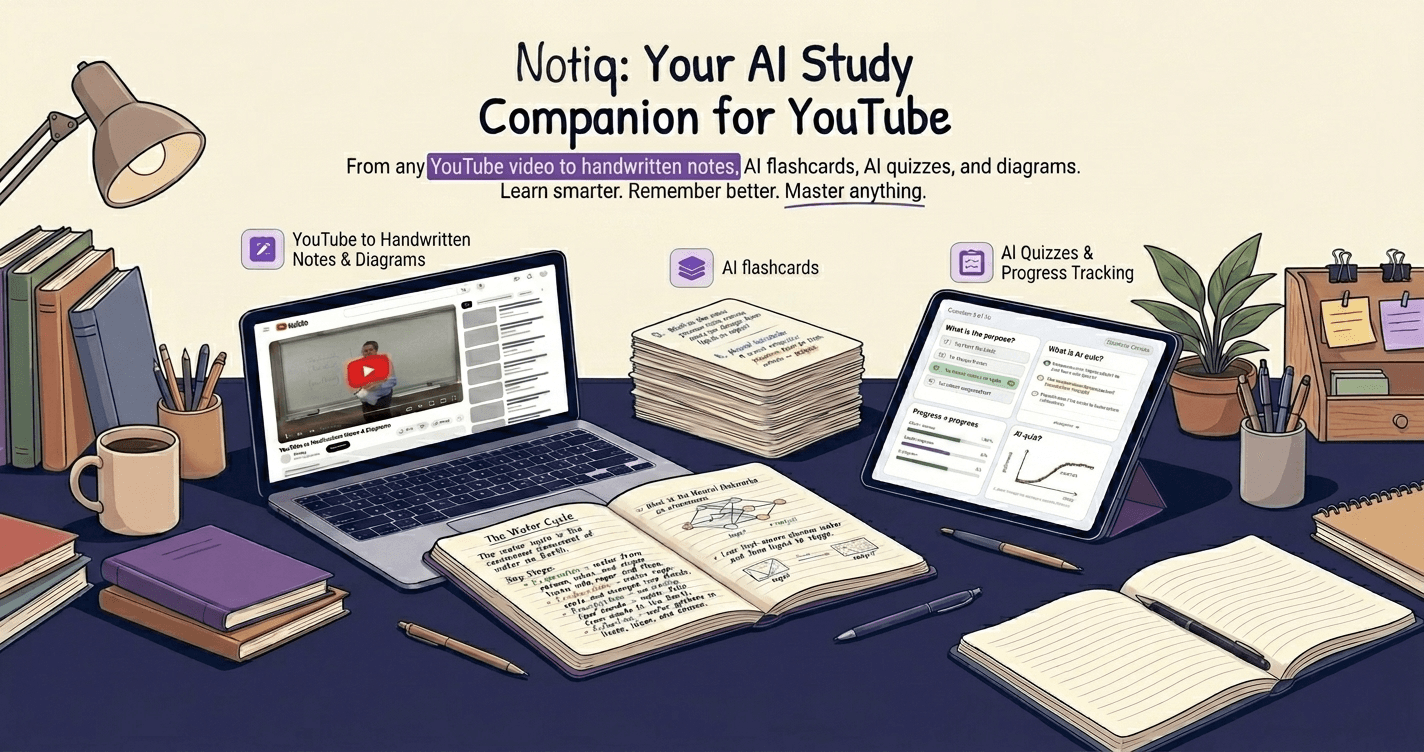
If you are working through content-review videos and want structured notes and flashcards generated automatically as you go — rather than manually writing every card by hand — that is exactly the workflow Notiq is built for: paste a Khan Academy MCAT video link, get back chapter notes and flashcard-ready question-answer pairs in under a minute, which you then refine and add to your spaced repetition deck.
The Realistic Ceiling of Free Resources
Free YouTube-based MCAT prep, used correctly, gets most students to a genuinely competitive score. It will not, on its own, replace the structured accountability of a full-length paid course for students who need external deadlines to stay consistent over a multi-month timeline, and it will not replace the AAMC's own official practice exams as your final predictive benchmark — those cost money and are worth paying for regardless of how you did your content review.
The honest framing: free resources solve the content-review problem completely. What they do not solve is discipline over a 3-to-6-month timeline with no external structure. If you know that is your weak point, build in external accountability — a study group, a scheduled weekly practice test, or a friend checking your progress — rather than assuming free content alone will carry you through months of self-directed study.
If you are prepping for a different standardized exam alongside or after the MCAT, the same structured-review-plus-retrieval-practice approach applies — see AP exam prep using YouTube and AI notes and JEE preparation using YouTube for the equivalent breakdowns. If you are heading toward medical school after the MCAT, USMLE Step 1 prep using YouTube picks up where this guide leaves off. For the underlying biology and physics content depth the MCAT tests, see how to learn biology from YouTube and how to learn physics from YouTube.
The AAMC built the Khan Academy MCAT collection specifically so cost would not be the deciding factor in who gets a competitive score. Used as a structured course rather than background video, it is genuinely sufficient content review for most students.
Want your MCAT content-review videos turned into structured notes and flashcards automatically? Try Notiq free at notiq.study — paste any lecture or review video link and get organized notes plus exam-ready flashcards in minutes.