There is a persistent myth that the best education requires expensive tuition, campus access, and formal enrollment. For certain things — accredited degrees, professional credentials, structured feedback from working experts — that is true. For the actual content of a university education, it has not been true for over a decade.
MIT, Stanford, Harvard, Carnegie Mellon, and dozens of other institutions have put their full lecture recordings on YouTube. Not summaries, not excerpts — the actual lectures, the same ones their enrolled students attend. Combined with free problem sets, reading materials, and exams that many of these institutions also publish, you have the raw material for a rigorous self-designed education in almost any STEM or social science discipline.
The constraint is not access. The constraint is structure. A YouTube playlist is not a course. This guide covers how to build the structure — how to reverse-engineer a real college curriculum from free video content and actually get the learning benefit of it.
Where to Find Complete Lecture Series for Free
Before getting into the methodology, here is a practical inventory of the best sources:
MIT OpenCourseWare (ocw.mit.edu) is the gold standard. Over 2,500 courses with lecture notes, problem sets, exams, and solutions. Many include full video lectures on YouTube. The breadth is extraordinary: from freshman physics and calculus through graduate-level courses in algorithms, AI, neuroscience, economics, and literature.
Stanford Engineering Everywhere and Stanford Online have put courses like Andrew Ng's original machine learning course, CS231n (computer vision), and CS224n (natural language processing) on YouTube in full. These are not approximations of the course — they are the recorded lectures.
Harvard Online has complete recordings of popular courses including CS50 (Introduction to Computer Science), Stat 110 (Probability), and courses from the law school and medical school.
Khan Academy (khanacademy.org) covers high school through early university level in mathematics, physics, chemistry, biology, history, and economics. For building foundational knowledge before tackling university-level content, it is unmatched.
3Blue1Brown, Computerphile, Numberphile, and StatQuest are independent creators producing lecture-quality content in mathematics, computer science, and statistics that is often clearer and better visualized than university lectures.
Step 1: Choose a Subject and Find Its Real Curriculum
Random YouTube learning — watching videos that seem interesting without a structure — produces knowledge that is scattered and difficult to build on. Effective self-directed study requires a curriculum.
The fastest way to build a curriculum is to borrow one. Pick the specific subject you want to study, then find the actual syllabus from a university course covering it.
Practical method:
- Search "[subject] [university] syllabus" or "[course code] syllabus" — Stanford, MIT, and Berkeley syllabi are often publicly available
- Look at what topics the course covers, in what order, and what the prerequisites are
- Use that topic order as your study plan
- Find the corresponding lecture recordings on YouTube or MIT OCW
For example: if you want to learn machine learning properly, the structure of Andrew Ng's original Stanford CS229 course (available in full on YouTube) gives you a 20-lecture sequence covering exactly the material you need in a pedagogically sound order. The Andrew Ng ML course notes guide covers what is in each module.
For deep learning, Stanford CS230 and MIT 6.S191 both have full lecture recordings. For AI foundations, MIT 6.034 is available in its entirety on YouTube and is one of the best single courses in the field.
Step 2: Map the Course to a Weekly Schedule
A university course meets two to three times per week for fifteen weeks. An online self-directed version can be compressed or stretched depending on your schedule, but having a realistic weekly commitment before you start is important.
A sensible baseline: two to three lectures per week, each 60–90 minutes. That means roughly two to four hours of lecture time per week, plus one to two hours for notes and problem sets. This produces a 12–15 week course, roughly equivalent to a semester.
Build your schedule before you start watching. This sounds obvious, but it makes a meaningful difference. A list that says "Week 1: Lectures 1–3, read chapter 2 of the textbook, complete problem set 1" is much more likely to be followed than a vague intention to "work through the course."
Use the university's actual schedule if it is published. MIT OCW often includes the exact weekly schedule used on campus. Follow it.
Step 3: Process Each Lecture Into Structured Notes
Watching a lecture is not enough. The students who benefit from recorded lectures treat them like library books — they take them seriously, they engage actively with the material, and they do something with what they learn.
The minimum viable note for each lecture:
- Main claim or topic of the lecture
- 5–8 key points or concepts introduced
- Definitions of new terms
- 2–3 questions you would need to be able to answer on an exam
- One thing you want to follow up on
For technical subjects (mathematics, CS, physics, economics), try to work through at least one example problem from each lecture before moving on. The feeling of comprehension while watching a well-explained derivation is not the same as being able to reproduce the reasoning independently. Testing yourself immediately is more valuable than watching again.
The YouTube-to-notes complete guide covers this workflow in detail, including how to handle dense technical content that requires pausing and re-watching.
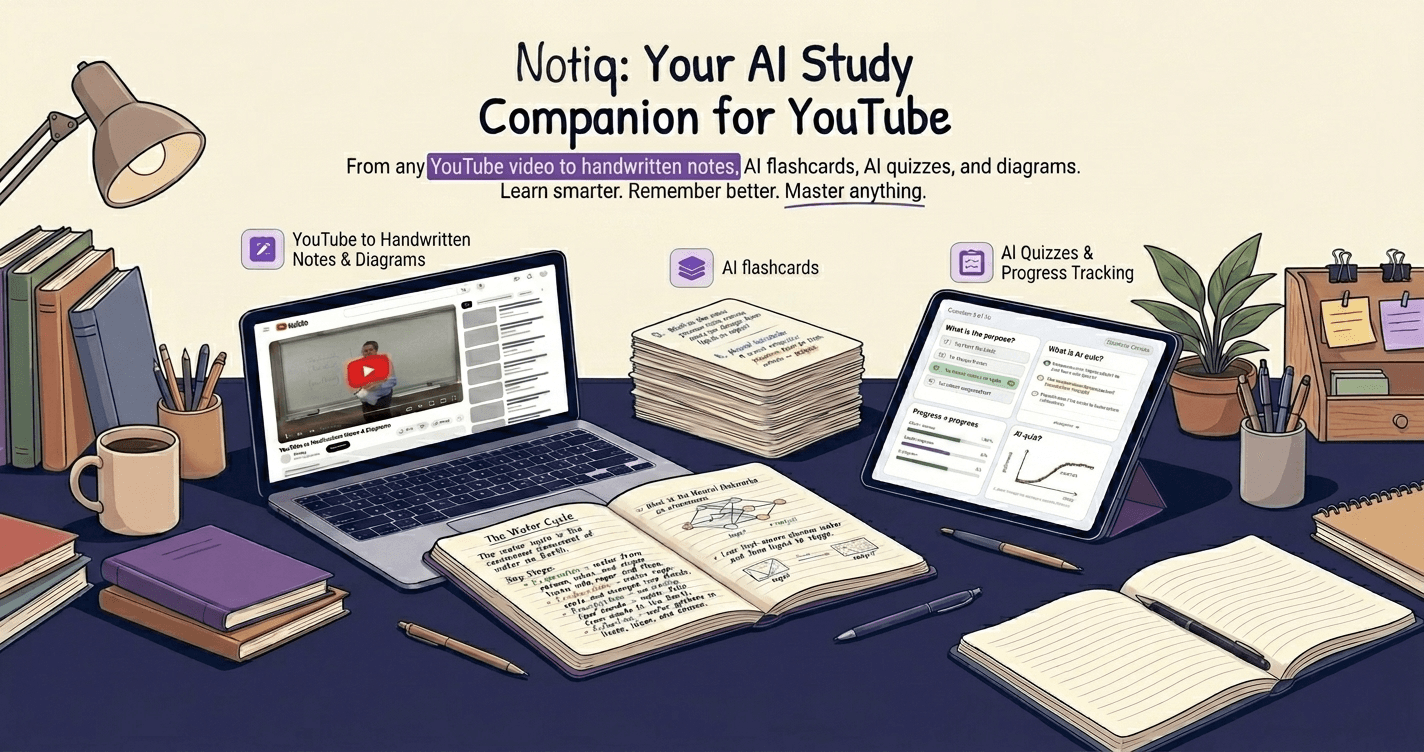
Notiq can accelerate this step significantly for YouTube lectures — generating structured notes from a lecture URL takes under two minutes and gives you a starting draft that you can edit and extend with your own observations.
Step 4: Do the Problem Sets
This is the step most self-directed learners skip and the reason most self-directed learners do not actually retain what they study.
Problem sets are not supplemental. They are the primary learning mechanism for technical subjects. Lectures teach you the concept; problem sets force you to use the concept, which is what encodes it.
Many MIT OCW courses publish the actual problem sets assigned to enrolled students, along with solutions. Use them. Do the problems before looking at the solutions. If you get stuck, try for at least 20–30 minutes before checking the solution — the struggle is the point.
A course you have watched with no problem work done is not a course you have taken. It is a course you have surveyed. There is nothing wrong with surveying — but be honest about what it gives you.
Step 5: Use Exams for Calibration
MIT OCW publishes past exams with solutions for most courses. Stanford and Harvard do as well for many courses.
Use these for two purposes:
Before you start: look at a midterm exam to understand what the course is actually asking you to be able to do. This anchors your study in the real performance standard rather than an imagined one.
After each major section: attempt problems from past exams covering the material you have just studied. Under timed conditions, without notes. This is the honest test of whether you have learned the material or just watched it.
The AI study notes guide discusses how AI tools can generate practice exam questions from your notes, which is a useful supplement to (not replacement for) working through official past papers.
Which Subjects Work Best for YouTube Self-Study?
Not all subjects are equally suited to self-directed learning from video. Being clear about this prevents wasted effort.
Excellent for YouTube self-study:
- Mathematics (calculus, linear algebra, statistics, discrete mathematics) — Khan Academy and 3Blue1Brown cover these exceptionally well
- Computer science and programming — YouTube tutorials are often better than textbooks for practical skills
- Physics and chemistry at the introductory and intermediate levels
- Data science and machine learning — the OpenAI/DeepMind research community posts extensively on YouTube
- Economics and finance at the undergraduate level
- History, political science, philosophy — lecture content translates very well to video
Harder to self-study effectively from YouTube:
- Writing — you need feedback on your own writing, which video cannot provide
- Anything lab-based (experimental physics, wet lab biology, chemistry lab work)
- Legal and medical professional training — the professional application requires supervised practice
- Anything where debate and argumentation in a group are the primary learning mechanism
For a comprehensive list of the best YouTube channels organized by subject, the best YouTube channels for self-learners section of the toolkit guide covers this.
How Do You Know If You Have Actually Learned Something?
This is the honest question that most self-study guides avoid. Having a certificate from a course platform means you completed the course. It does not mean you can use the knowledge.
Some useful tests:
The explanation test: can you explain the main ideas of a topic to someone who does not know it? Not a perfect explanation, not a complete one — but a coherent explanation that captures the core idea accurately.
The application test: given a new problem in the domain you studied, can you make a reasonable attempt at it? For programming, this means writing code. For mathematics, working problems. For economics, analyzing a case you have not seen before.
The question test: does studying this topic generate good questions? Deep knowledge is not just more facts — it is a richer sense of what you do not know and what questions are worth asking.
The time test: come back to the material three months after you studied it. What do you remember without reviewing your notes? What do you need to reconstruct from your notes? This gap is your actual retention.
Is a Self-Directed Education a Real Education?
For most working knowledge purposes — the ability to do a job, build something, understand a field — yes. The content of a university course is real regardless of whether you took it through formal enrollment or YouTube.
What a self-directed education does not give you: accredited credentials that certain employers and institutions require, the social and professional network that campus life provides, the structured feedback from instructors who know your specific work, and the accountability of formal enrollment.
For people whose goal is credentials or a specific professional pathway requiring accreditation, a self-directed YouTube education is a supplement, not a replacement. For people whose goal is actually knowing something — learning a new technical skill, understanding a field outside their formal training, building the knowledge to change careers — it is a legitimate primary path.
The self-learner's toolkit covers the full stack of tools and habits that make self-directed learning effective long-term.
Where to Start
If you are new to self-directed study from YouTube:
- Pick one subject and find the actual syllabus for a course that covers it
- Find the lecture recordings — MIT OCW, Stanford Online, and Khan Academy are the best starting points
- Commit to a specific weekly schedule before you start watching
- Process each lecture into notes; do the problem sets
- Use past exams to test what you have actually retained
The content is there. The structure is yours to build.
Take notes on your first lecture today. Notiq turns a YouTube lecture URL into structured notes and flashcards in under two minutes — free at notiq.study.