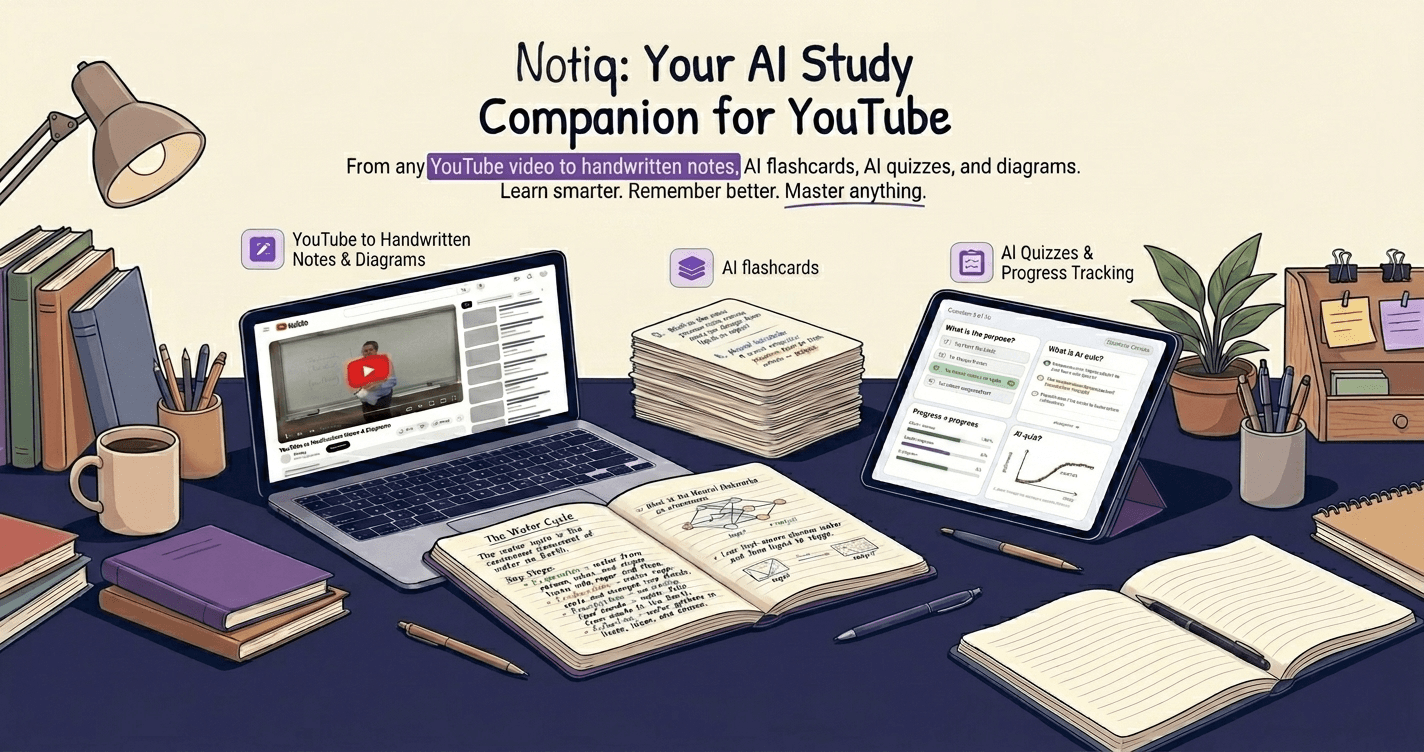
YouTube contains more educational content than most universities will ever produce. Stanford, MIT, 3Blue1Brown, Andrew Ng, Andrej Karpathy — the raw material for a world-class education in almost any technical or academic subject is available for free, right now, on your phone.
And yet most people who try to learn from YouTube fail. They watch hours of content, feel engaged and informed in the moment, and retain almost nothing two weeks later. They confuse entertainment with education, familiarity with knowledge.
This guide is a complete playbook for learning from YouTube in a way that produces real, durable understanding — the kind you can use on an exam, in a job interview, or when building something real.
A landmark lecture from Stanford Online — exactly the kind of content this playbook will help you extract lasting knowledge from.
Why YouTube Learning Fails for Most People
Before getting into the system, it helps to understand the mechanism of failure. YouTube is engineered for retention — viewer retention, meaning the platform wants you to keep watching. The recommendation algorithm, autoplay, the "just one more" effect. These features are excellent for entertainment and terrible for learning.
Learning requires repetition, retrieval, and spaced review over time. Watching a playlist end-to-end gives you none of those things. You might watch 12 hours of machine learning content and come away understanding roughly as much as you would from reading the introduction to a textbook — not because the content was bad, but because you processed it as passive entertainment.
The students who successfully learn from YouTube share a common trait: they treat watching as the beginning of a study session, not the whole thing.
Phase 1: Curating the Right Content
Not all YouTube educational content is created equal. Before you build a study system, you need to identify content that is worth the investment.
Prioritize lecture series over individual videos. A 20-lecture course from Stanford CS or MIT OCW has a coherent structure — concepts build on each other, terminology is defined and used consistently, and there is a clear progression from fundamentals to applications. Individual explainers, no matter how good, lack this architecture.
Check for syllabi and supplementary materials. The best YouTube courses come with associated problem sets, reading lists, or course notes. These are essential for actually testing your knowledge. Stanford CS229, CS230, and MIT 6.034 all have companion materials available on their course websites.
Look for active comment sections. A course where students are asking and answering questions in the comments is valuable beyond the content itself. You will find corrections to the lecturer, alternative explanations, and relevant follow-up resources.
Evaluate production quality critically. High production quality can mask thin content. Some of the most valuable YouTube learning content — raw MIT or Stanford lecture recordings — is technically terrible by YouTube standards: static camera, poor audio, handwritten slides. Content density matters more than polish.
Good starting points:
- Stanford Online — CS, statistics, medicine, law, and more
- MIT OpenCourseWare — complete course recordings across all disciplines
- 3Blue1Brown — mathematical intuition at a level that no textbook matches
- Andrej Karpathy — deep learning, from backpropagation to large language models
Phase 2: Pre-Watching Setup
The single most underrated step in YouTube learning is what you do before you press play. Five minutes of pre-watching setup dramatically improves what you retain.
Read the syllabus or course outline first. If you are working through a course, read the description of the week's topics before watching. This primes your brain to recognize and organize the incoming information — a technique called advance organizers in educational psychology.
Write down three questions you want the lecture to answer. These do not need to be sophisticated. "What is backpropagation?" or "How does this relate to what I learned last week?" Your brain processes information differently when it is searching for an answer versus passively receiving information.
Open a blank note. Have a document open before the lecture starts. Not to transcribe everything — to record the things that surprise you, the things you do not understand, and the key concepts in your own words.
Set a specific learning goal. "Understand what gradient descent is and why it works" is a goal. "Watch lecture 3" is not. A specific goal gives you something to test yourself against when the lecture ends.
Phase 3: How to Watch a YouTube Lecture
Active watching is a skill most people have never practiced. Here is what it looks like in practice.
Use 1.25-1.5x speed as your default. Most educational content is filmed at a pace designed for live audiences who are writing notes simultaneously. At normal speed, lectures often feel slow. 1.25x-1.5x keeps your attention engaged while preserving comprehension. (For genuinely technical content you are encountering for the first time, normal speed is often right.)
Pause at natural chapter breaks, not constantly. Pausing to write notes mid-sentence breaks the flow and fragments your understanding. Instead, identify the natural structure of the lecture — most good lecturers signal transitions with phrases like "so let us now turn to" or "the next concept is" — and pause at those points to consolidate.
Write understanding notes, not transcription notes. The question to answer in your notes is not "what did the lecturer say?" It is "what do I now understand that I did not before?" This distinction produces dramatically better notes. See our detailed guide on how to take notes from a YouTube lecture for specific techniques.
Mark confusion explicitly. When something does not make sense, write "??" in your notes and keep watching. Do not interrupt the lecture to go down a research rabbit hole. Stack up your confusions, resolve them after.
Watch the same segment twice if it matters. For truly foundational concepts — the ones the rest of the course builds on — watching a 5-minute segment twice is far more efficient than watching it once passively.
Phase 4: Post-Watching Consolidation
This phase is where most YouTube learners fail. They close the browser and move on. Do not do this.
Do a brain-dump immediately after the lecture ends. Before consulting your notes or re-watching anything, spend 5-10 minutes writing everything you can remember: the main arguments, the key concepts, the confusing parts, the examples used. This retrieval attempt — even when incomplete — is the most powerful encoding mechanism available to you.
Review your notes against your brain-dump. Compare what you recalled with what you actually noted. The gaps are your study priorities. Give them extra attention in your review.
Resolve your marked confusions. Go back to the "??" items in your notes. For each one, either re-watch the relevant segment, ask an AI tool for an explanation, or look it up in the supplementary materials. Do not carry unresolved confusions into the next lecture.
Generate practice questions. Write or generate 5-10 questions that test the key concepts from the lecture. You will use these for spaced review. If you are using an AI tool like Notiq, this step is automated — the tool generates flashcards from your notes.
Summarize in one paragraph. Write a one-paragraph summary of the lecture's core argument, in your own words, without consulting your notes. If you cannot do this, your understanding is shallower than it feels.
Phase 5: Spaced Review Over Time
A single study session on a lecture gets you maybe 30-40% retention after one week. A spaced review schedule — reviewing the same material at increasing intervals — can push that to 80-90% after a month.
The mechanism is simple: your brain strengthens the neural pathways associated with information each time you retrieve it successfully. The retrieval must be effortful — easy review of familiar material does not produce much encoding benefit. Reviewing at the point when you are just starting to forget (the "spacing" in spaced repetition) maximizes the benefit.
For YouTube course notes, a practical schedule looks like this:
- Review within 24 hours of watching
- Review again 3 days later
- Review again 1 week after that
- Review again 2 weeks after that
If you have flashcards from the lecture, use them for these reviews. If not, use your practice questions or do mini brain-dumps without consulting notes. The spaced review cards generated by Notiq are scheduled automatically based on your performance — you rate each card on how well you remembered it, and the algorithm adjusts the spacing accordingly.
For the research behind why this works so dramatically well, see our article on flashcards and spaced repetition science.
What Kinds of Subjects Work Best for YouTube Learning?
The playbook above works for almost any subject, but the fit is particularly good for:
Technical subjects with visual components. Mathematics, physics, computer science, data science — subjects where understanding requires seeing things animated, transformed, or built step by step. 3Blue1Brown's visual treatment of linear algebra and calculus is genuinely better than most textbooks at building geometric intuition.
Courses taught by the original experts. When you can watch Andrew Ng teach machine learning, or Gilbert Strang teach linear algebra, you are getting the primary source. The nuances, emphasis, and intuitions come from someone who has worked with these ideas at the frontier of the field.
Self-paced curriculum building. YouTube lets you construct a custom curriculum that moves faster or slower than a formal course, skips prerequisite material you already know, and goes deeper on specific topics that matter to your work. No formal course can be this adaptive.
Catching up on missed fundamentals. Many working engineers and researchers have gaps in their foundational knowledge — statistics, algorithms, theory. YouTube courses provide a way to fill those gaps without going back to school.
For a curated list of channels organized by subject, see our guide to the best YouTube channels for self-learners.
How Does Speed-Watching Fit In?
Speed-watching is a contested technique. At 1.5x, most students maintain full comprehension. At 2x, comprehension drops for complex content but holds for review material. At 2.5x+, you are probably not learning — you are checking that you already know the material.
The right use of speed-watching is:
- Use 1.25-1.5x for first-pass learning of new material
- Use 2x for reviewing content you have already studied
- Use normal speed for content that is genuinely demanding (novel mathematical derivations, dense theoretical lectures)
See our dedicated article on how to speed-watch YouTube lectures without missing anything for a complete breakdown.
Can AI Tools Replace This System?
AI tools can automate several parts of this system: generating structured notes from transcripts, creating flashcard decks, scheduling spaced reviews. They cannot replace the retrieval practice — the brain-dumps, the practice questions, the effortful recall — that is the actual mechanism of learning.
The best use of AI in a YouTube learning workflow is to handle the cognitive overhead (transcription, formatting, question generation, scheduling) so you can invest more time in the cognitive work (retrieval, application, explanation).
For a practical comparison of the AI tools best suited to YouTube learning, see our guide on tools to summarize YouTube videos.
A Complete Example: Learning CS230 from YouTube
To make this concrete, here is what the full system looks like applied to Stanford CS230 Deep Learning.
Curation: Stanford CS230 lectures are available on Stanford Online's YouTube channel. The course covers deep learning from foundations through state-of-the-art applications, taught by Andrew Ng and Kian Katanforoosh. The course website at cs230.stanford.edu has a syllabus, lecture slides, and problem sets.
Pre-watch setup: Before Lecture 1, read the course overview and note the progression: neural networks fundamentals → CNNs → sequence models → practical aspects of ML projects.
Active watching: Lecture 1 is Andrew Ng's introduction. Major segments include: why deep learning now (data at scale), course structure versus CS229 (machine learning course), overview of applications (speech recognition, image classification, NLP, autonomous driving). Pause and note at each transition.
Post-watch consolidation: Brain-dump. What do you remember? Check against notes. Generate questions: what is the key difference between CS229 and CS230? What did Andrew Ng mean by "traditional ML plateaus with data"?
Spaced review: Review notes after 24 hours, then 3 days later.
We have a complete study guide for CS230 at Stanford CS230 deep learning notes, including a full digest of Lecture 1 with the key concepts and study questions.
The Honest Expectation
Learning from YouTube is not faster than a formal course — not if done properly. A 20-lecture course that you actually retain and can apply requires watching, consolidation, spaced review, and practice problems. That is a serious time commitment, similar to a university course.
What YouTube learning offers is flexibility, access, and — for motivated self-learners — quality that matches or exceeds most formal courses. The constraint is entirely internal: the discipline to use the system rather than drift into passive watching.
The students who successfully build skills from YouTube are not watching more. They are watching better.
Notiq turns YouTube lectures into structured notes and spaced-review flashcards automatically. Paste a YouTube URL, get a complete study package — notes organized by topic, flashcards ready to drill, and a review schedule that adapts to your memory.