Self-directed learning has never been more accessible. Free lecture series from Stanford, MIT, and hundreds of independent educators sit on YouTube right now. Khan Academy covers high school through early university material in depth. Coursera and edX offer courses taught by the same professors who teach on campus.
The bottleneck is not access to content. It is the workflow that sits between watching or reading something and actually retaining it long enough to use it.
A well-chosen toolkit solves that workflow problem. This guide lays out what each layer of the stack does, which tools serve each layer well in 2026, and how they fit together. There are no sponsored picks here. Where a tool has a meaningful weakness, it is noted.
What Every Self-Learner's Stack Actually Needs
Before listing tools, it is worth being precise about the problem. Most people who study independently struggle with one of four things:
- Capture — getting content from a video, article, or lecture into a form you can work with
- Synthesis — turning captured material into structured, useful notes
- Retention — keeping information accessible in your memory over time
- Retrieval practice — testing yourself to confirm knowledge has actually been encoded
Most tools do one of these things well. A complete stack covers all four. The failure mode is having too many tools doing the same thing (three different note apps), or having gaps (lots of capture, no retrieval practice).
Layer 1: Capture — Getting Content Out of Video and Audio
The most common starting point for self-learners in 2026 is YouTube. A lecture on linear algebra, a tutorial on PostgreSQL internals, a podcast interview with a researcher — all of this is video content.
The capture problem with video is that you cannot highlight a timestamp. You either pause and type, or you fall behind and lose context.
The best solutions for video capture in 2026:
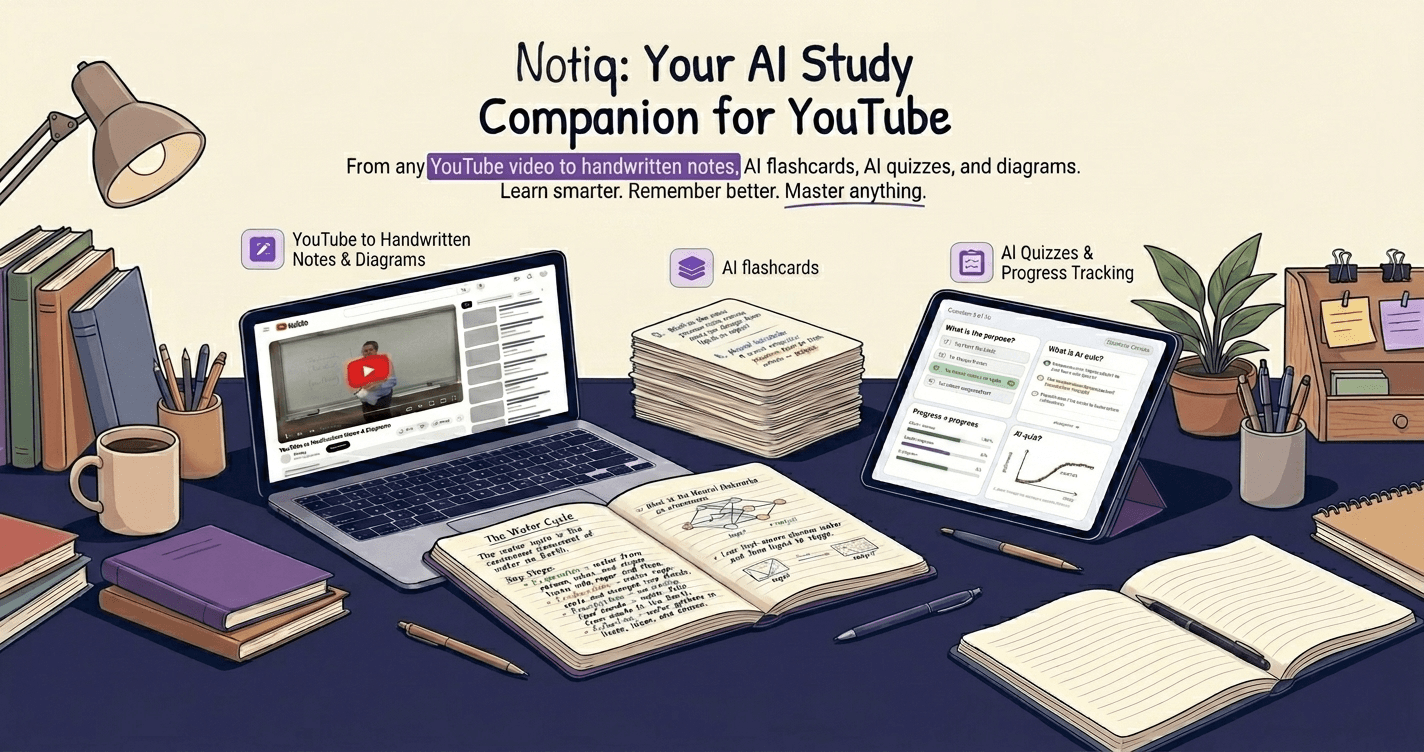
Notiq is purpose-built for this workflow. It watches a YouTube video, generates a structured transcript-based note with key concepts, definitions, and section headers, and optionally creates a first set of flashcards. If your primary learning source is YouTube, this is the fastest capture layer available. Read the full breakdown of how to extract notes from YouTube videos.
Tactiq works as a browser extension and captures live meeting transcripts from Google Meet, Zoom, and Teams. If you attend live sessions or office hours, it is useful.
Otter.ai handles audio — podcasts, recorded lectures, voice notes. It is strong on transcription accuracy and weak on structure.
For text content (articles, papers, documentation), the capture tooling is more mature: Readwise Reader, Instapaper, and Zotero (for academic papers) all work well. Readwise has the added advantage of syncing highlights to your note system automatically.
Layer 2: Synthesis — Turning Raw Notes Into Something Useful
Capture gives you raw material. Synthesis turns that into understanding.
This is where most self-learners underinvest. A folder full of highlights and transcript excerpts is not knowledge. Knowledge is what happens when you work through that material: identifying the main claim, connecting it to what you already know, writing a concise summary in your own words, flagging what you do not understand.
The tools that support synthesis well:
Obsidian is the best tool available for anyone who wants to build a genuine knowledge graph. Its backlink system means every note you write can be connected to related concepts. Its plugin ecosystem is enormous. The learning curve is real — you need to develop a system, and that takes weeks — but the payoff for long-term learners is significant. See the detailed comparison Obsidian vs Notiq if this is your choice point.
Notion is versatile and good for structured projects, wikis, and databases. It is less good for freeform synthesis where you want to discover connections between ideas. If your learning is project-based (you are learning web development to build a specific thing), Notion's structure is helpful. See Notiq vs Notion AI for the detailed breakdown.
Notiq handles synthesis for YouTube-sourced material automatically. The generated notes are structured by default, with headers and key terms surfaced. For material from other sources, you would need to paste in or import manually.
Bear (macOS/iOS only) deserves a mention as a clean, friction-free writing environment for anyone who processes notes through writing rather than tagging or linking.
Layer 3: Retention — Making Sure Information Stays Accessible
This is where most self-study workflows break down completely. You watch a lecture, you take notes, you feel good. Six weeks later, almost nothing has stuck.
The research on memory is unambiguous: retrieval practice with spaced repetition dramatically outperforms passive re-reading. The interval at which you review a piece of information matters as much as whether you review it at all.
The tools that handle retention:
Anki remains the gold standard for spaced repetition. It is free, open-source, has apps on every platform, and has been battle-tested by medical students and language learners for over a decade. The main friction is card creation — making good Anki cards takes effort and there is no shortcut.
RemNote combines note-taking and spaced repetition in one interface. You write notes with a specific syntax and RemNote automatically converts them to flashcards. This reduces the friction of card creation significantly. The tradeoff is that the note-taking interface is less flexible than a dedicated note tool.
Notiq generates flashcards as part of the note-creation workflow, making it the fastest path from YouTube video to review-ready flashcard deck. The cards are targeted to the actual content of the video you just watched, which is more useful than generic subject-area cards.
For language learning specifically, Duolingo and Clozemaster serve the retention layer well. They are not general-purpose tools, but within their domain they are well-designed.
Layer 4: Retrieval Practice — Testing What You Actually Know
Flashcard review is one form of retrieval practice. It is not the only one and, for technical subjects, it is often not the most useful.
The most effective retrieval practice for complex subjects is working through problems: coding exercises, derivations, essay outlines under time pressure, past exam papers. The discomfort of not being able to recall something immediately is the signal that your brain is encoding it.
Tools for retrieval practice:
LeetCode / HackerRank / Codewars — for programming. Working through problems is better practice than reading about algorithms.
Brilliant.org — for mathematics, physics, and computer science. Problems are well-structured and scaffolded by difficulty. A paid tool, but genuinely good.
Quizlet — for generating practice tests from a topic or document. It is useful for exam preparation when you need variety of question format.
Khan Academy's exercise system — for mathematics through early university level. The immediate feedback loop is well-designed and the problem sets are extensive. Their practice exercises cover more topics than most people realize.
Past papers — underrated and free. For any standardized exam (AP, SAT, GMAT, bar exam), the best retrieval practice is official past papers under timed conditions. They are usually available directly from the examining body.
How Should You Actually Combine These Tools?
The goal is a minimal stack that covers all four layers without friction between them. Here are three stacks based on different learning contexts:
Stack for YouTube-based self-study:
- Capture + synthesis + flashcards: Notiq
- Spaced repetition review: Anki (export from Notiq) or Notiq's built-in review
- Retrieval practice: Past papers or domain-specific problem sets
- Reference/organization: Notion or simple folder structure
Stack for building a long-term knowledge graph:
- Capture: Notiq (for video), Readwise (for articles/books)
- Synthesis + linking: Obsidian
- Spaced repetition: Anki or the Spaced Repetition plugin in Obsidian
- Retrieval practice: Domain-specific tools
Stack for structured course completion:
- Capture: Notiq (for lecture videos), manual notes for problem sets
- Synthesis: Notion (structured by module/week)
- Retention: RemNote or Anki
- Retrieval practice: Course problem sets, then past papers
Does More Software Equal More Learning?
No. This is worth saying clearly.
The self-learner's toolkit problem is often a procrastination problem in disguise. Evaluating tools, setting up Obsidian vaults, building Notion templates — these feel productive and are not. Spending two hours learning to use a tool you should spend two minutes deciding on is a reliable way to avoid the harder work of actually learning something.
The right stack for most people is simple: one place to put notes, one system for spaced repetition, a commitment to retrieval practice. Add complexity only when you have hit a real constraint in your current setup.
The 10 free AI tools for students guide covers the free tier availability of most tools mentioned here, which matters if you are working within a budget.
How Do You Avoid Tool Overload and Procrastination Disguised as Productivity?
One of the most insidious traps in self-directed learning is optimizing the system instead of doing the work. This is so common among ambitious learners that it deserves its own section.
The cycle looks like this: you want to learn something. You research the best tools. You spend a weekend setting up Obsidian with plugins, a complex template system, and a custom daily note structure. You feel accomplished. You have not yet learned anything.
A few practical rules that help:
Pick tools in one session, then stop. Give yourself ninety minutes to evaluate your options for each layer of the stack. At the end of those ninety minutes, commit to a choice and move on. Change tools only when you have a concrete problem with your current setup — not because a better option was posted in a Reddit thread.
Evaluate a tool by using it for two weeks, not by reading about it. The only way to know if a tool works for your workflow is to use it with real material for long enough to encounter its friction points. Reviews and comparison articles (including this one) can narrow your options, but they cannot tell you what fits your specific working style.
Prefer boring tools. A note tool should be invisible. If you are thinking about your note tool while you are learning, something is wrong. The tools that last in self-learner workflows are the boring ones — Anki, plain Markdown files, a simple folder structure. The elaborate ones get abandoned.
Time box system-building. If you are the kind of person who enjoys building systems (many dedicated learners are), give yourself explicit permission to do it — in a time-boxed session, once per month. The rest of the time, use the system you have. Continuous system-building is procrastination.
How Do You Measure Progress as a Self-Learner?
Formal education gives you external feedback: grades, exams, instructor comments. Self-directed learning removes those structures, which means you need to create your own feedback loops.
Three metrics worth tracking:
Hours of focused study per week. Not hours of watching YouTube, but hours of active processing: note-taking, problem-solving, flashcard review, writing summaries. The distinction matters because passive consumption does not produce learning.
Flashcard retention rate. If you are using Anki or a similar tool, your average retention rate is a proxy for how well the material is consolidating. A healthy retention rate for spaced repetition is around 85–90%. If it is significantly lower, your cards may be too complex, or you are not reviewing consistently enough.
The explanation test. Periodically (every two to four weeks), pick a concept you have studied and try to explain it from memory in writing. How far can you get without looking at your notes? The gap between what you expect to remember and what you actually remember is the most honest measure of your progress.
None of these require external validation. They can all be tracked in a simple spreadsheet.
What Is Actually Different About 2026?
The main change in the last two years is that AI has made the capture and synthesis layers dramatically faster. Generating structured notes from a YouTube lecture that would have taken 45 minutes now takes under a minute. This removes the main friction point for many self-learners.
The retention and retrieval layers have not changed as much. Spaced repetition works the same way it always has. Doing practice problems under pressure works the same way. AI has not found a shortcut around the need for active recall, and it probably will not.
What this means practically: if your current bottleneck is capture and synthesis (you watch things but do not have time to process them), AI tools genuinely help. If your bottleneck is actually sitting down to do the hard review and practice work, no tool will solve that.
Where to Go From Here
If you are building a YouTube-first study workflow, the complete guide to learning from YouTube covers the method in depth. If you are comparing note tools specifically, Notiq vs Notion AI and Obsidian vs Notiq lay out the honest trade-offs.
For the AI tooling layer, the honest AI study notes guide covers what works and what does not in the current generation of tools.
The stack you need is probably simpler than you think. Pick tools that cover the four layers, reduce friction between them, and then focus your energy on the actual learning.
Try Notiq free — upload a YouTube lecture and get structured notes and flashcards in under a minute. Start at notiq.study.