If you have ever tried to take notes from a YouTube lecture and felt like you were either pausing every 30 seconds (breaking your comprehension) or writing frantically and still missing things (getting overwhelmed), you already understand the problem.
Taking notes from a YouTube lecture is harder than taking notes in a live classroom. In a classroom, the lecturer's pace is partly governed by your visible comprehension. On YouTube, the lecture was recorded for a room full of people who may have had different preparation than you, and it keeps playing whether you are with it or not.
This guide covers the techniques that actually work — how to structure your notes for video content, when to pause and when not to, how to capture what matters without transcribing everything, and how AI tools fit into the workflow.
MIT OCW lectures are among the richest YouTube content available — and excellent material to practice structured note-taking on.
Why the Pause-and-Write Method Does Not Scale
The most common approach to YouTube lecture notes is straightforward: pause when the lecturer says something important, write it down, resume. This works for short videos. It breaks down for anything over 30 minutes, and here is why.
Every pause breaks the continuity of your comprehension. A good lecture builds — the example in minute 23 only makes sense because of the concept introduced in minute 17. When you pause frequently, you are constantly re-entering the stream, re-orienting yourself, and spending cognitive resources on keeping up rather than understanding.
There is also a transcription trap: when you pause-and-write, the natural impulse is to copy down exactly what the lecturer just said. This produces notes that are accurate but not yours — you have not processed the information enough to restate it, which means the notes are effectively a transcript you will have to read again later without any added comprehension.
The goal is understanding notes, not transcription notes. Understanding notes capture what you now know that you did not before, in language that reflects your own comprehension. They are written faster, require less pausing, and are significantly more useful to study from.
The Pre-Watch Setup: Two Minutes That Change Everything
Before starting a lecture, spend two minutes on setup. This primes your comprehension and reduces the note-taking load during the video.
Read the description, title, and timestamps. Most educational YouTube videos include timestamps that reveal the lecture's structure. Reading these before you watch gives you a cognitive map — you know where the lecture is going, which means you can identify where you are and what is coming instead of building the map live.
Scan the associated slides or syllabus if available. Many university courses post slides alongside their YouTube lectures. A two-minute scan of the slides before watching dramatically reduces your cognitive load during the video — you are recognizing and enriching material rather than encountering it cold.
Write three questions the lecture should answer. This activates your brain's question-answering mode. When you are watching to answer a question, you process information as a self-check rather than passive reception. The act of writing the questions takes 60 seconds and measurably improves retention.
Choose your note structure in advance. Decide before you start whether you are using outline notes, Cornell format, or something else. Making this decision mid-lecture wastes attention. If you are not sure, outline format (indented bullet points tracking the lecture's natural hierarchy) is the most flexible for video content.
The Right Structure for YouTube Lecture Notes
YouTube lecture notes have different structural requirements than notes from a textbook or live class. The key difference is temporal: the lecture moves in real time, and your notes need to reflect a structure you can track without pausing constantly.
Use the lecture's own structure. Good lecturers announce their structure: "Today we are going to cover three things: first X, then Y, then Z." Use these announcements as your top-level headings. You can write them down in the first minutes and leave space under each one as you continue watching.
One level of nesting is enough during the lecture. During active watching, try to stay at one level of bullet-point depth. Deeply nested notes require more formatting decisions in real time — decisions that cost attention you need for comprehension. After the lecture, you can go back and add structure.
Use abbreviations systematically. Develop a consistent shorthand: "→" for "leads to" or "causes," "≈" for "approximately," "∴" for "therefore," "eg" for "for example," "def" for "definition." Consistent abbreviations let you write faster without having to decode your own shorthand later.
Date and timestamp notes for important moments. When something is particularly important or confusing, jot down the video timestamp (e.g., "23:14 — gradient descent derivation"). This lets you return to exactly the right moment in the video without re-watching the whole thing.
A practical note structure for a 60-minute lecture looks like this:
[Lecture Title] — [Date watched]

Main question: [your pre-watch question]

## Section 1: [First major topic from timestamps]
- Key point 1
- Key point 2
  - sub-detail (only if essential)
- [23:14] Key derivation or proof — ??unclear

## Section 2: [Second major topic]
- ...

## Confusions to resolve:
- [list of ?? items]

## Key terms defined:
- Term: definition in my words

## Summary (post-watch):
[Written after video ends, from memory]
When to Pause — and When Not To
Rather than pausing reactively (whenever something seems important), pause at predictable, structural moments. This keeps your comprehension continuous while still giving you time to write.
Pause at section transitions. When the lecturer signals a shift — "Now let's move on to..." or "The second concept is..." — pause for 60-90 seconds to consolidate what you just covered and write a brief summary before moving into the new section.
Pause when you are genuinely lost. Not when something is slightly confusing — that often resolves in the next 2-3 minutes as the lecturer develops the point. Pause when you have completely lost the thread and you cannot follow what the lecturer is saying at all. This is the only time to re-watch immediately.
Pause at the end of each worked example. Examples are high-density. After an example completes, pause to write what the example demonstrated in your own words.
Do not pause to look up unfamiliar terms during the lecture. Write the term down with a "??" marker and look it up after. Research rabbit holes during the lecture destroy comprehension continuity.
For most educational content, this means pausing 4-8 times during a 60-minute lecture rather than 30-40 times. The notes are less exhaustive but significantly more useful.
How to Handle Dense Technical Content
Mathematical derivations, algorithm walkthroughs, and proof-heavy content require a different approach than conceptual lectures.
Do not try to reproduce derivations in real time. When a lecturer works through a mathematical proof, your goal during the video is not to copy each line — it is to understand the purpose of the derivation (what it proves, what assumptions it rests on, what it implies) and the high-level method (integration by parts, induction, substitution). The details are in the slides.
Write what the math means, not what the math says. Instead of copying the chain rule equation, write "chain rule: tells you how to differentiate composite functions — derivative of outer applied at inner, times derivative of inner." This is slower to write but more useful to study from.
Mark the "key equation" with a star. In any mathematical section, there is usually one result that everything else derives from or builds toward. Mark it clearly so you can find it in your notes.
Cross-reference slide numbers if you have them. If you are watching with the slides open, note the slide number for any derivation you did not fully follow. You can work through it at full attention after the lecture ends.
For a complete approach to learning technical material from YouTube, see our complete YouTube learning playbook.
Cornell-Style Notes for YouTube Lectures
The Cornell note-taking method adapts well to video content and is worth knowing if you are not already familiar with it. The method divides your note page into three sections:
- Main notes area (right, ~70% of page): Your standard lecture notes, taken during the video
- Cue column (left, ~30% of page): Keywords, questions, and headings added after the lecture
- Summary box (bottom): A 2-4 sentence summary written from memory after the lecture
The cue column is particularly valuable for YouTube notes because you fill it in during your post-watch review — when you read back through your notes and write down the key terms and questions each section addresses. This forces a re-encoding of the material without re-watching.
For a detailed guide on the Cornell method, including how AI can automate the cue-column generation step, see our article on the Cornell method with AI.
What AI Note-Taking Tools Actually Change
The legitimate use case for AI in YouTube note-taking is removing the transcription overhead so that your cognitive attention during the lecture can focus entirely on understanding.
When an AI tool processes a YouTube transcript and produces structured notes, it handles the mechanical work that previously required either pausing frequently or missing things. You can watch the lecture at full pace, focus on comprehension and your own annotations, and then use the AI-generated notes as a complete structural record that you review and enrich afterward.
The important distinction: AI-generated notes are a starting point for your study, not the endpoint. The notes themselves do not encode knowledge — your interaction with them does. Reading AI notes passively is only marginally better than not taking notes at all. What matters is what you do after: brain-dump, practice questions, spaced review.
For a comparison of the best AI tools for this workflow, see our guide on tools to summarize and take notes from YouTube videos.
Does Note-Taking Format Matter for Retention?
Research on note-taking format generally supports the following conclusions:
Writing in your own words significantly outperforms transcription. The Mueller and Oppenheimer studies on laptop vs. handwritten notes found that the advantage of handwriting was not physical — it was that handwriters were forced to paraphrase (they could not keep up with verbatim transcription), and paraphrasing required processing. You can get the same benefit with a laptop if you intentionally write in your own words.
Sparse notes outperform dense notes for long-term retention. Notes that capture the essential structure and key concepts — and leave the rest — are easier to review and produce better memory consolidation than exhaustive transcriptions.
Post-lecture summaries from memory are more valuable than notes taken during the lecture. This is counterintuitive for many students. The brain-dump you write from memory after a lecture activates retrieval, which encodes the information in long-term memory. The notes you took during the lecture are a reference — they support the brain-dump, but the brain-dump is the actual learning event.
A Sample Session: How This Looks in Practice
Here is a concrete example with a 45-minute CS lecture.
-
2-minute pre-watch: Read timestamps. Write: "Q1: What is a neural network? Q2: Why does depth matter? Q3: How does backpropagation work?"
-
Watch at 1.25x speed with notes document open. Use section headings from timestamps. Pause 5 times — at each section transition and at the end of the backpropagation worked example.
-
15-minute post-watch: Brain-dump for 8 minutes. Then compare against notes, identify gaps, resolve 2 confusion markers by re-watching 2-minute segments.
-
5-minute summary: Write a one-paragraph summary from memory.
-
Flashcard generation: Either manually create 8-10 cards from key concepts, or paste notes into an AI tool for automated card generation.
-
Review in 24 hours.
Total time investment for a 45-minute lecture: approximately 65-70 minutes. The extra 20-25 minutes post-watch is the difference between watching and learning.
How to Take Notes When You Do Not Have Time for the Full System
The full system above is for content you want to retain long-term. For lighter learning objectives — getting an overview, quickly assessing whether a resource is worth deeper study, reviewing material you mostly know — a lighter version is appropriate.
Skim version: Watch at 2x speed with no notes. At the end, write 3 things you learned and 1 question you would want to look up. This takes 10 extra minutes and gives you basic retention.
Quick-notes version: Take notes only on things that surprise you or that you did not know before. Do not try to capture the full structure. Review these notes within 24 hours with a brief brain-dump.
AI-only version: Feed the transcript to an AI tool and read the summary. This is useful for overview purposes but should not be mistaken for learning. It is significantly better than nothing and is the right approach for assessing relevance, not for building knowledge.
Tying It All Together: Note-Taking as One Part of a System
Note-taking from YouTube lectures is valuable, but it is only one component of a system that includes pre-watching, active watching, post-watching consolidation, and spaced review over time. Notes taken during the lecture are a supporting artifact — they enable better post-watch consolidation and make spaced review possible.
The big picture: the goal is not good notes. The goal is durable knowledge. Notes are a means to that end, and the specific note-taking method matters less than consistently doing the retrieval practice (brain-dumps, flashcards, practice questions) that converts notes into retained knowledge.
For the complete system, see our guide to learning anything from YouTube. For notes on a specific challenging YouTube course, see our Stanford CS230 lecture notes as an example of what structured notes from a technical lecture look like.
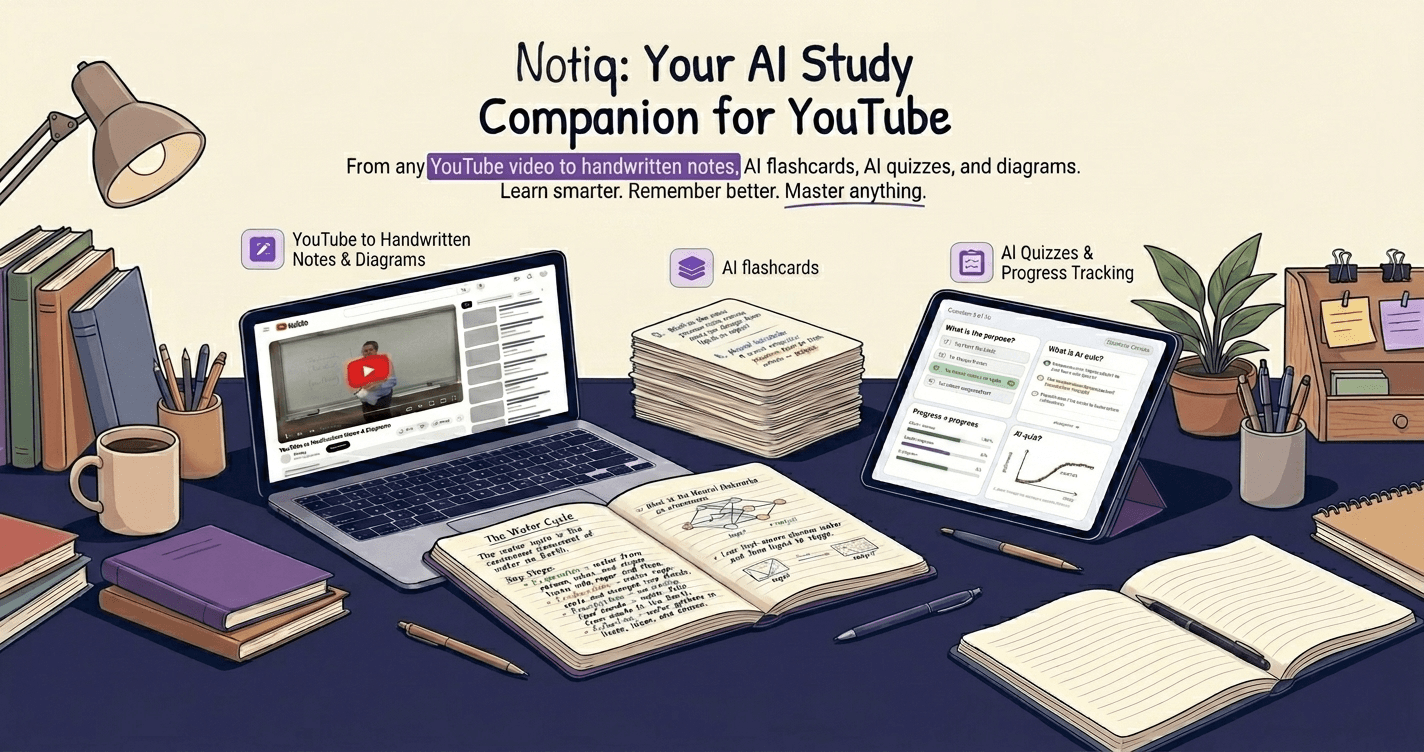
Notiq generates structured study notes from any YouTube lecture URL — organized by topic, complete with key terms and definitions, and ready for spaced review. Paste your lecture link and get a full study package in under a minute.
Turn your YouTube lectures into structured notes at notiq.study