The ability to summarize a YouTube video in seconds used to be a significant technical challenge. In 2026, it is a commodity — there are dozens of tools that can take a 2-hour lecture or documentary and produce a readable summary in under a minute.
The real question is no longer whether you can summarize YouTube videos automatically. It is which tools produce summaries that are actually useful for studying, research, or knowledge-building — as opposed to summaries that are accurate but shallow, or well-structured but missing the things that mattered most.
This article compares the five best free tools for summarizing YouTube videos in 2026, with specific attention to study use cases: how well does the output support note-taking, spaced review, and genuine comprehension?
Long-form content like the Lex Fridman Podcast is exactly where AI summarization tools earn their keep — 3+ hour conversations distilled into structured notes.
What Makes a Good YouTube Summary for Studying?
Before diving into specific tools, it is worth being clear about what you actually want from a YouTube summary in a study context. A summary that is good for casual consumption is not necessarily good for learning.
Good study summaries are structured, not flat. A wall of text is not useful. Summaries organized into sections with headers, bullet points, and a clear hierarchy that reflects the lecture's own structure are significantly easier to review and study from.
Good study summaries capture key terms and definitions. For academic content, terminology is often the hardest thing to remember. A summary that extracts and defines the key terms introduced in a lecture is substantially more valuable than one that paraphrases the concepts without naming them precisely.
Good study summaries are honest about uncertainty. All summarization tools occasionally miss nuance or slightly misstate a technical claim. Tools that produce confident-sounding but occasionally inaccurate summaries are dangerous for studying. You want to know when to verify.
Good study summaries integrate with retrieval practice. A summary by itself is a reading exercise — it produces fluency, not recall. The most valuable study tools take the summary further: flashcards, practice questions, or other mechanisms that force active retrieval.
With those criteria in mind, here are the five best free tools currently available.
1. Notiq
Best for: Students who want complete study packages from YouTube lectures, not just summaries.
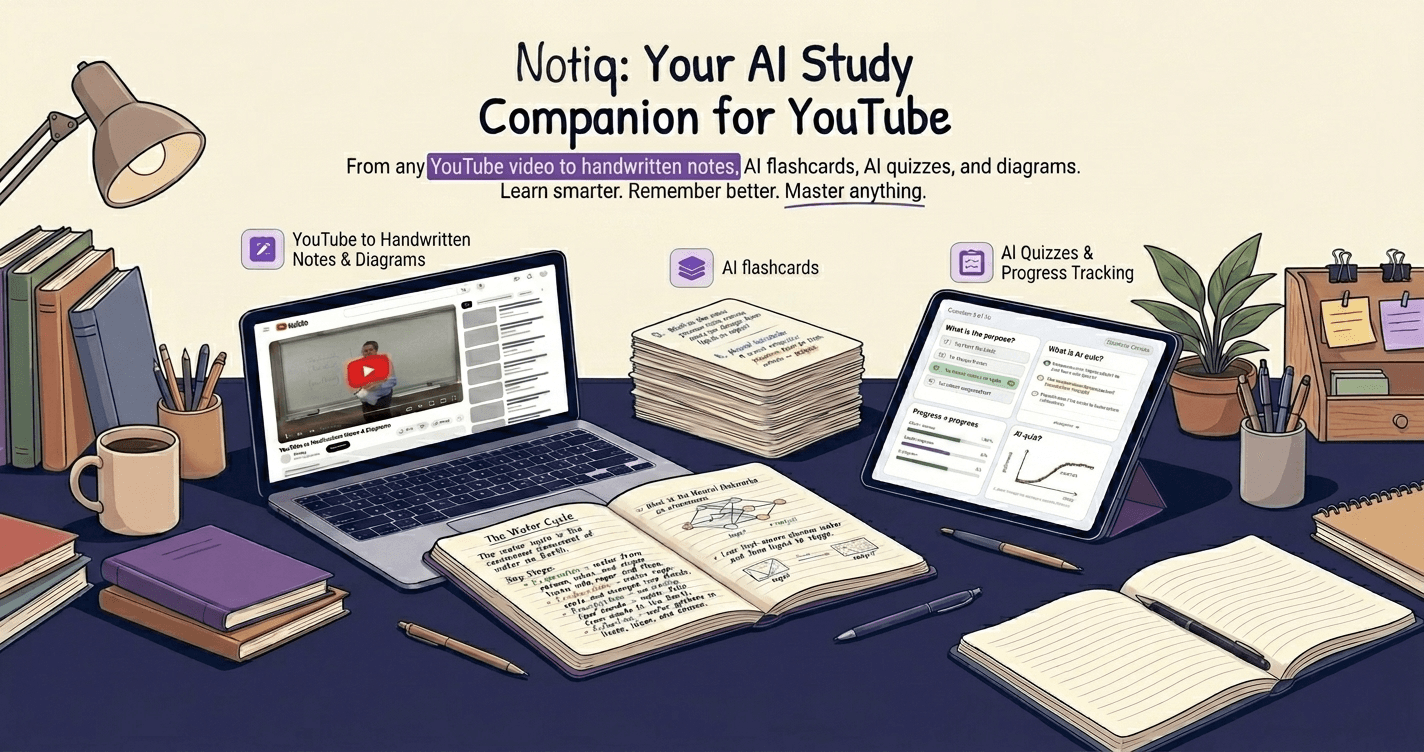
Notiq is purpose-built for learning from YouTube. You paste a video URL, and it processes the transcript to produce not just a summary but a full study package: organized notes divided by topic, key term definitions, and a flashcard deck for spaced repetition — all automatically generated.
What distinguishes Notiq from general-purpose summarization tools is that it is designed around the cognitive science of learning. The output is structured to support retrieval practice, not just consumption. The flashcards are generated automatically and scheduled for spaced review based on your performance.
What the free tier includes: 2 lifetime note sets (not a monthly reset — it's a trial allowance) on videos up to 20 minutes, Summary mode, and watermarked PDF/PNG export. Notiq Lite (12/month) raises that further to 30 note sets per month, videos up to five hours, hand-drawn diagram extraction, full lecture notebooks, and worked-solution mode for exam-walkthrough videos.
Honest limitations: Notiq is optimized for educational content — lectures, tutorials, course videos. It works on other content types (podcasts, documentaries) but produces less structured output than it does for lecture-format videos where the structure is more predictable.
Best for: University students, self-learners working through YouTube course content, and anyone building a structured knowledge base from video material.
Try Notiq for free at notiq.study
2. Tactiq
Best for: People who want high-quality transcripts with AI-enhanced summaries across multiple platforms.
Tactiq started as a meeting transcription tool (it integrates with Zoom, Google Meet, and Teams) and expanded to YouTube summarization. The YouTube integration works as a Chrome extension — you install it, navigate to any YouTube video, and Tactiq produces a transcript with an AI-generated summary.
The summary quality is consistently good for factual content. Tactiq uses a solid language model and the output is coherent and organized. The transcript access is particularly valuable: being able to search the full transcript of a lecture, find specific quotes, and copy exact text is useful for research and writing.
What the free tier includes: A limited number of AI summaries per month (the limit is fairly generous for occasional use) and full transcript access.
Honest limitations: Tactiq's free tier has a monthly cap that you can hit relatively quickly if you are working through a lecture series. The output is good but not study-optimized — you get a summary, not a study package. There is no built-in flashcard generation or spaced repetition.
Best for: Researchers who want transcript access and summaries for content research, students who primarily need summaries for quick orientation rather than deep study.
3. YouTube's Built-in AI Summaries
Best for: Quick orientation before deciding whether to watch a video.
YouTube has been rolling out its own AI-generated summaries for a growing number of videos. These appear as expandable panels below the video title, generated automatically by YouTube's own AI systems. As of 2026, coverage is not universal — longer educational videos and videos from established educational channels tend to have better coverage.
The built-in summaries are honest and accurate in our experience, though they are notably shallow. They give you the "what this video is about" level — useful for deciding whether to watch, less useful for studying content you have already watched.
What the free tier includes: Everything. YouTube's built-in summaries require no account, no extension, and no cost. They are simply there if available.
Honest limitations: Coverage is inconsistent. Quality varies significantly by video. The summaries are flat text with no hierarchy, definition extraction, or study-oriented structure. No transcript access. No integration with study tools.
Best for: Quick triage — deciding whether a video is worth watching — rather than study purposes.
4. ChatGPT with Transcript Copy-Paste
Best for: Students who want maximum control over summary structure and depth, and do not mind a manual workflow.
This is not a dedicated tool — it is a workflow. You get the transcript of a YouTube video (via Tactiq, the YouTube transcript feature in the video settings, or a browser extension), paste it into ChatGPT, and ask for a structured summary with a prompt you design.
The quality ceiling with this approach is higher than any dedicated tool because you have complete control over the prompt. You can ask for summaries structured in a specific format, tell ChatGPT to pay special attention to mathematical concepts, ask for a glossary of key terms, request practice questions, or specify the level of detail you want.
A good prompt for study summaries:
"Here is a transcript from a university lecture on [topic]. Please produce: (1) a structured summary with H2 headers matching the lecture's main sections, (2) a glossary of technical terms introduced, (3) 8 exam-style practice questions based on the content. Use precise language and do not simplify technical claims."
What the free tier includes: ChatGPT's free tier allows this workflow with some context length limits. Very long transcripts (over 2-3 hours) may need to be processed in sections.
Honest limitations: Manual. Copy-pasting transcripts and writing prompts takes meaningful time. No automatic scheduling, no flashcard integration, no spaced repetition. The quality of the output depends heavily on your prompting skill.
Best for: Advanced students who are comfortable with prompt engineering and want maximum control over summary format. Also good for research contexts where the default tool formats are not appropriate.
For a detailed comparison of ChatGPT versus other AI tools for studying, see our ChatGPT vs Claude vs Gemini study comparison.
5. Kagi Universal Summarizer
Best for: Power users who want fast, high-quality summaries as part of a broader research workflow.
Kagi is a privacy-focused search engine that includes a Universal Summarizer — a tool that can summarize any URL, including YouTube videos. You paste the YouTube URL, and it produces a summary within seconds. No transcript copying required.
The summary quality is notably high. Kagi uses good underlying models and the output is consistently structured and accurate. For research purposes — getting a quick but reliable overview of what a video covers — Kagi's summarizer is among the best.
What the free tier includes: Kagi offers a limited number of free summaries per month as part of its search trial. The Universal Summarizer is a paid feature within Kagi's subscription, but the trial allocation is useful for occasional use.
Honest limitations: Kagi is not free beyond the trial tier, which limits its appeal as a student tool. The output is a clean summary but not study-optimized — there is no flashcard generation, no spaced review integration, no vocabulary extraction.
Best for: Researchers and academics who are already Kagi subscribers and want seamless summarization integrated into a search workflow.
How Do These Tools Compare for Common Study Scenarios?
| Scenario | Best tool |
|---|---|
| Summarizing a full lecture series | Notiq |
| Quick orientation before watching | YouTube built-in AI |
| Research with transcript search | Tactiq |
| Custom summary format with full control | ChatGPT + transcript |
| Summarizing a mix of video and non-video content | Kagi |
| Creating flashcards automatically from a lecture | Notiq |
| Spaced repetition review from video notes | Notiq |
What These Tools Cannot Do
All five tools share a fundamental limitation: they produce summaries, not learning. A summary is a reading exercise. It produces fluency — the material feels familiar, things seem to click — without producing the recall that exams and real-world application require.
This is not a criticism of the tools. It is a reminder of how to use them. A good workflow uses an AI summary as one input into a study process that includes retrieval practice: brain-dumps from memory before consulting the summary, practice questions you answer without looking at the notes, and spaced review over time.
See our complete guide on how to learn from YouTube for a full system that integrates summarization tools into a workflow that produces genuine retention. And for the broader picture of AI study tools, see our AI study notes complete guide.
What to Look for When Choosing a Summarization Tool
If you are deciding which tool to use beyond this list, these are the criteria worth evaluating:
Does it produce structured output? Flat summaries are harder to use than hierarchically organized notes with headers. This matters most for long-form content.
Does it extract key terms? For academic content, vocabulary extraction is extremely valuable. Tools that produce a glossary alongside a summary save significant post-processing time.
Does it integrate with retrieval practice tools? Flashcard generation, spaced repetition, practice questions. Tools that close the loop from summary to active review are more valuable than tools that just produce text.
How accurate is it on technical content? Test any tool you are considering on a lecture you already know well. Read the summary and count the errors. Some tools are reliable for factual claims; others regularly introduce subtle inaccuracies on technical material.
What happens when the transcript is missing or low-quality? Some videos — older lectures, videos without captions, videos in non-English languages — produce poor transcripts that result in poor summaries. Know your tool's behavior in these cases before depending on it for important content.
Does Summarization Replace Watching?
Occasionally yes; usually no.
If your goal is triage — deciding which of five potential lecture videos are worth your full attention — AI summaries are an excellent time-saver. Read five summaries in 10 minutes, identify the two that match your learning objectives, watch those.
If your goal is actually learning the material, summaries are not a replacement for watching. The worked examples, the visual demonstrations, the way a good lecturer builds intuition through analogy and repetition — these are in the video, not the summary. A summary can tell you that backpropagation was explained via a computational graph; it cannot give you the moment when the visualization suddenly made the chain rule make sense.
For subjects where you are building from zero, watch first and use summaries to review and consolidate. For subjects where you already have a foundation and are updating your knowledge, summaries-first is often efficient.
For the note-taking techniques that complement summarization tools, see our article on how to take notes from a YouTube lecture. For the free tools beyond summarization, see 10 free AI tools every student should use in 2026.
Notiq is the only free tool on this list that takes you from YouTube URL to a complete study package — structured notes, key term glossary, flashcard deck, and spaced review schedule, all in one step.