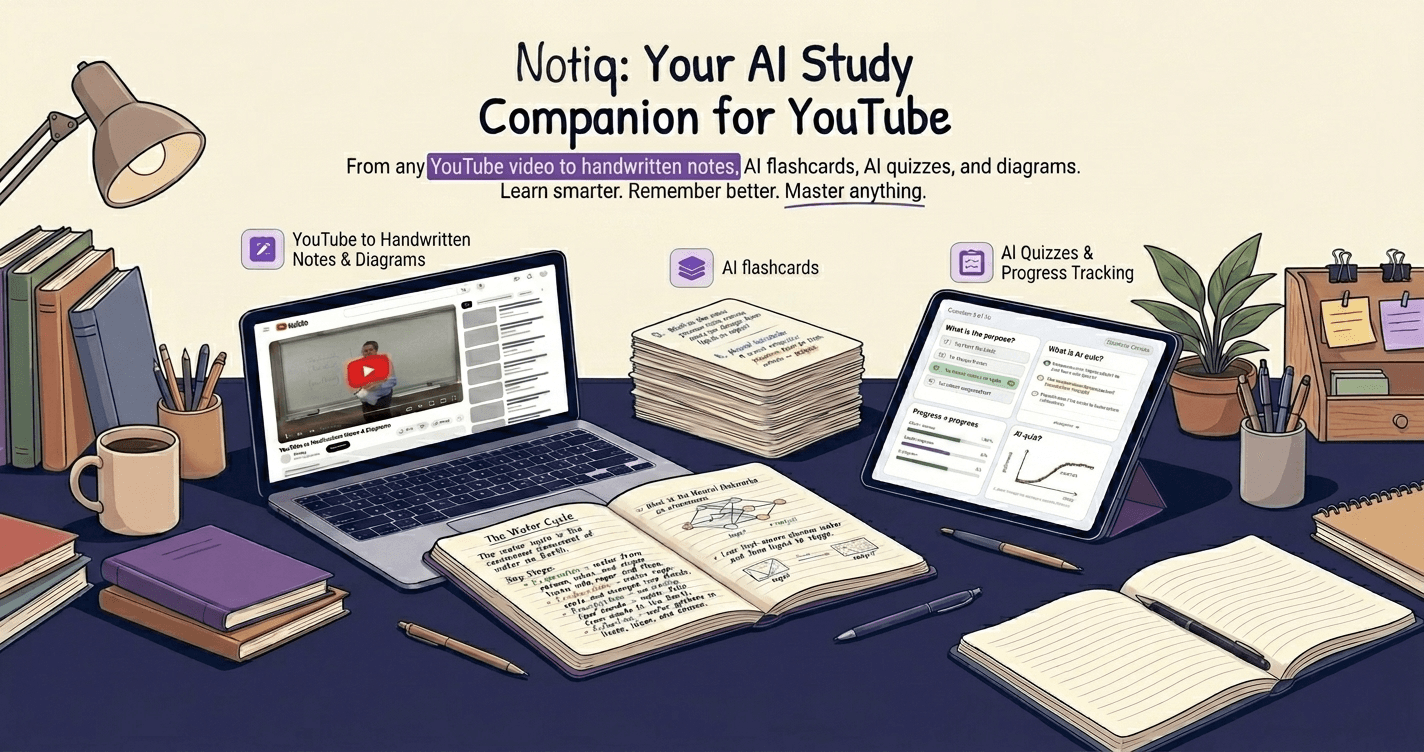
Cornell note taking with AI is one of those combinations that sounds gimmicky until you actually try it. The Cornell method is 60 years old. AI is a few years old. Together, they address the exact weaknesses that have always made Cornell harder to stick with than it should be.
This article explains how the Cornell system works, why it produces better recall than most alternatives, and specifically how AI changes the workflow in ways that matter for students dealing with high lecture volumes.
What Is the Cornell Method, Exactly?
The Cornell note-taking system was developed at Cornell University in the 1950s by Walter Pauk, a professor of education. It divides a page into three sections:
The Note Column (right, wide): This is where you capture content during the lecture — bullet points, diagrams, definitions, whatever the lecturer covers. You write fast and don't worry about perfection.
The Cue Column (left, narrow): After the lecture, you review your notes and write keywords, questions, or prompts in the left column that correspond to the content in the note column. This is the part most students skip — and it's the most important part.
The Summary Box (bottom): At the very end of the page or session, you write 2–4 sentences summarizing the main idea of the entire set of notes. In your own words, not copied from the notes.
The system is effective because it builds active review directly into the note-taking process. The cue column means you have to re-read your notes and identify what's worth testing yourself on. The summary forces you to synthesize. Both activities engage retrieval, which is what moves information from short-term to long-term memory.
The problem? Both the cue column and summary require time after class — time most students don't have, or don't spend, which turns Cornell notes into expensive ordinary notes.
Why Students Abandon Cornell After Week Two
There's a consistent pattern. A student reads about Cornell, sets up the page format, takes reasonably good notes in the note column — and then never fills in the cues or summary. A month later they're back to bullet points on blank pages.
The failure mode is predictable: the post-lecture review step requires willpower that competes with everything else in a student's day. After a 90-minute lecture, sitting down to write cue questions and a summary is the last thing most people feel like doing.
This is precisely where AI changes the equation.
How AI Automates the Hard Parts of Cornell
When you use an AI tool to process your lecture notes, it can generate two of the three Cornell sections automatically:
Generating cue questions: Given your note column content, a language model can identify the key concepts and produce left-column cue questions that probe each one. "What is the difference between supervised and unsupervised learning?" is a better cue question than "machine learning types" — and an AI will write the better version without you having to think about it.
Writing the summary: AI can produce a concise synthesis of a full page or full lecture's worth of notes. You still need to read it and check it, but you don't have to stare at a blank summary box.
What AI cannot do is replace the note column itself. You still need to pay attention during the lecture. You still need to capture the actual content. The AI can help you process what you captured — it can't capture it for you if you weren't listening.
This division of labor is actually healthy. The note-taking during class is where engagement happens. The AI assistance comes afterward, reducing the friction that causes students to skip the most effective part of the system.
Does Cornell Actually Work? What the Research Says
The evidence for Cornell specifically is decent rather than definitive — most of the strong research is on the underlying mechanisms rather than the format itself. But those mechanisms are solid.
The retrieval practice that Cornell forces (using cue questions to test yourself) is supported by decades of research. Jeffrey Karpicke's work at Purdue — including his 2011 Science paper — showed repeatedly that retrieval practice outperforms re-reading for long-term retention by a wide margin. Students who tested themselves on material retained significantly more a week later than students who re-read it, even when total study time was held constant.
The summary writing engages elaborative encoding — connecting new information to existing knowledge and expressing it in your own words. This is consistently associated with better retention than passive review.
The Cornell format doesn't produce these benefits automatically. A Cornell page with no cue questions and no summary is just a wide right column. The format is a forcing function — and AI makes the forcing function easier to actually use.
A Practical Workflow: Cornell with AI Step by Step
Here's how to make this work in practice without it feeling like extra overhead:
During lecture: Use the note column normally. Write fast. Don't format. Abbreviate. Capture the structure of the lecture — main topics, definitions, examples, and anything the lecturer emphasizes repeatedly. Don't try to fill in the left column yet.
Immediately after: Paste your note column into an AI tool. Ask it to generate 8–10 cue questions for the left column and a 3-sentence summary for the bottom. This takes about two minutes.
Review once: Read through what the AI generated. Delete any cue questions that are trivial. Add any questions you think are missing. Edit the summary if it missed the main point. This step forces you to re-engage with the content within 30 minutes of the lecture — which is exactly when review is most effective.
Test yourself that evening: Cover the note column. Work through the cue questions. This is the retrieval practice that makes Cornell worth doing. If you can't answer a question, uncover the notes, re-read that section, and try again.
Weekly review: Once a week, run through all the cue questions from that week without looking at the notes. What you can't answer goes on a flashcard.
This workflow is about 15 minutes of active work per lecture hour, much of which happens automatically. Compare that to the traditional approach of re-reading notes before an exam, which is both more time-consuming and significantly less effective.
Which Subjects Does Cornell Work Best For?
Cornell is particularly strong for content-heavy lectures where there's a clear hierarchy of concepts: science courses, history, economics, law, medicine. Anything where the lecturer introduces terms, explains them, and then applies them to examples maps naturally onto the Cornell format.
It's less intuitive for mathematics, where the note column ends up being worked examples rather than prose. For math, a modified version works better: the note column captures the worked example step by step, and the cue column captures the underlying principle being demonstrated. "This step uses the chain rule because the outer function is g(f(x)) where f(x) is itself differentiable" as a cue is more useful than "chain rule" as a keyword.
For qualitative fields like literature, philosophy, or creative writing seminars, Cornell still works but you need to adapt the cue column. Instead of factual questions, you're writing interpretive prompts: "What's the author's central claim in this passage?" or "How does this argument differ from the counter-argument in chapter 3?"
Combining Cornell with Other Study Methods
Cornell doesn't exist in isolation. It works well as part of a broader study system — particularly when combined with spaced repetition and active recall techniques.
The cue column is essentially a set of flashcard fronts. The corresponding notes are the backs. Many students transfer their Cornell cues directly into their spaced repetition system (Anki, RemNote, or a tool like Notiq that handles this automatically). This gives you both a structured note-taking system for capturing information and a spaced repetition system for retaining it — with the cue column serving as the bridge between the two.
For more on how these techniques interact, see note-taking methods compared, which covers how Cornell sits alongside outline notes, Zettelkasten, and mind maps. The flashcards that stick article covers the specific science of how to write cards that work for long-term retention.
If you're also dealing with the question of whether handwritten or digital notes work better for Cornell — the answer matters, and it's more nuanced than most people realize. Handwritten vs typed notes covers the research on this directly.
What AI Still Cannot Do in This Workflow
The limits are worth being explicit about:
AI-generated cue questions are pattern-matched, not pedagogically reasoned. The model looks at what's in your notes and generates questions that look like cue questions. It doesn't know what's going to be on your specific exam. It doesn't know which concept your professor considers central and which is incidental. You still need to do that filtering yourself.
AI summaries compress information — they don't necessarily identify the most important idea. A summary that captures the mechanical steps of a process may miss the conceptual point the lecture was making about why that process matters. Read the summary critically.
None of this replaces the actual lecture engagement. The students who do best with any note-taking system are the ones who show up having done the pre-reading, who are actively trying to understand rather than passively transcribe. AI downstream of poor lecture engagement just cleans up bad notes faster.
Is Cornell Right for You?
Cornell is not for everyone. Some students find the rigid three-column format uncomfortable. Others find that the system works well for some courses and not at all for others. If you've tried it before and abandoned it, it's worth asking whether you abandoned the format or just abandoned the cue-and-summary step.
For most students dealing with high-volume lecture-based courses, Cornell with AI assistance is worth a genuine two-week trial. The format forces review habits that genuinely improve retention. The AI makes those habits significantly easier to maintain. And the combination addresses the core problem most students face: they have good intentions during class and then spend the evening doing anything other than reviewing what they just learned.
Most students aren't taking notes wrong because they're lazy. They're taking notes wrong because the methods that work require effort that spikes in the wrong places — right after class, when mental energy is lowest. AI smooths that spike. The effort that remains is the effort that actually moves information into long-term memory.
For a broader look at the evidence on note-taking, most students take notes wrong is a good starting point. And if you're already applying Cornell or other methods to YouTube lectures and video content, AI study notes: the complete guide covers how to integrate this with your video learning workflow.
How Do You Know If Your Cornell Notes Are Actually Working?
A simple test: at the end of the week, sit down with your Cornell pages from the last five lectures. Cover the note column completely. Work through every cue question, speaking your answers out loud. Don't check until you've attempted each one.
If you can answer more than 80% of the cues confidently, your Cornell workflow is solid — you're capturing the right things and the cues are well-written. If you're struggling with more than half, one of two things has gone wrong: either your note column didn't capture the right concepts, or your cue questions are too vague to actually test your knowledge. AI assistance addresses the second problem directly — it generates specific, answerable questions rather than keyword-only cues.
The other indicator is exam performance itself, with a lag. Students who consistently work through cue columns weekly — rather than re-reading notes the night before an exam — typically find that pre-exam review takes much less time and produces higher confidence. The work has been distributed across the semester in small daily increments rather than concentrated in a panic session.
This is the real promise of Cornell done consistently: not a perfect note format, but a structure that forces you to do the right cognitive work at the right time. A 2014 study by Mueller and Oppenheimer at Princeton found that students who processed information during note-taking — rather than transcribing — retained significantly more on conceptual questions a week later. Cornell's forced compression and cue-writing is exactly that kind of processing. AI removes the post-lecture friction that prevents students from completing the format, which means the barrier to getting the full benefit is lower than it's ever been.
Notiq generates Cornell-style notes from any YouTube video, lecture recording, or document — including the cue questions and summary, automatically. Try Notiq free at notiq.study and run your next lecture through it.