If you've been trying to figure out whether to use ChatGPT vs Claude for studying — or whether Gemini fits somewhere in there — you're not alone. Every student who starts using AI tools hits this decision point, and the marketing from all three companies is nearly useless for making it.
This article is based on actual use across real study tasks: summarizing lectures, generating flashcards, explaining difficult concepts, producing structured notes, and helping with exam preparation. Not benchmarks. Not vibes. Practical results.
Before diving in, watch Andrej Karpathy's breakdown of how language models actually work — it's the best foundation for understanding why these tools behave the way they do:
Andrej Karpathy — Intro to Large Language Models
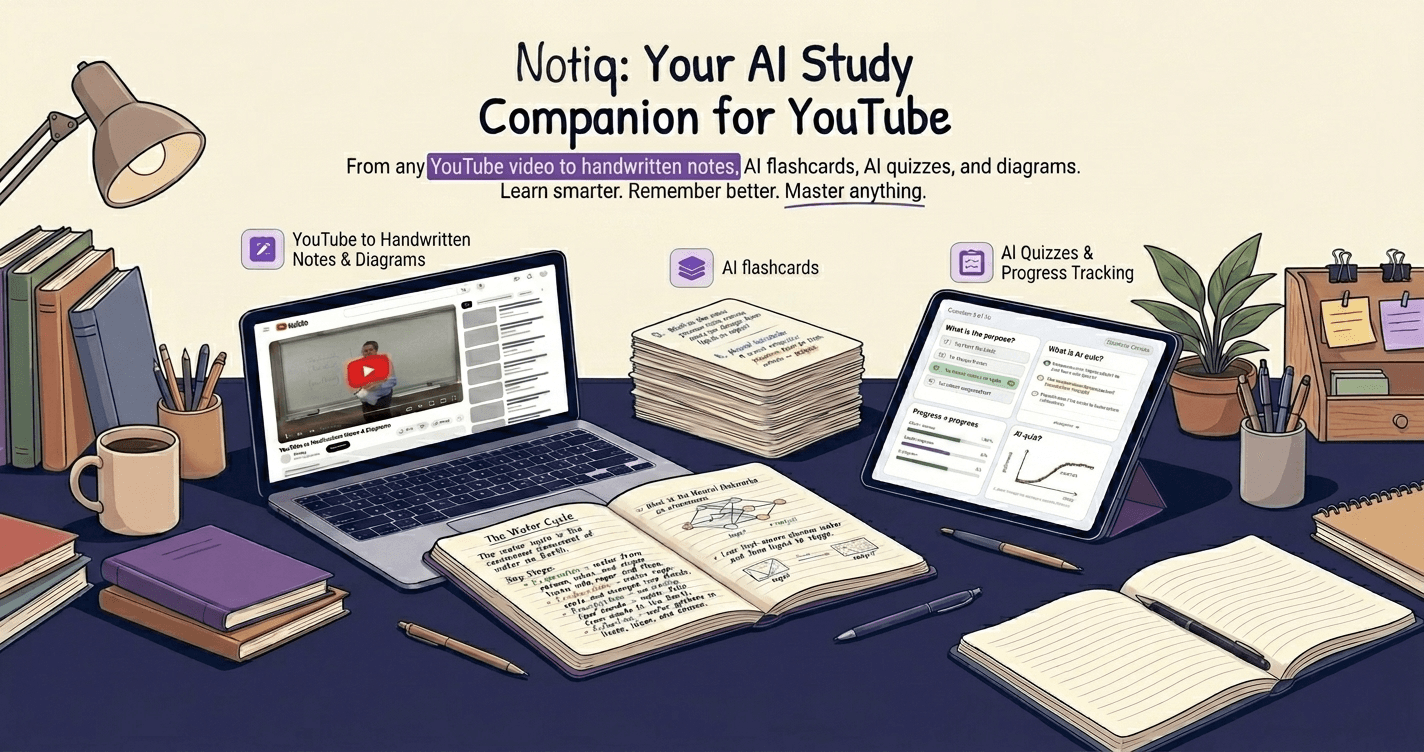
Once you've read this comparison, try a specialized study tool that wraps the best of these models: Notiq turns any YouTube lecture into structured study notes — free to try.
The Short Answer (If You Just Want the Verdict)
- ChatGPT: Best all-rounder. Strongest at structured output, flashcard generation, and working with uploaded files. The default choice if you're picking one.
- Claude: Best for nuanced explanation, long documents, and analytical writing. Superior at understanding context and giving thoughtful, calibrated answers. Excellent for humanities and writing-heavy subjects.
- Gemini: Best integration with Google ecosystem — Docs, Drive, YouTube. If your study materials live in Google's world, this is a genuine advantage. Long context window is useful for dense textbooks.
None of them is objectively best for all tasks. The right choice depends on what you're studying and how you study — and all three companies ship new model versions often enough that specific version numbers here would be stale within months, so this comparison focuses on the consistent behavioral differences between the three products rather than any single release.
What Were the Actual Tasks?
To make this concrete, here are the five study tasks used to evaluate each model:
- Lecture summarization: Pasting a 10,000-word transcript from a Stanford CS lecture and asking for structured notes
- Concept explanation: Asking each model to explain a difficult concept (gradient descent, the social construction of reality, constitutional law interpretation) at three levels: high school, undergraduate, graduate
- Flashcard generation: Generating 20 Anki-style flashcards from a set of notes
- Practice exam: Generating a 10-question practice exam from a syllabus outline with answer keys
- Writing assistance: Helping revise a study essay or explaining why a specific argument is weak
These tasks cover the real range of what students use AI for. Let's go through each.
Task 1: Lecture Summarization — How Does Each Model Perform?
ChatGPT
ChatGPT produces reliable, consistently structured summaries. When asked for Cornell-style notes, it delivers correctly formatted Cornell-style notes. When asked for a concept map outline, it delivers that. The output is predictable in the best sense.
It handles long transcripts well via file upload and doesn't tend to lose track of earlier material in very long documents. The summaries are accurate but can be generic — it doesn't always identify the intellectually interesting parts of a lecture, just the structurally prominent ones.
Rating for lecture summarization: 8/10
Claude
Claude's summaries read more like notes taken by a thoughtful student than a mechanical extraction. It tends to identify the argumentative structure of a lecture, not just the information content. For humanities, law, philosophy, and social science lectures — where the argument matters more than the facts — this is a significant advantage.
Claude is also more likely to add a comment like "this argument appears to contradict what was said in [earlier section]" or to flag where the lecturer's claim is contested in the literature. This is useful for graduate students but may be confusing for undergraduates who just want the clean summary.
For very long documents, Claude's large context window handles material that other models have to chunk into pieces.
Rating for lecture summarization: 9/10 (for analytical subjects); 7/10 (for pure information extraction)
Gemini
Gemini's core advantage here is direct YouTube integration via Google. You can, in theory, feed it a YouTube URL and get notes without the transcript extraction step. In practice, this works inconsistently — it's better on popular videos with clean auto-generated captions.
The summaries themselves are solid but tend toward comprehensiveness over selectivity. Gemini also has a genuine long-context advantage, which matters for full-length textbook chapters or multi-hour lecture sets.
Rating for lecture summarization: 7/10 (general), 9/10 (Google-native workflows)
Task 2: Explaining Difficult Concepts — Which AI Teaches Best?
This is where the differences become most pronounced.
ChatGPT
ChatGPT explains well. It uses analogies, structures explanations logically, and adapts to the requested level. The explanations are accurate and accessible.
The weakness: sometimes too eager to provide a complete answer when a Socratic exchange would be more educational. Ask it why an argument is wrong and it'll tell you — which is great for checking your understanding but bad for developing your own analytical capacity.
Claude
Claude is notably better at explaining why something is the way it is, not just what it is. Ask it to explain the chain rule in calculus and it'll derive it from first principles and explain the intuition. Ask it about the same concept at three different levels and the transitions between levels are remarkably well-calibrated.
Claude also pushes back when students make incorrect assumptions in their questions, which is pedagogically valuable. It's more likely to say "that framing contains a misunderstanding — here's what's actually happening" rather than just answering the literal question.
For STEM subjects requiring deep conceptual clarity and for philosophy/law/social theory requiring nuanced argument, Claude has a real edge.
Gemini
Gemini's explanations are accurate and usually clear. The integration with Google's knowledge base sometimes surfaces relevant references. However, compared to Claude for nuanced conceptual explanation and ChatGPT for structured breakdown, it's typically the third choice for pure explanation tasks.
Winner for concept explanation: Claude (especially at graduate level and for analytical subjects)
Task 3: Flashcard Generation — Which AI Produces the Best Cards?
Flashcard quality matters more than most students realize. Bad flashcards (ambiguous, too broad, based on trivial facts) waste review time. Good flashcards are specific, testable, and force meaningful recall.
ChatGPT
ChatGPT is the strongest at structured, format-correct flashcard generation. It reliably produces front/back pairs, follows Anki conventions, and distributes questions across conceptual levels. You can specify a format (cloze deletion, basic Q&A, image occlusion-style) and it follows it.
It also exports well to CSV/TSV for direct Anki import, which is a practical workflow advantage.
Winner for flashcard generation: ChatGPT
Claude
Claude generates good flashcards but is more likely to produce higher-order questions (compare/contrast, explain the significance of, why does X happen rather than just what is X). This is better cognitively but can be harder to evaluate — you need to judge whether your answer is correct, not just match a fact.
For subjects where understanding trumps recall (philosophy, economics, history), Claude's cards are arguably better. For subjects with clear-cut factual answers (anatomy, organic chemistry, legal definitions), ChatGPT's are more practical.
Gemini
Gemini produces solid flashcards but doesn't have a strong differentiating advantage here. The Google Docs integration means you can more easily manage and edit card sets if your workflow already lives in Docs.
Task 4: Practice Exam Generation — Does AI Help with Exam Prep?
This is underused and genuinely valuable. All three models can generate practice exams from a syllabus or set of notes. The quality varies significantly.
ChatGPT
Strong at generating diverse question types (multiple choice, short answer, essay prompts) with accurate answer keys. Good at calibrating difficulty if you specify the exam level. Reliable for STEM subjects with objective answers.
Claude
Claude's practice exams include better distractors for multiple choice questions (the wrong answers are plausibly wrong, not obviously wrong) and better essay prompts for analytical subjects. It's also better at explaining why a given answer is correct, which is important for learning from practice exams rather than just testing yourself.
Gemini
Competent for practice exam generation. The main advantage is integration — if your course materials are in Google Classroom or Drive, Gemini can pull from them directly.
Winner for exam prep: Claude (for analytical subjects); ChatGPT (for fact-heavy STEM subjects)
Which AI Model Is Best for Specific Subjects?
| Subject Area | Best Model | Reason |
|---|---|---|
| Mathematics / Statistics | ChatGPT | Strong at structured problem-solving and step-by-step derivation |
| Computer Science / Programming | ChatGPT or Claude | Both excellent; Claude better for architecture/design discussion |
| Physics / Chemistry | ChatGPT | Reliable formula extraction, unit analysis, worked examples |
| Biology / Medicine | ChatGPT | Strong factual recall; check for accuracy on cutting-edge topics |
| History / Political Science | Claude | Better at argument analysis, source evaluation, nuance |
| Philosophy / Law | Claude | Superior handling of contested concepts and normative arguments |
| Economics | Claude | Strong causal reasoning, good at explaining mechanism vs. correlation |
| Literature / Writing | Claude | Best at stylistic feedback, argumentation, thematic analysis |
| Language Learning | ChatGPT | Wide language coverage, good at grammar and usage examples |
| Business / MBA | ChatGPT | Strong frameworks, case analysis, structured output |
Free Tier vs Paid: What Do You Actually Get?
All three have free tiers. Here's the honest picture for students:
ChatGPT Free The free tier runs on a lighter, faster model than the flagship paid version, which is meaningfully weaker for complex tasks. For basic summarization and Q&A it's fine. For sophisticated note-taking tasks, the quality drops noticeably. The free tier also has usage limits, and OpenAI has changed exactly which model powers the free tier more than once, so check current availability before relying on it for a big study push.
Claude Free The free tier gives you access to Claude Sonnet with message limits. For students using it sporadically, this is often enough. The quality gap between free and paid Claude is smaller than for ChatGPT because the free tier includes a capable model.
Gemini Free Google's free tier is generous in terms of context window. For students in Google's ecosystem (Docs, Drive, Gmail, YouTube), the free tier provides real workflow value.
Verdict: For students on a tight budget, Claude's free tier and Gemini's Google integration provide the most functional free experience. ChatGPT's paid tier (historically around $20/month, though pricing and plan names shift over time — check OpenAI's current pricing page) is worth it if you're a heavy user.
For a broader look at free tools available to students, see our roundup of 10 free AI tools every student should use in 2026.
What About Specialized Study Tools vs Raw LLMs?
One thing this comparison doesn't address: should you be using raw ChatGPT/Claude/Gemini at all, or should you be using a study-specific tool that wraps these models?
The case for raw LLMs: maximum flexibility, no subscription overhead, works for any task you can prompt.
The case for specialized tools: they handle the prompting for you, often produce better output for specific study tasks because they've been fine-tuned or carefully prompted, and typically have better UX for study-specific workflows (flashcard decks, note organization, YouTube integration).
For YouTube-to-notes specifically, tools like Notiq use these underlying models but add the transcript extraction, note formatting, and visual presentation layer that raw LLMs don't provide. The result is faster and usually better-formatted than starting from scratch in a chat interface.
For broader context on how these tools fit into a study system, see our complete guide to AI study notes.
Privacy and Academic Integrity: What You Should Know
Privacy: All three companies use your inputs to improve their models by default (though they offer opt-out options). If you're working with sensitive academic materials — proprietary research, exam questions from your institution — check the privacy settings before pasting.
Academic integrity: The same considerations apply to all three models. Using AI to generate notes or explain concepts is generally acceptable. Using AI to write assessments or complete graded work is not — and the policies vary by institution. See our article on using AI for studying without cheating yourself for the nuanced breakdown.
Do You Need to Pick Just One?
No — and this is important. Most effective AI-assisted study workflows use different tools for different tasks:
- Claude for analytical reading, essay planning, and nuanced explanation
- ChatGPT for flashcard generation, structured notes, and STEM problem-solving
- Gemini for YouTube-adjacent workflows and Google Docs integration
- A specialized tool like Notiq for YouTube-to-notes workflows
The switching cost is low. All are browser-accessible, all have free tiers. The overhead of knowing which tool to reach for is small relative to the quality improvement.
The Bottom Line
ChatGPT vs Claude for studying isn't a clean winner — they're genuinely good at different things. ChatGPT is more reliable for structured output and STEM subjects. Claude is better for analytical subjects, nuanced explanation, and long documents. Gemini's advantage is ecosystem integration and context length.
If you're choosing one: start with Claude if you're in humanities, law, social science, or any writing-heavy field. Start with ChatGPT if you're in STEM or need reliable structured output. Add Gemini if you're already in the Google ecosystem.
And for YouTube-specific study workflows that sit on top of these models and handle the ugly parts for you, Notiq is worth trying first.
If Claude is the one you're leaning toward, see our complete guide to using Claude for studying for how to set up Projects, prompt it for long lecture transcripts and PDF chapters, and use Artifacts for flashcards and study guides.
For more on building a full AI-assisted study system, see our complete guide to AI study notes. For a curated list of free tools, see 10 free AI tools every student should use in 2026.