Free AI tools for students have never been better — or more confusing to navigate. There are hundreds of tools claiming to be "the AI study app," most of them mediocre, many of them not actually free.
This list cuts through the noise. Every tool here has a genuinely useful free tier (not a 3-day trial). Each one solves a specific study problem. And the list is opinionated — we tell you what each tool is actually good for and when to skip it.
Start with this overview from Ali Abdaal's channel on building an effective study system, which provides the right context for how tools fit into a workflow:
Ali Abdaal — How to Study for Exams (An Evidence-Based Masterclass)
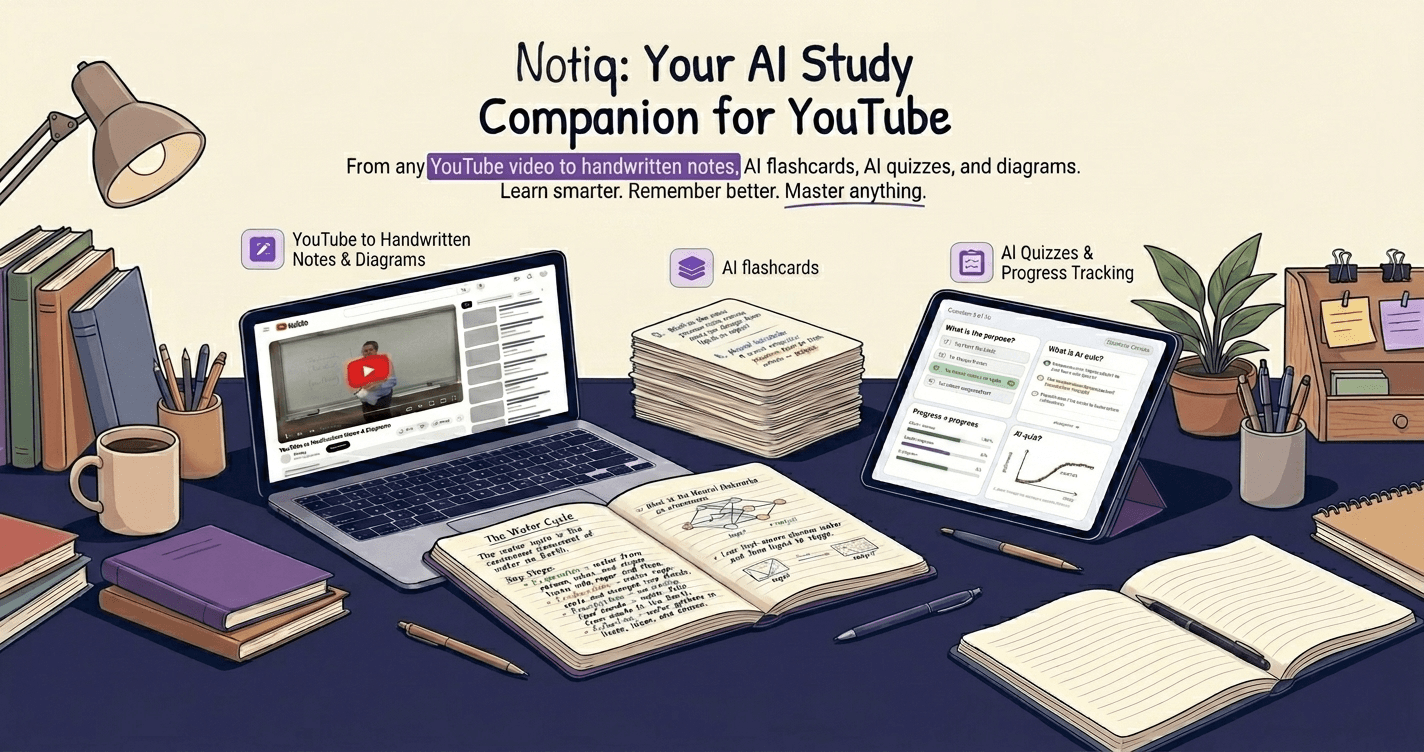
One of the tools in this list: Notiq converts YouTube lectures to structured study notes for free — no credit card required.
How This List Is Organized
Tools are grouped by function, not by hype. A tool that does one thing very well beats a tool that does five things poorly. Here's the function map:
- YouTube and video notes — turning lectures into structured content
- AI writing assistance — explaining, summarizing, drafting
- Flashcards and spaced repetition — retention tools
- Research and reading — papers, sources, synthesis
- Focus and productivity — the meta-skill that makes everything else work
1. Notiq — YouTube-to-Handwritten-Style Notes
Free tier: Yes — generate notes from YouTube videos at no cost
Best for: Students who learn from YouTube lectures, MOOCs, and recorded seminars
Notiq is purpose-built for one workflow: take a YouTube video URL, extract the transcript, and produce structured, handwritten-style visual notes. The output is genuinely different from what you get when you paste a transcript into ChatGPT — the visual presentation, the organization, and the focus on what matters in a lecture rather than just what was said.
The free tier is real. You don't need a credit card. The turnaround time is under 60 seconds for most videos.
When to use it: Before every lecture you watch on YouTube. Generate the notes, then annotate them with your own questions and observations. Use the output as the starting point for flashcard generation.
When to skip it: For non-video content (PDFs, textbooks, live lectures), other tools in this list are better suited.
2. Claude (Free Tier) — Analytical Thinking Partner
Free tier: Yes — daily message limit, but substantial for regular use
Best for: Humanities students, essay planning, nuanced concept explanation, long document analysis
Claude's free tier includes access to Claude Sonnet — a highly capable model that's particularly strong at analytical reasoning, nuanced explanation, and working through complex arguments. For students in philosophy, law, history, political science, economics, or any field where you need to think through arguments rather than just recall facts, Claude is exceptional.
Prompts that work particularly well with Claude:
- "Explain this concept to me and then give me three ways the argument could be criticized"
- "I think I understand X. Here's my explanation — where is my understanding incomplete or wrong?"
- "From these notes, what are the 5 most important things I need to understand deeply, and why?"
The free tier message limits reset daily, which is enough for most study sessions.
When to use it: Essay planning, explaining confusing concepts, working through arguments, analyzing long texts.
When to skip it: Generating structured flashcard decks at scale (ChatGPT is more reliable for this).
3. ChatGPT (Free Tier — GPT-4o mini) — Structured Output and STEM
Free tier: Yes — GPT-4o mini is the free model
Best for: Generating structured notes, flashcards, practice exams, STEM problem-solving
ChatGPT's free tier uses GPT-4o mini, which is good for structured tasks — generating flashcards in a specific format, producing Cornell-style notes from pasted text, step-by-step math and science explanations.
The quality gap between GPT-4o mini (free) and GPT-4o (paid) is noticeable for complex analysis. For structured, templated tasks — flashcard generation, practice exam creation, outline building — the free model performs well.
Practical free-tier workflow:
- Paste lecture notes or a transcript section
- Request 15 flashcards in Q/A format
- Export the text, format as CSV, import to Anki
This takes about 5 minutes and produces a usable deck without paying for anything.
When to use it: Generating flashcards, structured summaries, math step-throughs.
When to skip it: Long document analysis, nuanced argument evaluation (Claude is better there).
For a full comparison, see our ChatGPT vs Claude vs Gemini for studying comparison.
4. Anki — Spaced Repetition Flashcards
Free tier: Completely free on desktop and Android; iOS version has a one-time cost
Best for: Any subject requiring long-term retention — medical school, law school, language learning, sciences
Anki is not an AI tool in the generative sense, but it's the best-evidenced study tool that exists. The spaced repetition algorithm it implements has decades of research behind it. Medical students who use Anki consistently outperform non-users on board exams by a significant margin.
The current workflow is: use ChatGPT or Claude to generate flashcard text, format it as CSV, import to Anki. This combines AI generation with Anki's battle-tested scheduling algorithm.
The Anki interface is famously ugly. This matters less than you think. Functionality over aesthetics.
When to use it: For any subject where you need to retain information long-term — which is most subjects.
When to skip it: For one-time exams where long-term retention isn't the goal (though even then, spaced repetition beats cramming for exam performance).
For a deeper look at why spaced repetition works and how to set up your card system, see our science of AI flashcards and spaced repetition.
5. NotebookLM (Google) — Multi-Source Research Synthesis
Free tier: Yes — Google account required
Best for: Working across multiple sources simultaneously; research papers; building an overview of a topic
NotebookLM lets you upload multiple documents (PDFs, Google Docs, YouTube links, URLs) and then have a conversation with all of them simultaneously. Ask "what do these three papers disagree about?" and it synthesizes across sources.
For research-heavy subjects — history, political science, any social science — this is genuinely powerful. You can upload an entire semester's worth of readings and ask synthesis questions that would take hours to answer manually.
The free tier has generous limits. The quality of synthesis is good for factual extraction; less reliable for nuanced interpretive questions.
When to use it: Literature reviews, synthesizing across multiple readings, understanding how sources relate to each other.
When to skip it: Real-time lecture notes; single-document summarization (ChatGPT is faster).
6. Elicit — Academic Research Tool
Free tier: Yes — limited monthly searches
Best for: Finding and evaluating academic papers on a specific research question
Elicit is an AI research tool built specifically for academic papers. Enter a research question and it finds relevant papers, extracts their key findings, and lets you filter by methodology, year, and study type.
For students writing research papers or trying to understand the evidence base for a field, Elicit saves hours of manual literature search and abstract screening.
The free tier is limited (around 5,000 credits per month) but enough for occasional research tasks.
When to use it: Writing papers, understanding what research says about a topic, preparing for seminars on empirical questions.
When to skip it: For non-academic content; for exploratory question-answering (Claude or ChatGPT are better there).
7. Otter.ai — Live Lecture Transcription
Free tier: Yes — 300 minutes of transcription per month
Best for: Transcribing in-person lectures, office hours, and study group discussions for later note generation
Otter records audio and produces real-time transcriptions. The free tier gives 300 minutes monthly, which covers about five 60-minute lectures.
The workflow: run Otter during your in-person lecture → get the transcript → paste into Claude or ChatGPT for structured notes → generate flashcards.
Accuracy is good for clear audio and standard academic English. Technical vocabulary and accented speech reduce accuracy.
When to use it: In-person lectures where you want a capture backup; study groups; office hours.
When to skip it: Online lectures where the video's automatic captions are already available.
Are There Free AI Tools Specifically for Exam Preparation?
Yes — two that are worth knowing:
8. Quizlet (AI features on free tier)
Quizlet has added AI features to its core flashcard product. The free tier includes AI-assisted flashcard creation from pasted text. The UI is more student-friendly than Anki, and sharing decks with classmates is built in.
The spaced repetition algorithm is less sophisticated than Anki's, but for students who find Anki's interface off-putting, Quizlet's free tier is a reasonable alternative.
When to use it: When you want to share decks with classmates; for lower-stakes subjects where Anki's optimization overhead isn't justified.
9. Khan Academy (with Khanmigo AI)
Khan Academy has integrated an AI tutor (Khanmigo) into its free platform. For high school and early college STEM subjects — math, chemistry, physics, economics — Khan Academy's AI tutor provides guided problem-solving that's genuinely pedagogically sound.
It uses Socratic dialogue rather than just giving answers, which means it's actually teaching you rather than just completing your work. This is one of the few AI tools that is as good for learning as it is for efficiency.
When to use it: STEM subjects at high school or early college level; SAT and standardized test prep.
When to skip it: Advanced or graduate-level material; humanities and writing subjects.
What About AI Note-Taking Apps That Claim to Be Free?
A word of caution: many apps marketed as "free AI note-taking tools" are actually freemium products with severe limitations on the free tier — a few notes, no export, limited AI queries. Before investing time in setting up a workflow around any tool, check:
- Is the free tier usable without a credit card?
- Does the free tier include the AI feature specifically, or just basic note-taking?
- Are there export capabilities, so you're not locked into the platform?
- What happens to your notes if the company shuts down?
The tools listed in this article all pass this test. They have genuinely functional free tiers and export capabilities.
10. Hemingway App — Writing Clarity
Free tier: Yes — browser-based, no account required
Best for: Improving the clarity and readability of essays, reports, and written assignments
Hemingway isn't an AI tool in the generative sense — it's a rule-based editing tool that highlights complex sentences, passive voice, adverb overuse, and readability issues. The free web version is instant.
It's on this list because students consistently underestimate how much their writing clarity affects grades. Writing that's hard to read doesn't just frustrate professors — it hides the quality of your thinking. Hemingway surfaces structural problems that spell-check misses.
Use it on your essay drafts before submission. Run the text through, address anything at grade 9+ reading level, and your writing will be cleaner without becoming dumbed-down.
When to use it: Essay editing, report writing, research paper drafts.
When to skip it: Technical writing where specialized vocabulary is unavoidable.
How to Build a Stack, Not a Tool Collection
The mistake most students make is collecting tools without a system. Here's a simple stack that uses this list effectively:
Capture → Notiq (YouTube) or Otter.ai (in-person)
Process → Claude or ChatGPT (structured notes + flashcard generation)
Retain → Anki (spaced repetition)
Research → Elicit + NotebookLM
Write → Claude (drafting and argument analysis) + Hemingway (polish)
This stack costs $0. Every component has a free tier. The total time investment to set up these workflows is about two hours.
The key is using each tool for what it's good at and not trying to make one tool do everything. AI generalists (ChatGPT, Claude) are flexible but require more prompting work. Specialists (Notiq for YouTube, Elicit for research, Anki for flashcards) require less work for their specific task but less flexibility.
What Should Students Avoid?
A few categories of tools that often disappoint despite heavy marketing:
Generic "AI study app" aggregators: Tools that wrap GPT-4 with a nice UI but don't add real value over using the underlying model directly. Pay for the specialized tool only if it saves significant time or produces meaningfully better output.
AI essay writers: Tools designed to write essays for you rather than help you learn. Beyond academic integrity issues, they don't help you understand the material — which means exam performance suffers.
Subscription-only AI tutors with no free tier: Several "AI tutor" apps have no meaningful free tier. Khan Academy's free AI tutor is better than most of the paid alternatives.
Should Students Pay for Any AI Tools?
Eventually, probably. The free tiers of Claude, ChatGPT, and the specialized tools in this list are genuinely capable for moderate use. Heavy users — daily AI-assisted study sessions, large flashcard decks, research-intensive work — will hit the limits.
If you're going to pay for one thing: Anki Pro is free (the core app costs nothing). For an AI subscription, Claude Pro or ChatGPT Plus adds real value for heavy users; the choice depends on which model works better for your subject area (see our detailed comparison).
For a more comprehensive look at how these tools fit into a complete study system, see our complete guide to AI study notes and our guide to building a self-learner's toolkit for 2026.
The simplest place to start: Notiq. Take any YouTube lecture you're currently studying, drop the URL in, and get structured notes back in under a minute. Free, no account required. It's the fastest way to see what AI-assisted studying actually looks like in practice.