Using AI for studying is one of the best decisions you can make as a student in 2026 — as long as you understand the exact trap that swallows most people who try it.
The trap is passive consumption. You paste in a lecture transcript, the AI produces beautiful structured notes, and you read them once and close the tab. You feel like you studied. You did not. You watched someone else study on your behalf, and that someone is a machine that does not take exams.
The good news is that the fix is not to use AI less. It is to understand which parts of the learning process must remain yours, and design your AI workflow around that constraint. This article gives you that framework.
Why Using AI for Studying Feels Like Learning But Often Is Not
Cognitive scientists distinguish between two mental states that students regularly confuse: fluency and recall. Fluency is the feeling that material makes sense when you encounter it. Recall is the ability to retrieve and apply that material without prompts.
Re-reading your notes produces fluency. Testing yourself produces recall. The problem is that fluency feels like learning — the material seems familiar, things click, you finish a study session feeling productive — while the test on Friday measures recall.
AI-generated notes are particularly effective at producing fluency feelings. They are clear, well-organized, and often better structured than the original lecture. Reading them is pleasant. It is also largely useless for retention unless it is followed by active retrieval practice.
This is not a reason to avoid AI. It is a reason to be deliberate about where AI sits in your workflow relative to the retrieval practice that actually encodes information.
Andrew Huberman's research-backed overview of how the brain consolidates learning through effort and repetition.
The Active Learning Principles That Govern Good AI Use
Before getting into specific workflows, it helps to internalize the cognitive science that should shape them. These three principles explain why some AI habits help and others hurt.
The generation effect. Information you generate yourself is retained better than information you read passively. When you explain a concept in your own words — even badly — you create richer neural encoding than when you read a perfect explanation. This means AI should give you the scaffold, and you should fill it in.
The testing effect. Being tested on information — even before you know it well — dramatically improves long-term retention compared to re-reading the same content. Active retrieval under uncertainty is more valuable than comfortable review. Your AI workflow needs regular friction points where you are forced to recall.
The desirable difficulties principle. Coined by psychologist Robert Bjork, this refers to the counterintuitive finding that introducing certain difficulties into learning — spacing, interleaving, reducing feedback frequency — improves long-term retention even when they reduce short-term performance. AI tools that make studying feel effortless may be systematically removing the desirable difficulties that drive deep learning.
With these three principles in mind, the question becomes: how do you use AI to handle the cognitive overhead that does not improve learning (mechanical note formatting, searching for explanations) while preserving the cognitive work that does (generating, testing, struggling)?
What AI Should and Should Not Do in Your Study Workflow
A useful framework is to draw a line between cognitive overhead and cognitive work.
Cognitive overhead is mental effort that does not improve your mastery of the subject. Formatting lecture notes into a readable structure. Searching for a definition you could find in 30 seconds. Transcribing a video. Scheduling your review sessions. AI should handle all of this.
Cognitive work is mental effort that encodes information and builds understanding. Working through a problem you cannot solve. Explaining a concept to yourself before checking if you got it right. Making connections between ideas without being prompted. Reconstructing the key arguments of a lecture from memory. AI should not do this for you.
Most students who feel like they are "cheating themselves" with AI are assigning cognitive work to the AI — usually because it feels faster and less uncomfortable. It is faster. But the discomfort is where the learning happens.
Here is a practical breakdown:
| Task | AI should do it | You should do it |
|---|---|---|
| Structure lecture transcript | Yes | |
| Define terms | Yes | |
| Generate practice questions | Yes | |
| Answer practice questions | Yes | |
| Explain a concept you don't follow | Yes (as a scaffold) | |
| Reproduce that explanation from memory | Yes | |
| Create flashcard content | Yes | |
| Self-test with flashcards | Yes | |
| Produce a summary after you've studied | Yes | |
| Produce a summary to start studying from | Use with caution |
How to Structure a Study Session That Uses AI Well
The highest-leverage change most students can make is shifting when in the study session they interact with AI. The default pattern — let AI summarize first, then read — produces fluency with minimal retention. The better pattern looks like this:
Step 1: Engage with the raw material first. Watch the lecture, do the reading, or scan the original slides without AI assistance. Do not take exhaustive notes. Focus on understanding the overall structure: what is the main argument, what are the two or three big ideas, what confused you?
Step 2: Brain-dump before consulting notes. After the lecture or reading ends, spend 5-10 minutes writing everything you can remember without looking at anything. This retrieval attempt, even when incomplete, activates the testing effect and flags exactly where your memory has gaps.
Step 3: Now use AI. Load the transcript or your rough notes into an AI tool and ask for a structured summary. Compare it against your brain-dump. The gaps — what the AI captured that you did not — are your study priorities.
Step 4: Generate questions, then test yourself. Ask the AI to generate 10 exam-style questions on the material. Close the notes and try to answer them. Check your answers. Review anything you missed.
Step 5: Spaced review using flashcards. Use AI-generated flashcards for spaced repetition over the following days. The AI built the deck; your job is to actually drill it.
This workflow uses AI for steps 3 and 5 — the cognitive overhead — while preserving the retrieval practice in steps 2 and 4 that actually encodes the material.
For a deeper look at how AI fits into a complete notes workflow, see our AI Study Notes complete guide.
What Happens When You Rely Too Much on AI Summaries?
This is worth being honest about because the failure mode is subtle. Students who replace retrieval practice with AI reading develop a specific problem: their recognition memory is strong but their recall memory is weak.
Recognition memory is what activates when you see a multiple-choice option and think "yes, I've seen that." Recall memory is what you need to write an essay, solve a problem, or explain a concept out loud. Exams, job interviews, and actual work all demand recall.
If you have been reading AI summaries instead of testing yourself, you will likely perform much worse on open-ended assessments than on multiple-choice, and you may struggle to use the knowledge in any practical context even though it "feels" familiar.
The fix is not to abandon AI. It is to add the retrieval step that AI workflows tend to skip. See our article on flashcards and spaced repetition science for the research behind this.
Does the Type of AI Tool Matter?
Yes, though perhaps not in the way you expect. The most important variable is not which AI model you use — it is how the tool structures your interaction with it.
Tools that give you AI-generated content and then prompt you to test yourself on it are better than tools that just give you the content. Tools with built-in flashcard generation that you are expected to use are better than tools with flashcard generation buried in a menu. Tools that keep your raw notes alongside the AI summary are better than tools that replace the raw material with the clean version.
The tool architecture shapes your behavior. When choosing or setting up an AI study tool, ask: does this tool make it easy to do retrieval practice, or does it make it easy to read passively?
For a comparison of the major AI study tools, see our ChatGPT vs Claude vs Gemini comparison. For free options, see 10 free AI tools every student should use.
Is It Cheating to Use AI for Studying?
This question comes up often and is worth addressing directly. Academic dishonesty is about misrepresenting your work — submitting AI-generated essays as your own writing, having AI complete assessments on your behalf, or using AI during closed-book exams when it is prohibited.
Using AI to help you learn — to structure notes, explain concepts, generate practice questions — is not cheating any more than using a textbook is cheating. The purpose of academic work is to develop genuine understanding. AI used as a learning scaffold supports that purpose.
The concern this article addresses is not academic dishonesty. It is the softer, self-directed failure mode where students use AI in ways that feel productive but undermine their own learning. You are not cheating the institution. You are shortchanging yourself.
See also our piece on why most students take notes wrong for how passive note-taking habits create the same problem even without AI.
How to Use AI for Specific Study Scenarios
For lecture videos: Use an AI tool to generate timestamped notes, then watch the video at 1.5x speed with the notes in a side panel. After each major section, pause and test yourself before moving to the next.
For reading assignments: Read the chapter or paper first, annotating as you go. Then ask AI to produce a structured summary and compare it against what you marked as important. The discrepancies are what to review.
For exam preparation: Describe the exam format and syllabus to an AI tool. Ask it to generate a bank of 50 practice questions weighted toward the topics you find hardest. Use those questions as your primary study driver in the final week.
For understanding confusing concepts: When something does not make sense, ask AI to explain it three different ways: technical, intuitive analogy, and real-world example. Then try to reproduce one of those explanations from memory. That reproduction attempt is what moves the concept into long-term storage.
For research papers: Ask AI to extract the main claim, the key evidence, and the key limitations of a paper. Then read the abstract and conclusion yourself. This gives you the frame before the detail, which dramatically improves comprehension.
The Bigger Picture: AI as a Studying Partner, Not a Studying Replacement
The students who get the most from AI tools are the ones who use AI to do more hard cognitive work, not less. AI handles the logistics — transcription, formatting, scheduling, question generation — freeing up time and mental energy for the retrieval practice and deep engagement that actually builds knowledge.
The students who struggle are the ones who let AI do the cognitive work on their behalf: reading the summary instead of the source, having AI answer the practice questions, treating clean notes as evidence of learning.
The tool is not the problem. The workflow is.
With a workflow built on the active learning principles above — brain-dump before consulting AI, test before reviewing, generate before reading — AI becomes a genuine study multiplier. Without that workflow, it becomes an elaborate way to feel productive while learning very little.
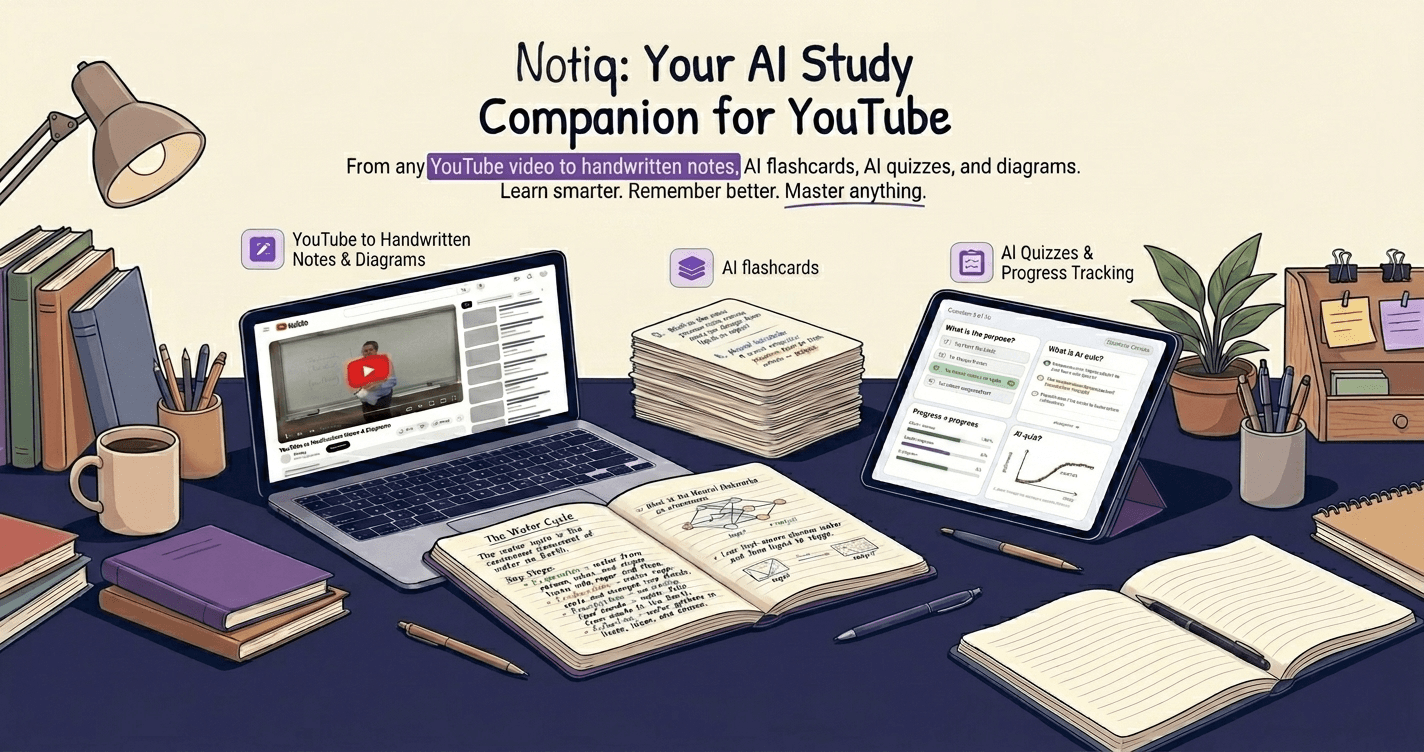
Try Notiq — the AI study tool built around active learning. Notiq generates structured notes from YouTube lectures and automatically creates spaced repetition flashcards, so the mechanics are handled and your time goes to the retrieval practice that actually matters.