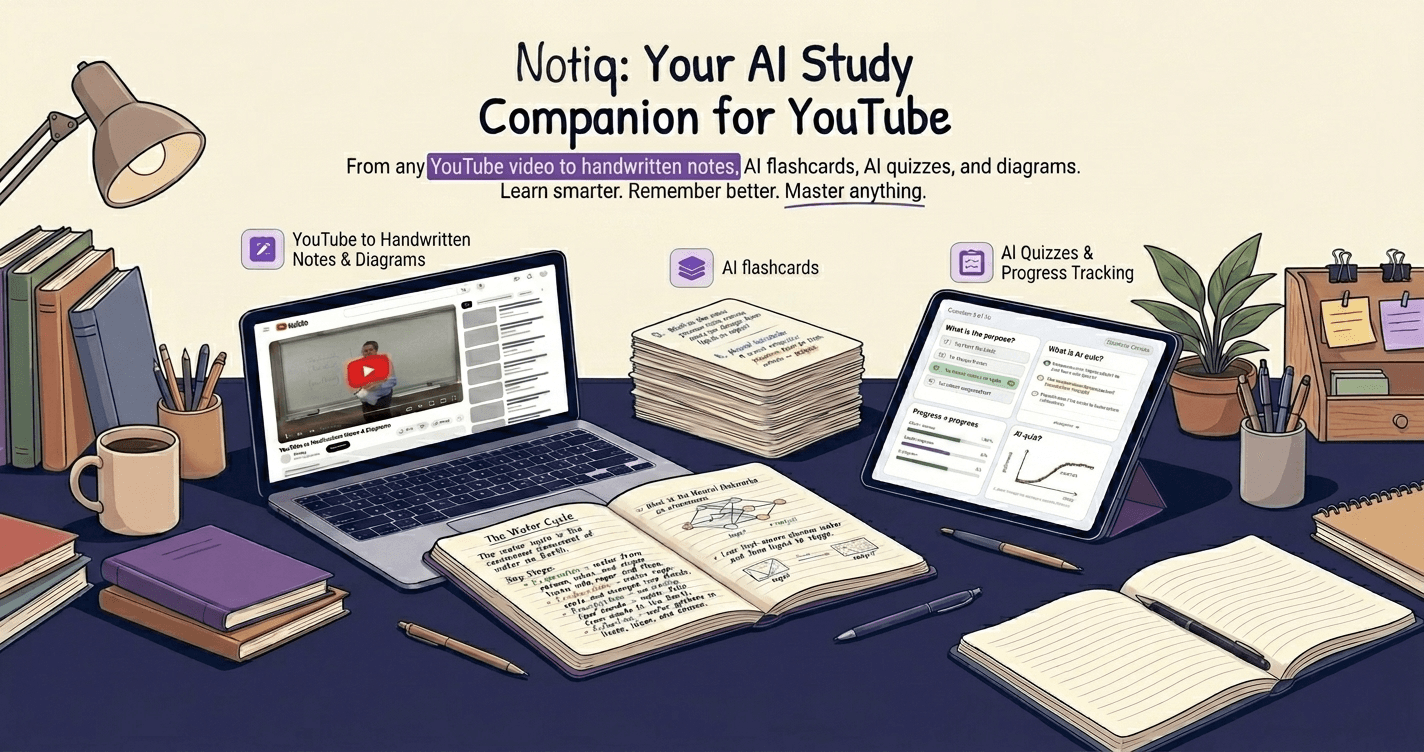
AI flashcards and spaced repetition are two of the most evidence-backed tools in the study science toolkit — and combining them produces results that look almost implausible until you understand the mechanisms.
Medical students using spaced repetition have demonstrated retention rates above 90% on board exam material six months after studying. Language learners using spaced-repetition systems report reaching conversational fluency in a third of the traditional classroom time. These aren't cherry-picked anecdotes — they're reproducible outcomes from a well-understood cognitive process.
This article explains exactly why it works, what AI adds to the equation, how to set up a system that produces these results, and the most common ways students implement it incorrectly.
Watch this before going further — 3Blue1Brown on the mathematics of learning, and how distributed practice beats massed practice:
3Blue1Brown — But What Is a Neural Network?
Want to generate your own AI flashcard deck from a YouTube lecture in minutes? Try Notiq free — paste any YouTube URL and get structured notes plus flashcard-ready content.
The Forgetting Curve: Why Passive Review Doesn't Work
Hermann Ebbinghaus's forgetting curve is one of the oldest empirical findings in psychology (1885) and one of the least-heeded by students. The core finding: within 24 hours of learning something, you've forgotten approximately 50% of it. Within a week, approximately 70%. Within a month, approximately 80%.
This isn't a failure of intelligence or effort. It's the default behavior of a memory system that allocates consolidation resources based on signals of importance — and passively reading notes sends weak signals.
The forgetting curve has a different shape depending on how you review:
- No review: exponential decay
- Single review (re-reading notes): decay still follows the same curve, just from a slightly higher starting point
- Active recall at spaced intervals: the curve flattens dramatically with each successful retrieval — each time you successfully recall something, the memory trace strengthens and the decay rate slows
This is the core principle behind spaced repetition. You're not fighting the forgetting curve — you're exploiting it. You review material at the optimal moment before forgetting and trigger the memory consolidation process again.
What Is Spaced Repetition, Exactly?
Spaced repetition is a review scheduling system that surfaces material for review at increasing intervals based on how well you know it.
The algorithm (in its simplest form):
- Study a new card → if you get it right, schedule review for 1 day later
- 1 day later: get it right again → schedule for 3 days later
- 3 days later: get it right again → schedule for 1 week later
- And so on, with increasing intervals up to months
If you get a card wrong, the interval resets. The system ensures you spend the most review time on material you're weakest on, and the least time on material you've already mastered.
The math behind this is more sophisticated in modern implementations. The SuperMemo SM-2 algorithm (published by Piotr Woźniak in 1987 and still the basis of most spaced repetition software) uses an "easiness factor" that adjusts interval growth based on performance history. Tools like Anki implement SM-2 or variants of it.
The empirical result is consistent: spaced repetition produces retention rates 1.5x to 3x higher than massed practice (cramming) at equivalent total study time, with dramatically better long-term retention.
What Is Active Recall and Why Does It Work?
Active recall is the practice of retrieving information from memory rather than recognizing or re-reading it.
The testing effect (also called retrieval practice) is one of the most robust findings in cognitive psychology. A landmark 2008 paper by Roediger and Karpicke at Washington University compared three study strategies:
- Study material repeatedly (SSSS)
- Study then test once (STST)
- Study then test repeatedly (STTT)
On a test one week later, the STTT group outperformed SSSS by a staggering margin — roughly 50% better retention — despite spending the same total time on the material.
The mechanism is not fully understood, but the leading theory involves retrieval-induced potentiation: the act of successfully retrieving a memory strengthens the neural connections associated with it more effectively than any passive encoding strategy.
The implication for flashcards: the review side of the card is almost irrelevant. What matters is the attempt to retrieve before flipping. Students who flip immediately (to "check" rather than to recall) are not doing active recall — they're doing passive re-reading with extra steps.
How Does AI Improve the Flashcard Pipeline?
Traditional flashcard creation has a significant bottleneck: making good cards is time-consuming and requires judgment. Most students either skip the process or make poor-quality cards.
AI disrupts the bottleneck at multiple points:
1. Automated Card Generation from Notes
Feed an AI your lecture notes, a chapter summary, or a research paper and request 20 Anki-style flashcards. A good AI will produce cards that:
- Test single, specific concepts (not multiple things at once)
- Phrase questions in ways that require genuine recall, not just recognition
- Include cloze deletion variations for important terms
- Distribute difficulty across basic recall and conceptual application
This takes 30 seconds instead of 30 minutes. More importantly, you don't have to decide what to turn into a card — the AI handles that initial triage.
2. Better Card Quality Than Most Students Produce
The biggest problem with student-generated flashcards is poor question design. Common failures:
- Questions with multiple correct answers ("What are the properties of X?" — which properties?)
- Questions that are too vague ("What is X?" for a complex concept)
- Questions that test recognition rather than recall ("Is X true or false?" — 50/50 guessing)
- Questions about trivial details rather than core concepts
AI, when prompted well, avoids these failure modes. The prompt matters: "Generate 15 flashcards using the minimum information principle — each card tests exactly one fact or concept" produces significantly better cards than "make flashcards from these notes."
3. Concept Clustering and Prerequisite Mapping
Advanced AI prompting can identify which concepts are prerequisites for which others, producing a card set that builds from foundational to advanced rather than random order. This matters for complex subjects where you can't recall X without first knowing Y.
4. Contextual Clues and Elaborative Interrogation
AI can generate cards that include a hint or context on the back, or that ask "why" rather than "what." The elaborative interrogation technique — asking "why is this true?" rather than "what is this?" — produces superior retention for conceptual material because it requires you to connect the fact to causal or structural explanations.
Example:
- Weak card: Front: "What is the central dogma of molecular biology?" Back: "DNA → RNA → protein"
- Strong card: Front: "Why can't information flow backwards from protein to DNA? What does this imply about evolution?" Back: "Proteins lack the enzymatic machinery for reverse transcription; this means beneficial protein changes can't be heritably encoded without corresponding DNA changes first — selection must act at the DNA level."
The strong card requires understanding, not just recall.
How to Set Up Your AI Flashcard System
Here is a concrete workflow that combines AI generation with a proper spaced repetition schedule.
Step 1: Generate Notes First
Don't try to generate flashcards directly from a raw transcript. Generate structured notes first — with headings, definitions, examples, and key arguments clearly identified. AI flashcard generation is better when it has organized input.
If you're studying from YouTube lectures, tools like Notiq handle the transcript-to-structured-notes step automatically.
Step 2: Prompt for Cards Strategically
Use a specific prompt. Here's one that works well:
"From these notes, generate 20 Anki-style flashcards. Follow these rules: (1) each card tests exactly one concept; (2) prefer 'why/how/what is the difference between' questions over 'what is' questions; (3) include cloze deletion versions for key terms; (4) add a brief explanation on the back that goes beyond just the answer. Format: Q: [question] A: [answer + brief explanation]."
Adjust the number based on the material length. A 60-minute lecture should generate 25-40 cards.
Step 3: Review and Edit (Don't Skip This)
AI generates imperfect cards. You need to:
- Remove duplicate cards
- Fix any factually incorrect backs
- Merge or split cards that are too broad or too narrow
- Add personal examples or mnemonics on the back
This editing step takes 5-10 minutes but significantly improves the deck quality. More importantly, the editing process itself forces you to read and evaluate the material — you're doing a review pass you wouldn't have otherwise done.
Step 4: Import into a Spaced Repetition System
- Anki (free, powerful, cross-platform) — the gold standard. Export from AI as CSV, import to Anki. Large community, shared decks available.
- RemNote (free tier available) — integrated note-taking and spaced repetition, better for students who want everything in one place
- Notiq built-in review — for students who want to stay in one app
- Mochi — cleaner UI than Anki, good for students who find Anki's interface off-putting
The choice of software matters less than consistent use. Pick one and stick with it.
Step 5: Daily Review — The Non-Negotiable Part
Spaced repetition only works if you do the daily reviews. The algorithm surfaces cards when they're due; if you skip days, cards pile up and the optimal review window closes.
Minimum effective dose: 15 minutes of review daily. This is enough to maintain a deck of 500-700 active cards. For exam periods, increase to 30-45 minutes by adding new cards from current study material.
The research on distributed practice shows that 15 minutes daily produces significantly better retention than 2 hours the day before an exam. This is counterintuitive but consistently demonstrated.
What Kind of Material Works Best for Flashcards?
Not all knowledge is well-suited to flashcard format. Here's a guide:
Works well:
- Definitions and terminology (especially in technical fields)
- Foreign language vocabulary
- Dates, names, formulas, equations
- Conceptual distinctions (difference between X and Y)
- Causal relationships (X causes Y because Z)
- Classification schemes (types of X)
- Diagnostic criteria (symptoms of condition X)
Works less well:
- Complex procedural knowledge (how to solve this type of problem — better practiced with worked examples)
- Essay arguments (flashcards can't capture the structure of a 5-page argument)
- Nuanced interpretive positions (literature, philosophy)
- Skills that require doing (programming, math problem-solving, writing)
For skills-based knowledge, interleaved practice (doing problems in mixed order rather than blocked by topic) is more effective than flashcards. This is a separate technique worth understanding.
The Evidence: How Much Does Spaced Repetition Actually Improve Retention?
The quantitative evidence is strong.
A 2016 meta-analysis by Cepeda et al. covering 254 studies on distributed practice found an average effect size of d = 0.46 — meaning spaced practice produced better outcomes than massed practice by about half a standard deviation. In practical terms: a student at the 50th percentile with massed practice would perform at roughly the 68th percentile with spaced practice, all else equal.
For medical students using Anki, a 2020 study published in Medical Education found that consistent spaced repetition users scored significantly higher on Step 1 board exams than non-users, controlling for baseline metrics. The r correlations between Anki use consistency and performance were in the 0.3-0.5 range.
The caveat: these results require consistent use. Students who used spaced repetition sporadically showed no significant improvement over controls. The system must be used daily to produce its benefits.
Common Mistakes That Kill the System
Mistake 1: Making too many cards at once
Adding 200 cards from one lecture is a recipe for burnout. Cap new cards at 20-30 per day and let the review queue build gradually. A sustainable pace is better than an ambitious one that collapses in week two.
Mistake 2: Treating hard cards as failures
When you rate a card "hard" and the interval resets, that's the system working correctly. Hard cards are where your learning is happening. Suspending or deleting hard cards — which many students do — removes the most valuable material from rotation.
Mistake 3: Passive flipping
Flipping a card before attempting recall is not active recall. Train yourself to pause, generate an answer mentally, and only then flip. Even an incorrect mental attempt before flipping produces better encoding than immediate flipping.
Mistake 4: Reviewing without context
Flashcards work best as a retrieval practice supplement, not a sole study method. Cards should reinforce understanding developed through reading, lectures, and problem-solving — not replace that understanding.
Mistake 5: Poor card design
"What is the Krebs cycle?" is a bad card. "What is the net output per turn of the Krebs cycle, and why is this significant for aerobic respiration?" is a good card. AI prompting helps, but you need to edit the generated cards to ensure quality.
Connecting This to Your Broader Study System
Spaced repetition and AI flashcards are one component of a complete learning system. They handle retention — ensuring that what you understood at time of study is still accessible weeks later.
The other components:
- Initial understanding (AI notes, reading, lectures) — handled upstream
- Active processing (annotation, summarization, problem-solving) — the bridge between notes and flashcards
- Synthesis (connecting across topics, essay planning) — handled downstream
For building a complete system, see our complete guide to AI study notes, which walks through a five-step workflow connecting all of these.
If you're interested in comparing the spaced repetition tools (Anki vs RemNote vs newer alternatives), see our guide to Anki, RemNote, and AI alternatives for spaced repetition.
For the pre-flashcard step — how to take better notes so your AI-generated cards are higher quality — see why most students take notes wrong.
Is This Worth the Setup Time?
The question every student asks: is building a spaced repetition system worth the overhead?
For a one-time course you're taking for non-major credit: probably not. The setup time is non-trivial.
For your major's core subjects, medical or law school, language learning, or any field where you need deep, lasting knowledge: emphatically yes. The research shows cumulative benefits that compound over time. A deck started in your first year of medical school is still useful in your residency.
The AI-assisted version (automatic card generation from notes) dramatically reduces the setup overhead. The question shifts from "is it worth building?" to "is it worth reviewing for 15 minutes a day?" — and the answer to that is almost always yes.
Try Notiq's YouTube-to-notes pipeline to generate the structured notes that feed your flashcard system. Upload any lecture, get organized notes, export flashcard-ready content — the manual work that used to take an hour takes five minutes.