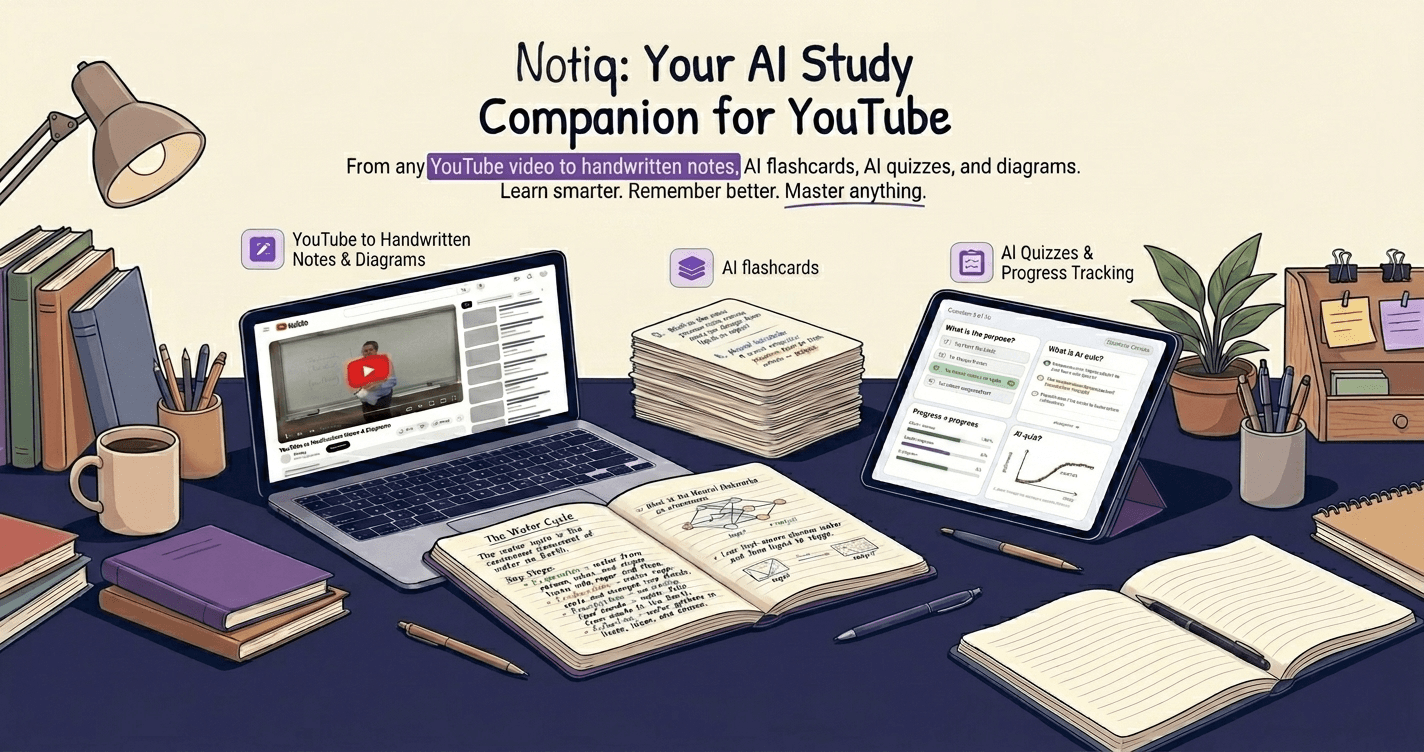
Note-taking is not one problem. It is several problems that happen to involve a pen or a keyboard. Taking notes during a live lecture is different from taking notes while reading a textbook, which is different from building a long-term knowledge base from research, which is different from preparing for an exam.
Most discussions of note-taking methods conflate these use cases. The result is advice like "use the Cornell method" — which is excellent for lectures and nearly useless for building a personal knowledge base — applied generically to all note-taking situations.
This guide compares the four dominant note-taking methods — Cornell, Zettelkasten, outline, and mapping — on the dimensions that matter: when they work, when they do not, the overhead they require, and how they interact with modern AI tools.
Watch this overview before diving in — it covers the visual intuition behind each method:
For a deeper look at specific methods, see our dedicated posts on the Cornell method with AI and building a Zettelkasten from YouTube videos. For the evidence on why standard note-taking fails, see why most students take notes wrong.
The Four Methods at a Glance
Before the detailed comparison, a quick orientation:
| Method | Best for | Core mechanism | Overhead |
|---|---|---|---|
| Cornell | Lectures, structured content | Cue-Note-Summary split | Low |
| Zettelkasten | Research, long-term knowledge | Atomic notes with links | High |
| Outline | Reading, structured material | Hierarchical indentation | Low |
| Mind mapping | Brainstorming, relationships | Visual branching | Medium |
None of these is universally best. Most effective note-takers use two or three methods for different contexts.
Cornell Method: The Best System for Lectures
Walter Pauk developed the Cornell method at Cornell University in the 1950s. The page is divided into three sections:
- Notes column (right, ~70% of page): taken during the lecture or reading
- Cue column (left, ~30% of page): filled after — questions, keywords, prompts that the notes answer
- Summary section (bottom): a brief summary in your own words, written after
The method's power is in the cue column and summary, which are added after the content is captured. They force two acts of active processing: identifying what is worth remembering (cue column) and consolidating the whole in your own words (summary).
The cue column also transforms the notes into a self-testing tool. Cover the notes column, look at each cue, and try to recall the answer. This is spaced repetition built into the note format itself.
Where Cornell works best:
- Live lectures where content arrives linearly and you cannot control the pace
- Structured textbook chapters with clear sections
- Any content where you need to self-test systematically
Where Cornell falls short:
- Non-linear content (research papers, discussions, exploration)
- Building connections across notes taken weeks apart
- Long-term knowledge bases — Cornell notes are complete in themselves but do not connect to each other
With AI tools: The Cornell structure maps naturally to AI processing. Given a lecture transcript, an AI can populate the notes column directly, and you fill in the cue column and summary — the parts that require your understanding. This cuts the mechanical transcription work while preserving the active recall structure. See our guide on the Cornell method with AI for a practical workflow.
Zettelkasten: The Best System for Long-Term Knowledge
Zettelkasten (German: "slip box") was developed by sociologist Niklas Luhmann, who used it to write over 70 books and 400 academic papers. His physical system had over 90,000 index cards.
The method has three principles:
-
Atomicity: each note contains exactly one idea. Not one topic — one idea, one claim, one concept. A note titled "Machine learning" is not atomic. "Gradient descent converges to the global minimum for convex cost functions" is atomic.
-
Connectivity: every note links to at least one other note. Notes that have no connections are orphans — they decay. The value of the system comes from the network of links, not from the individual notes.
-
Your own words: notes are written in your own words, not as quotes or transcriptions. Paraphrasing forces comprehension. If you cannot write the idea in your own words, you do not yet understand it well enough to file it.
The Zettelkasten does not organize notes by topic or folder. It organizes by connection. An idea about gradient descent might link to a note about optimization in economics, a note about the shape of the cost surface, and a note about why convex functions are special in mathematics.
Where Zettelkasten works best:
- Research and writing — the network of linked notes surfaces unexpected connections that lead to original ideas
- Learning from many sources over time — the system accumulates knowledge across books, lectures, papers, and conversations
- Long-term projects where synthesis matters more than coverage
Where Zettelkasten falls short:
- Live note-taking — the atomic note creation is too slow for real-time capture
- Exam preparation for specific content — the system optimizes for synthesis, not for drilling a finite body of material
- Beginners — the method requires judgment about what constitutes an atomic idea, and that judgment takes time to develop
With AI tools: AI can help with the conversion step — turning a transcript or a set of highlight quotes into atomic-note candidates. The actual linking and curation is yours to do; the AI cannot know what connects to what in your existing note network. See building a Zettelkasten from YouTube videos for a practical workflow.
Outline Method: The Default for a Reason
The outline method is the default, and it earns that status. You capture content hierarchically: main points at the top level, sub-points indented beneath, details indented further. Most people learn some version of this in school and use it for the rest of their lives.
The outline's strength is its universality: it works for almost any structured content, the cognitive overhead is low, and it produces readable, organized notes quickly.
The structure:
I. Main Topic
   A. Subtopic
      1. Detail
      2. Detail
   B. Subtopic
      1. Detail
II. Main Topic
Most note-taking apps (Notion, Obsidian, Apple Notes) are outline editors at their core.
Where outlining works best:
- Reading structured material — textbooks, organized articles, well-structured reports
- Any content with a clear hierarchy that you want to preserve
- Fast note-taking where you want minimal overhead
Where outlining falls short:
- Content with non-hierarchical relationships — ideas that link across branches of the hierarchy
- Building connections across documents — outlines do not naturally link to each other
- Creative or exploratory thinking — the hierarchy forces structure too early
Common mistakes with outlining:
The biggest is over-transcription: copying what the lecturer or author says rather than paraphrasing. An outline of copied text has the same cognitive value as a highlighted textbook — it feels productive but does not produce learning. Force yourself to write in your own words at every level.
The second is confusing structure with understanding. A well-formatted outline of content you do not understand is an organized copy, not a note. The test: can you explain the outline without looking at it?
Mind Mapping: Best for Relationships and Brainstorming
Mind mapping, popularized by Tony Buzan in the 1970s, starts with a central idea and branches outward. Main branches represent major subtopics; sub-branches represent details. The structure is visual and radial rather than linear.
The cognitive rationale: some knowledge is genuinely non-hierarchical. The relationships between concepts in a complex domain form a network, not a tree. Forcing that network into a linear outline loses the relationships. A mind map preserves them visually.
Where mind mapping works best:
- Brainstorming and planning — the spatial freedom encourages exploration
- Understanding relationships between concepts, especially before writing
- Visual learners and spatial thinkers who find linear notes limiting
- Summarizing a body of knowledge to see the whole before the parts
For a full treatment of mind mapping for study, see our post on mind maps for visual learners.
Where mind mapping falls short:
- Dense technical content with sequential logic (derivations, code)
- Live note-taking — building a spatial structure in real time is cognitively demanding
- Content where order matters — the radial structure obscures sequence
Digital versus physical mind maps: Digital tools (XMind, MindMeister, Miro) allow infinite canvas and easy rearrangement. Physical mind maps on paper are faster to draw but harder to revise. For study purposes, digital is usually better because you can add detail without running out of space.
The Handwritten vs. Typed Question
Every comparison of note-taking methods raises the handwritten-versus-typed debate. The short version: the research supports handwriting for comprehension and typing for coverage.
The famous Mueller and Oppenheimer (2014) study found that students who took notes by hand retained conceptual material better than typists, even though typists captured more content. The explanation: handwriters are forced to paraphrase (you cannot write fast enough to transcribe), which produces deeper encoding. Typists transcribe verbatim and process less.
The practical implication: the method matters less than whether you are processing content as you take notes. A typed outline with genuine paraphrasing beats handwritten notes that are copied verbatim. For a full treatment, see handwritten vs. typed notes — what the research says.
How Do These Methods Interact with AI?
AI note-taking tools change the equation for every method on this list.
For Cornell and outline methods: AI can handle the initial transcription and structuring, which eliminates the most mechanical part of note-taking. Your job becomes reviewing and improving the AI-generated draft — which is a higher-cognitive-value activity than transcription.
For Zettelkasten: AI can propose atomic note candidates from a source, but the linking, synthesis, and judgment about what is genuinely atomic are yours. AI accelerates the input processing without replacing the intellectual work.
For mind mapping: AI can generate a mind map from a document or transcript, which is useful as a starting point. But the most valuable mind maps emerge from your own thinking, not from automated generation.
The common thread: AI handles the low-value mechanical work (transcription, initial structuring), leaving the high-value cognitive work (synthesis, connection, judgment) for you. The risk is using AI to avoid the cognitive work entirely — reading AI-generated notes instead of generating retrieval of your own. See AI study notes: the complete guide for a full treatment of this trade-off.
Which Method Should You Use?
The practical decision tree:
For live lectures: Cornell. The structured format supports real-time capture and post-lecture processing. The built-in cue column and summary are more valuable than they look.
For reading textbooks or structured articles: Outline. Fast to produce, easy to navigate, good for preserving hierarchical structure.
For research across multiple sources over time: Zettelkasten. Higher setup cost but pays off in synthesis and unexpected connections.
For planning, brainstorming, or visualizing relationships: Mind mapping. Do not use it for everything, but when you need to see a domain's structure, it is the right tool.
For exam preparation: Cornell or outline, with spaced retrieval practice added on top. The method is less important than the practice testing.
Most serious self-learners end up using all four: Cornell or outline for initial capture, Zettelkasten for long-term knowledge building, mind mapping for synthesis and planning. The choice is not permanent — you can switch methods for different contexts.
The One Thing That Matters More Than Method
Note-taking method affects the quality of your notes. But the biggest lever on learning is not which method you use — it is whether you review and retrieve the material after taking the notes.
The research on this is unambiguous: a single retrieval attempt (trying to recall material without looking at notes) does more for long-term retention than multiple passive re-readings. Notes that you review actively are orders of magnitude more valuable than notes you file and never open.
The best note-taking method is the one you will actually review. A simple outline you revisit weekly beats a sophisticated Zettelkasten you never use.
Ready to stop losing what you learn from lectures and videos? Notiq converts YouTube transcripts into structured notes in the format you choose — Cornell-style, outlines, or atomic notes for your Zettelkasten — and generates flashcards automatically. Start building a knowledge base that actually compounds at notiq.study.