Learning how to take notes effectively is one of the highest-return skills a student can develop — and it's almost never taught directly. You get handed a notebook and a pen and it's assumed you'll figure it out. Most students don't. They develop habits that feel productive but produce poor retention, and those habits follow them through secondary school, university, and into professional life.
This article is about what goes wrong and how to fix it. The fixes aren't complex. But they require understanding what notes are actually for — which turns out to be different from what most students assume.
What Are Notes Actually For?
Most students treat notes as a recording device. The goal, implicitly, is to capture as much of the lecture or text as possible so you can review it later. A good set of notes, in this model, is comprehensive and legible.
This is a plausible model but it's wrong, or at least incomplete, in a way that matters.
Notes are a cognitive tool. Their primary value isn't the document that results — it's the processing that happens while you create it. The decisions you make during note-taking ("is this worth writing down?", "how does this connect to what was said before?", "what's the underlying principle here?") are acts of encoding that move information toward long-term memory.
A note-taking method that maximizes capture — transcription — bypasses this processing entirely. You produce a comprehensive document and you understand almost nothing. This is why students who type everything their professor says often perform worse on exams than students who write less but think more while writing it.
The research on this is unambiguous. The Mueller and Oppenheimer (2014) study at Princeton and UCLA directly tested transcription versus selective note-taking by comparing typists (who tended to transcribe) against hand-writers (who couldn't keep up and had to rephrase). Handwriters consistently outperformed typists on conceptual questions — not because handwriting is magic, but because the constraint forced encoding that transcription avoided.
The Seven Specific Mistakes Most Students Make
Mistake 1: Transcribing Instead of Processing
This is the root mistake. When you write or type verbatim sentences from a lecture or textbook, you're outsourcing the thinking to the source rather than doing the thinking yourself. The resulting notes look good. They don't produce learning.
The fix: summarize in your own words, in real time. You will write less. You will understand more. The compression required to rephrase forces you to extract the core idea, which is the cognitive work that produces encoding.
Mistake 2: Never Reviewing Notes Within 24 Hours
Forgetting is fast. Within 24 hours of a lecture, you've lost a significant fraction of what you didn't review. Within a week, the curve has flattened — the loss is already severe, and reviewing once at this point produces far less benefit than reviewing immediately after encoding.
The Ebbinghaus forgetting curve has been replicated many times. The practical implication is simple: notes reviewed once the evening after a lecture encode much better than notes reviewed twice the night before an exam. The spacing is the mechanism.
Mistake 3: Re-reading as the Primary Study Method
Re-reading feels like studying. You're engaged with the material. The concepts pass through your mind. But if you're not retrieving information — pulling it out of your own memory under effort — you're not producing the kind of consolidation that turns short-term exposure into long-term knowledge.
Jeffrey Karpicke's research at Purdue is the key reference here. In one study, students who spent all their study time on retrieval practice (answering questions about the material) retained 50% more a week later than students who spent the same time re-reading. The effect holds across subjects and age groups.
Re-reading is appropriate for initial learning. As a review strategy, it's one of the least efficient uses of study time.
Mistake 4: Passive Highlighting
Highlighting is a near-perfect illusion of studying. You're reading carefully enough to identify what seems important. The colors make the page look processed. But no retrieval has happened. You've just colored some text.
Multiple studies have compared highlighting to other study methods. It consistently produces weak results, roughly equivalent to re-reading without highlighting. The exception is when highlighting is followed by self-testing on the highlighted material — but at that point, the testing is doing the work, not the highlighting.
Mistake 5: Cramming Rather Than Spacing
Massing study time the night before an exam — the cram — is familiar to every student. It can produce short-term performance on a next-day test. It produces poor long-term retention.
Bjork's desirable difficulties framework explains why: distributed practice (studying the same material across multiple sessions with gaps between them) forces the kind of effortful retrieval that cramming avoids. The difficulty of remembering something you haven't thought about for three days is the mechanism by which that memory becomes durable.
Students who cram for a Monday exam and ace it are often surprised to find, two weeks later, that they remember very little of what they "learned." They were optimizing for short-term performance, not long-term retention. For anyone who needs the knowledge to stick — for a professional qualification, a cumulative exam, or a field they're actually trying to work in — cramming is the wrong optimization.
Mistake 6: Disorganized Notes That Can't Be Used for Retrieval
A set of notes that captures information but can't be easily used to test yourself on that information is only half-useful. The format of notes should facilitate retrieval, not just storage.
This is why the Cornell method's cue column is valuable. It takes the note document and turns it into a practice test. If your notes don't have any questions in them — any prompts for retrieval — you're more likely to default to re-reading rather than self-testing when you sit down to study.
Mistake 7: Taking Notes Without Knowing What the Lecture Is About
Arriving at a lecture cold — without having done the pre-reading or reviewed what was covered last time — means your notes will be worse in a predictable way. You won't recognize what's new versus what's a review. You won't know which terms are important versus incidental. You won't have the hooks in your existing knowledge to attach new information to.
Five minutes of preparation before a lecture (scanning the pre-reading, reviewing last session's notes) dramatically improves what you're able to encode during the lecture itself.
What Does Good Note-Taking Actually Look Like?
Effective note-taking is characterized by four things:
Compression: You're writing your own summary, not the source's words. Every sentence in your notes represents an understanding decision you made, not a transcription decision.
Structure: The notes are organized in a way that reflects the logical structure of the content — what depends on what, what's central versus peripheral, what's a definition versus an application.
Gaps: Effective notes have deliberate gaps — questions you didn't understand in real time, concepts you couldn't summarize, claims you want to verify. These gaps are prompts for later work, not evidence of bad notes.
Retrieval-readiness: The format should make it easy to cover the answers and test yourself on the questions. Cornell's cue column does this explicitly. Any format that includes questions alongside answers serves the same function.
How Does This Change Depending on the Type of Content?
The specific application varies:
For linear lecture content (a professor talking through a topic for 90 minutes): Cornell remains effective. Capture in the note column, generate cues afterward, summarize at the end. The cue column converts the notes from a recording into a practice test.
For technical content (mathematics, programming, engineering): The emphasis shifts to worked examples. Understanding a concept in mathematics means being able to reproduce the steps under examination conditions. Your notes should include worked examples with the reasoning annotated at each step, not just the final answers.
For reading-based courses (literature, philosophy, law): The annotation happens in the source rather than in separate notes. Mark the key claims, the turns in the argument, the places where you disagree. Separate notes should capture your analysis and synthesis — not summaries of the text, but your thinking about it.
For YouTube and video content: The challenge is that you can't annotate in real time the way you can with text. The solution is a two-pass approach: capture rough notes during viewing (timestamps and keywords), then process them afterward into structured notes with explicit questions and connections. The AI study notes complete guide covers this workflow in detail.
How Should You Review Notes for Maximum Retention?
The review schedule matters as much as the initial note quality. A rough but evidence-based schedule:
- Review within 2–4 hours of taking notes (same evening is fine)
- Review again 2–3 days later
- Review again 1 week later
- Review again 1 month later
Each review should be primarily retrieval-based: cover the notes, attempt to recall the key points, then check. This is more effort than re-reading and produces dramatically better retention.
At the one-month review, anything you still struggle to recall consistently should move to a spaced repetition system — flashcards scheduled for review based on your performance history. This is how you convert short-term course knowledge into long-term knowledge that persists beyond the exam.
For more on the science of retrieval practice and spaced repetition, flashcards and spaced repetition science covers the research in detail. For the practical mechanics of building a retrieval system, active recall techniques is a good follow-on.
Does the Format of Notes Matter More Than the Practice?
Students spend significant energy arguing about whether Cornell is better than outline notes, whether Zettelkasten outperforms mind maps, whether digital tools produce better retention than paper. These debates are real but they're second-order.
The first-order question is whether you're doing retrieval practice at all. A bad format used with consistent retrieval practice outperforms a perfect format used for passive re-reading. Format optimization only starts to matter once the core habit — testing yourself on the content — is in place.
The single change that would improve most students' retention is not a better note-taking format. It's adding 20 minutes of retrieval practice to their existing workflow, using whatever notes they currently have. Cover the notes. Attempt to recall. Check. Repeat.
Once that habit is established, format improvements compound on top of it. The note-taking methods compared article covers the landscape of methods — Cornell, Zettelkasten, outline, mind map — with their respective trade-offs. The handwritten vs typed notes research article covers the evidence on medium, which is a different question from method.
Why Don't Schools Teach This?
The short version: note-taking is treated as a means to an end (producing a study document) rather than as a learning activity in its own right. Teachers focus on the content of notes — is it accurate, is it complete — rather than on the cognitive process of taking them.
The irony is that most of the evidence on effective note-taking has been available for decades. Spaced repetition principles were understood in the 19th century. The testing effect was documented systematically in the early 20th century. The comprehensive failure to translate this knowledge into classroom practice says something about educational institutions and something about the underestimation of how much method matters relative to content.
The good news is that this is individually correctable. You don't need your school to change how it teaches. You need to understand the evidence and change how you study — specifically, to shift from passive capture to active retrieval. The shift in outcomes, done consistently, is significant enough that it shows up clearly in controlled studies and clearly in the experience of students who make the change.
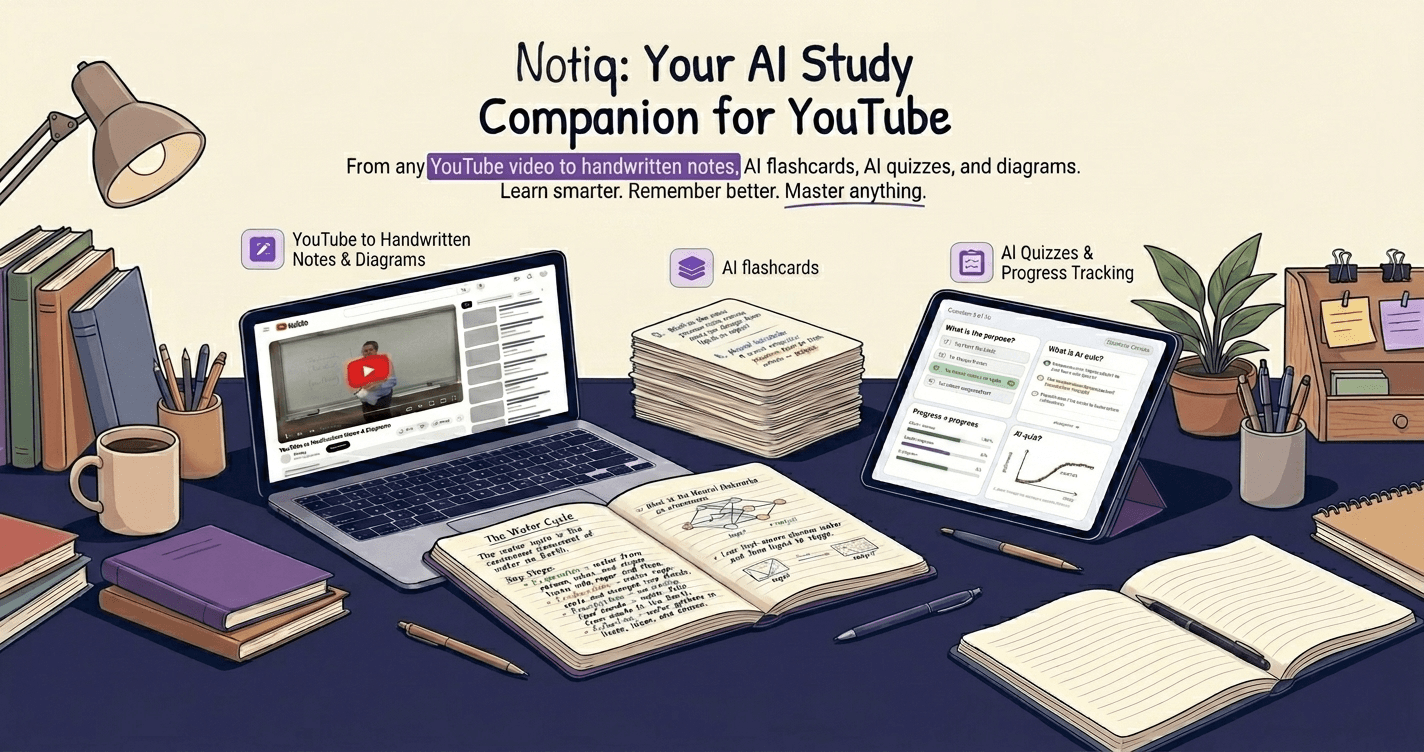
Notiq is built around the retrieval-first principle: AI generates structured notes from your video content, and then converts them into flashcards and practice questions automatically. The result is a note-taking workflow that produces long-term retention rather than a folder of documents. Try it free at notiq.study.