Study for AP Biology from any lecture
Paste an AP Biology lecture or unit review from YouTube and get the whole video as a notebook: every process step by step, the experiments and data examples, and the vocabulary the free-response rubrics look for, timestamped back to the video. Then make a free practice quiz from any unit.
- All 8 units
- Processes + experiments
- MCQ and FRQ prep
Works with unit reviews and lectures from Khan Academy, Bozeman Science, CrashCourse and your teacher's channel.
AP Biology at a glance
- Section I
- 60 multiple-choice questions, 90 minutes, 50% of the score
- Section II
- 6 free-response questions (2 long, 4 short), 90 minutes, 50%
- Course
- 8 units, from chemistry of life to ecology
- Scores
- 1 to 5; exams are in May
How AP Biology students study, and where the notebook fits
AP Biology rewards understanding processes and reading experiments, not just vocabulary: the free-response section asks you to interpret data, predict what happens when a step is blocked and justify it with the right term. Most students supplement class with YouTube unit reviews in the weeks before the May exam.
Notiq turns a unit review into a notebook that keeps the cause and effect: each process step by step (what happens, where, and what it needs), the experiments the teacher walks through, and key terms in the context the rubrics expect. Timestamps take you back to the diagram or animation when the text is not enough.
After reading, test yourself. The free quiz below generates questions on mechanisms and consequences, close to the reasoning AP questions demand.
A real AP Biology notebook, made from one lecture
We pasted this lecture into Notiq. Below is the start of the notebook it produced, unedited; the full notebook is free to read in the library.
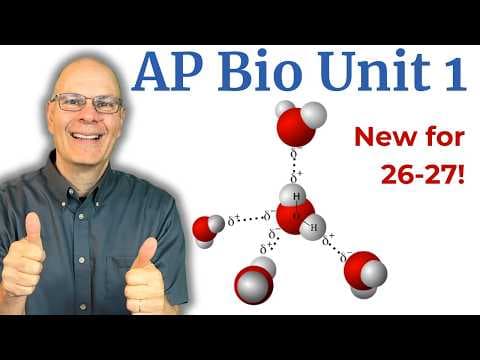
The Ultimate AP Biology Unit 1 Review (Score a 5 on the Exam!)
sciencemusicvideos (Glenn Wolkenfeld)30 minEnglish
Covers: Unit 1: Chemistry of Life
Watch on YouTubeThis lecture provides an in-depth review of key concepts in AP Biology Unit 1, focusing on the properties of water, biomolecules, and the structure and function of proteins and nucleic acids. Students will learn how these foundational topics interconnect and their significance in biological systems, preparing them for success on the AP exam.
1. Water and Hydrogen Bonding
Unit 1 covers water, hydrogen bonding, elements of life, and four biomolecule families: carbohydrates, lipids, proteins, and nucleic acids. Water is a polar molecule due to unequal electron sharing between oxygen and hydrogen, resulting in a partial negative charge on oxygen and partial positive charges on hydrogen.
- Water is a polar molecule with unequal electron sharing.
- Hydrogen bonds are weak intermolecular bonds.
- Hydrogen bonds are key to DNA, RNA, and protein structure.
- 1.Water and Hydrogen Bonding0:00
- 2.Properties of Water and pH2:13
- 3.Elements of Life and Biomolecules4:36
- 4.Carbon, Synthesis, and Hydrolysis6:33
- 5.Polar Functional Groups and Macromolecules9:02
- 6.Lactose Tolerance and Lipids11:53
- 7.Functions and Structure of Lipids14:46
- 8.Overview of Proteins and Amino Acids16:48
+ 5 more sections
AP Biology subjects and topics
Any lecture on these works. Paste one per chapter or topic, and the notebook follows the teacher's structure.
Units 1 to 4
- Chemistry of life
- Cell structure and function
- Cellular energetics: enzymes, photosynthesis, respiration
- Cell communication and cell cycle
Units 5 to 8
- Heredity
- Gene expression and regulation
- Natural selection
- Ecology
Science practices
- Concept explanation
- Visual representations
- Questions and methods
- Representing and describing data
- Statistical tests (chi-square)
- Argumentation
Free AP Biology practice quiz from your notes
Paste a textbook section or your notes and get multiple-choice questions with explanations. The sample covers enzymes and inhibition from Unit 3.
Paste your notes or text
AP Biology: frequently asked questions
Which videos work best for AP Biology?
Longer unit reviews and full lectures give the richest notebooks. Short 10-minute explainers work too, but the notebook can only contain what the video says, so a 10-minute video gives a short notebook.
Does it help with free-response questions?
The notebook keeps the reasoning (cause and effect, experiment set-ups, data interpretation) that free-response answers are built from. It does not grade your written answers; practise FRQs from past exams released by the College Board and compare with their scoring guidelines.
Can I make flashcards too?
Yes. Paste any section of your notebook or your own notes into the free text-to-flashcards tool and it turns them into question-and-answer cards.
Is it free?
The quiz tool is free to try without signing up. For lecture notebooks, the free plan covers one lecture up to 20 minutes; Lite and Solver cover more and longer lectures.
Other exams
- Study for NEETNEET UG (National Eligibility cum Entrance Test)
- Study for Cambridge O LevelCambridge O Level (Mathematics 4024 and sciences)
- Study for CBSE Class 12CBSE Class 12 Board Exams (AISSCE)
- All examsNEET, JEE Main, CBSE Class 12, UPSC CSE, Cambridge O Level, CFA Level I, KPSS, AP Biology
- Text to quiz generatorMCQs from any notes, free