Study for JEE Main from any lecture
Paste a JEE lecture from YouTube and get it back as a notebook with every derivation, formula and solved problem written out step by step, typeset properly and timestamped to the video. Practise MCQs on any chapter for free.
- Physics · Chemistry · Maths
- Formulas typeset in LaTeX
- Hindi or English lectures
Works with Physics Wallah, Unacademy, Vedantu, Mohit Tyagi and other JEE lectures, in English, Hindi or Hinglish.
JEE Main at a glance
- Questions
- 75: 25 each in Physics, Chemistry and Maths (20 MCQs + 5 numerical)
- Marks
- 300 (+4 correct, −1 wrong)
- Time
- 3 hours, computer-based
- Sessions
- Two sessions a year (January and April); your best score counts
How JEE students study from lectures, and where the notebook fits
JEE preparation is lecture-heavy: a typical aspirant watches a chapter as a series of 60 to 120 minute classes, then works through problem sheets and previous years' questions. The lecture is where the method lives (why a Gauss surface is chosen, which constraint relation to write, how to spot the limiting reagent), and that method is exactly what gets lost when you only copy the board.
Notiq turns the lecture into a notebook that keeps the method: derivations line by line with the reasoning between the lines, each formula with the condition it holds under, and every solved example with its steps. Formulas are typeset, so the notebook is readable on a phone. Use it to revise a chapter in 20 minutes instead of rewatching two hours, and jump to the timestamp when a step needs the teacher's explanation again.
Theory alone does not clear JEE, so treat the notebook as the "why" and keep solving PYQs for the "how fast". The quiz tool below is useful for the conceptual layer: statements, conditions and exceptions that turn into trap options.
A real JEE Main notebook, made from one lecture
We pasted this lecture into Notiq. Below is the start of the notebook it produced, unedited; the full notebook is free to read in the library.
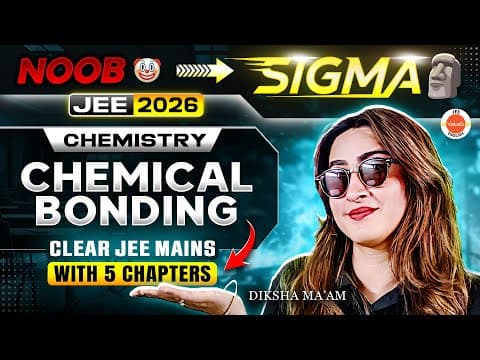
Day 1: Chemical Bonding | Clear JEE Mains 2026 in 5 Chapters | 5 Day Challenge | Diksha Ma'am
Vedantu JEE English1 h 17 minEnglish
Covers: Chemistry: Chemical Bonding and Molecular Structure
Watch on YouTubeThis lecture covers essential concepts of chemical bonding, including types of orbital overlapping, hybridization, and molecular geometry, tailored for JEE Mains preparation. Students will learn how to calculate bond parameters and understand the implications of lone pairs on molecular shapes and dipole moments.
1. Introduction to Chemical Bonding
We are starting a five-day challenge focusing on key chemistry chapters for JEE Mains. Today's topic is chemical bonding, which is very scoring and has the potential for several exam questions.
- The five-day challenge covers five important chemistry chapters for JEE Mains.
- Bond formation occurs at a specific distance where attractive forces balance repulsive forces.
- Energy decreases and stability increases until bond formation; further distance decrease leads to repulsion.
- 1.Introduction to Chemical Bonding0:25
- 2.Types of Orbital Overlapping4:42
- 3.Hybridization and Valence Electrons7:25
- 4.Hybridization of Nitrogen Compounds9:53
- 5.Steric Number and Hybridization12:26
- 6.Geometrical Shapes of Hybridization15:21
- 7.Molecular Geometry and Steric Number17:21
- 8.Valence Electrons and Bond Formation20:04
+ 22 more sections
JEE Main subjects and topics
Any lecture on these works. Paste one per chapter or topic, and the notebook follows the teacher's structure.
Physics
- Kinematics, laws of motion, work-energy
- Rotational motion and gravitation
- Thermodynamics and kinetic theory
- Electrostatics, current, magnetism, EMI
- Optics and waves
- Modern physics
Chemistry
- Mole concept, atomic structure, bonding
- Thermodynamics, equilibrium, electrochemistry, kinetics
- p-block, d- and f-block, coordination compounds
- GOC and reaction mechanisms
- Hydrocarbons and functional groups
- Biomolecules and practical chemistry
Mathematics
- Quadratics, complex numbers, sequences
- Permutations, binomial theorem, probability
- Matrices and determinants
- Coordinate geometry: straight lines, conics
- Limits, differentiation, integration, differential equations
- Vectors and 3D geometry
Free JEE concept MCQs from your notes
Paste theory notes or a textbook section and get conceptual MCQs with explanations. The sample is a compact summary of Gauss's law and electric potential.
Paste your notes or text
JEE Main: frequently asked questions
Are the equations readable, or does it mangle them?
Formulas in the notebook are typeset (LaTeX rendered with KaTeX), the same way they appear in a textbook. On Solver, Notiq also reads the board from the video frames, so equations and diagrams the teacher writes but does not say aloud are captured too.
How long a lecture can I paste?
Free: the first 20 minutes of one lecture. Lite: up to 90 minutes. Solver: up to 5 hours, which covers full chapter one-shots and long live classes.
Can it solve JEE problems from a problem-solving video?
Solver has a worked-solution mode for videos where a teacher solves problems: each problem comes out as numbered steps with the equations, the givens and the final answer, so you can attempt it yourself and check step by step.
Is this useful for JEE Advanced too?
The notebook covers whatever the lecture covers, so an Advanced-level lecture gives you an Advanced-level notebook. The practice MCQs are single-answer conceptual questions; Advanced's multi-correct and matrix-match formats are not generated.
Other exams
- Study for NEETNEET UG (National Eligibility cum Entrance Test)
- Study for CBSE Class 12CBSE Class 12 Board Exams (AISSCE)
- Study for Cambridge O LevelCambridge O Level (Mathematics 4024 and sciences)
- All examsNEET, JEE Main, CBSE Class 12, UPSC CSE, Cambridge O Level, CFA Level I, KPSS, AP Biology
- Text to quiz generatorMCQs from any notes, free