Study for CFA Level I from any lecture
Paste a CFA Level I lecture from YouTube and get the whole learning module as a notebook: definitions, every formula with its variables explained, worked examples step by step, timestamped to the video. Then test yourself with free multiple-choice questions from your notes.
- 10 topic areas
- Formulas + worked examples
- Ethics to derivatives
Works with lectures from free CFA prep channels and the recorded classes you study from.
CFA Level I at a glance
- Questions
- 180 multiple-choice, 3 options each, no penalty for wrong answers
- Time
- Two sessions of 2 hours 15 minutes, computer-based
- Topics
- 10 topic areas; Ethics, FSA and Equity carry the most weight
- Study time
- CFA Institute suggests around 300 hours or more
How CFA candidates study, and where the notebook fits
Most Level I candidates are working professionals fitting 300 hours of study around a job. The common pattern is a lecture per learning module (from a prep provider or a free YouTube channel), then the curriculum readings or summaries, then thousands of practice questions and mock exams. Lectures are often watched on a commute or at 1.5x speed, which is exactly when you cannot take notes.
Notiq turns each lecture into a notebook you can revise from later: every formula with what each variable means, the definitions examiners like to swap (for example, money-weighted versus time-weighted return), and each worked example with calculator steps written out. Timestamps let you jump back to the explanation without rewatching the whole module.
The exam is about application, so the notebook is the reference, not the practice. Use the free quiz on a topic's notes to check recall, then move to question banks and mocks.
A real CFA Level I notebook, made from one lecture
We pasted this lecture into Notiq. Below is the start of the notebook it produced, unedited; the full notebook is free to read in the library.
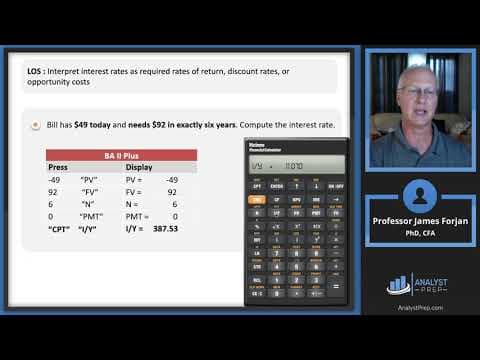
The Time Value of Money (2023 CFA® Level I Exam – Quantitative Methods – Module 1)
AnalystPrep54 minEnglish
Covers: Quantitative Methods: Time Value of Money
Watch on YouTubeThis lecture covers the fundamental concepts of the time value of money, including compounding, future and present value calculations, and the impact of interest rates. Students will learn how to apply these principles using financial calculators, making it essential for CFA Level I exam preparation.
1. Understanding Time Value of Money
The time value of money means that money accumulates value over time through compounding. If you save an amount today and invest it at a positive interest rate, it will grow in the future.
- The time value of money means that money accumulates value over time.
- Compounding refers to earning interest on both the principal and accumulated interest.
- Receiving money today is generally preferred over receiving it in the future due to investment opportunities.
- 1.Understanding Time Value of Money0:04
- 2.Calculating Future Value Efficiently4:08
- 3.Compounding and Financial Calculator Use7:26
- 4.Calculating Present and Future Values12:25
- 5.Calculating Interest Rates and Annuities15:48
- 6.Required Rate of Return and Risks20:47
- 7.Collateral and Interest Rates25:47
- 8.Interest Rates and Risk Premiums30:47
+ 5 more sections
CFA Level I subjects and topics
Any lecture on these works. Paste one per chapter or topic, and the notebook follows the teacher's structure.
Ethics and Quantitative Methods
- Code of Ethics and Standards of Professional Conduct
- GIPS overview
- Time value of money and rates of return
- Statistics, probability and hypothesis testing
- Simple linear regression
Economics and FSA
- Firms, market structures and business cycles
- Monetary and fiscal policy, currency exchange rates
- Income statement, balance sheet, cash flows
- Inventories, long-lived assets, taxes
- Financial reporting quality and analysis
Corporate Issuers, Equity, Fixed Income
- Corporate governance and capital structure
- Market organisation and indexes
- Equity valuation models
- Bond pricing, yields and spreads
- Duration, convexity and credit risk
Derivatives, Alternatives, Portfolio Management
- Forwards, futures, options and swaps
- Pricing and valuation basics
- Private capital, real estate, hedge funds
- Portfolio risk and return, CAPM
- Behavioural biases and risk management
Free CFA-style practice questions from your notes
Paste notes or a summary of a learning module and get multiple-choice questions with explanations. The sample covers time value of money, the foundation of Quantitative Methods.
Paste your notes or text
CFA Level I: frequently asked questions
Does this replace the CFA Institute curriculum?
No. The curriculum defines what is examinable. Notiq turns the lectures you already use into revisable notes, so you spend your hours on practice questions rather than on rewinding videos.
Are the formulas written out properly?
Yes. Formulas are typeset, with each variable explained, and worked examples keep their calculation steps. On Solver, Notiq also reads the slides and whiteboard from the video frames, so formulas shown on screen but not read aloud are captured.
Do the practice questions use the 3-option CFA format?
They are four-option multiple-choice questions with explanations, generated from your notes. They are good for checking recall and understanding of a module; for exam-style vignettes and the 3-option format, use a question bank and official mocks.
Does it work for Levels II and III?
The notebook works for any lecture, so yes for the notes. This page is about Level I because that is where most candidates start.
Other exams
- Study for UPSC CSEUPSC Civil Services Examination (IAS)
- Study for KPSSKPSS (Kamu Personeli Seçme Sınavı)
- Study for Cambridge O LevelCambridge O Level (Mathematics 4024 and sciences)
- All examsNEET, JEE Main, CBSE Class 12, UPSC CSE, Cambridge O Level, CFA Level I, KPSS, AP Biology
- Text to quiz generatorMCQs from any notes, free