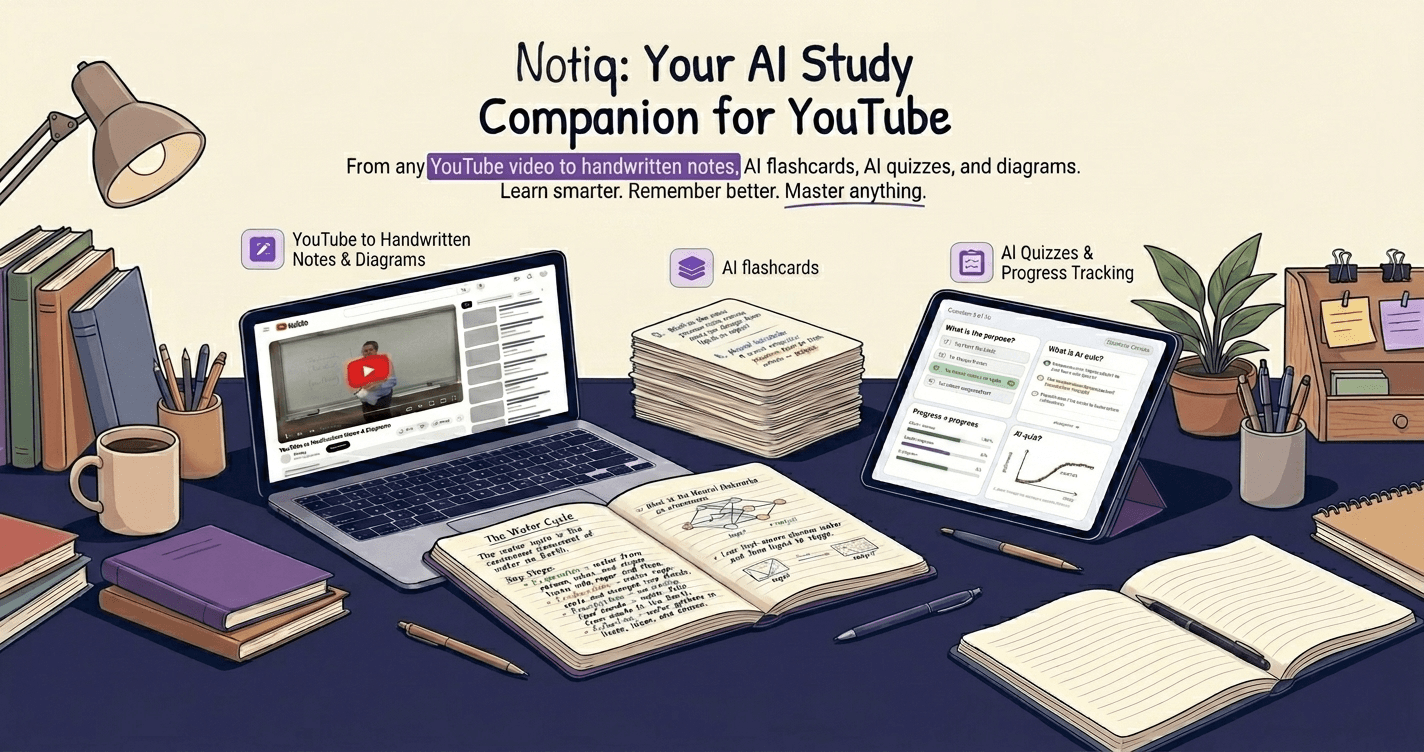
The debate over AI notes vs human notes has a real answer — but it's probably not the one you expect. It's not "AI wins" or "humans win." It's both, in different roles, and the research gives us a pretty clear map of what those roles should be.
This article breaks down the cognitive science, gives you an honest comparison, and tells you exactly when to reach for AI tools versus when to put pen to paper (or fingers to keyboard without AI help).
Watch this first — Veritasium's take on the most common cognitive biases in learning applies directly to why students misjudge their own note-taking effectiveness:
Veritasium — This is Why You're Always Tired
After reading, try converting a YouTube lecture to structured notes with Notiq and compare them against your own — you'll immediately see where the two approaches complement each other.
The Setup: What We're Actually Comparing
Before getting into the data, let's be precise about what "AI notes" and "human notes" mean — because the categories aren't as clean as they sound.
AI notes covers a spectrum:
- Fully automated notes from a transcript (no human involvement beyond a button click)
- AI-structured notes from rough human jottings
- AI-generated first draft that a student then edits and annotates
- AI-generated flashcards or question sets derived from a lecture
Human notes also covers a spectrum:
- Verbatim transcription (the worst kind, cognitively)
- Paraphrased outline notes
- Cornell-style structured notes with cues and summaries
- Concept maps and visual notes
- Margin annotations on source text
The comparison that matters isn't "AI vs. human" as monolithic categories — it's which type of each produces better outcomes for which learning goals.
What the Research Actually Says About Human Note-Taking
The Mueller and Oppenheimer (2014) Princeton study on longhand vs. laptop note-taking is the most cited piece of research in this debate. Students who typed notes verbatim performed significantly worse on conceptual questions one week later than students who wrote longhand. The reason: laptop note-takers transcribed more words but processed less, while longhand note-takers were forced to paraphrase — which requires understanding.
This result is often misread as "handwriting is better." The more precise interpretation is: processing depth predicts retention, not the medium. Longhand happened to force deeper processing because it's slow. Typing that involves paraphrasing and synthesis produces the same benefit.
A 2021 meta-analysis by Luo et al. in Educational Psychology Review examined 36 studies on note-taking and found that the quality of notes — completeness and organization — was a stronger predictor of performance than the method used to take them. In other words: good notes beat bad notes regardless of how they were made.
The implication for AI: if AI produces better-organized, more complete notes than a student's rushed lecture scribbles, the AI notes should outperform the human ones on retrieval — assuming the student actually engages with them.
What Happens Cognitively When You Take Notes vs. Read AI Notes?
This is the crux of the debate, and it's where the nuance lives.
The Generation Effect
The generation effect is one of the most robust findings in cognitive psychology: when you generate information yourself — even partially — you remember it significantly better than when you read the same information passively. This was established by Slamecka and Graf in 1978 and has been replicated dozens of times.
Human note-taking, especially paraphrased notes, activates the generation effect because you're producing your own words and structures. You're not copying the source — you're translating it, which requires comprehension.
AI-generated notes, read passively, do not activate this effect. You're reading a summary that someone else (the AI) generated. This is cognitively similar to reading a well-organized textbook summary — useful for orientation, but weak for encoding.
The fix: annotate AI notes. Ask the AI questions and try to answer them before checking. Generate your own examples for each concept. Any active manipulation of the AI-generated content starts triggering the generation effect.
Cognitive Load Theory
Cognitive load theory (Sweller, 1988; elaborated extensively since) distinguishes between:
- Intrinsic load: the inherent complexity of the material
- Extraneous load: cognitive effort spent on format, organization, legibility
- Germane load: cognitive effort spent on understanding and schema formation
Traditional note-taking carries high extraneous load — you're spending mental energy on spelling, abbreviation, keeping up with the speaker, organizing on the fly. AI note-taking offloads most of that extraneous load.
The question is what you do with the freed-up capacity. If you use it for deeper engagement with the material (germane load), AI notes are a significant advantage. If you use it for passive reading, you've lost the benefit.
Head-to-Head: AI Notes vs Human Notes Across Key Metrics
Comprehensiveness
AI wins. A well-prompted AI note system captures more of a lecture's content than a student taking notes under time pressure. Students consistently record only 60-75% of the important points in a typical 60-minute lecture. AI working from a complete transcript captures close to 100%.
The caveat: comprehensiveness isn't always the goal. Sometimes less is more — a tightly curated set of notes that focuses on what's hardest to understand is more useful than exhaustive coverage.
Organization and Structure
AI wins, with conditions. AI produces clean, consistently structured notes — headings, bullets, definitions, examples. Human notes under real-time conditions are often messy, non-linear, and hard to navigate later.
The condition: AI structure imposes a generic framework. A student who deeply understands a topic and tailors their note structure to the material's actual logical flow will produce notes that are more personally useful than AI's one-size-fits-all hierarchy.
Accuracy
Human wins for concepts; AI wins for coverage. Human notes sometimes contain misunderstandings — you heard something wrong, filled in a gap incorrectly, wrote a wrong number. AI working from an accurate transcript avoids this.
But AI also hallucinates — especially when summarizing rather than extracting. A student who knows the material well will catch errors in their own notes; a student relying on AI notes may not recognize when the AI has paraphrased a concept into inaccuracy.
Retention
Depends entirely on review behavior. If both sets of notes are reviewed identically (same time, same active recall practice), notes that are better organized and more complete tend to support better retention. AI notes have the edge here.
If human note-taking was more effortful — the student paraphrased, struggled with formulations, made connections — the encoding during note-taking itself may produce stronger initial retention. This is lost with passive AI note consumption.
Personalization
Human wins. Your notes reflect your prior knowledge, your confusions, your connections to other things you know. They are calibrated to what you already understand. AI notes are produced for a hypothetical average student.
This is why the best workflow is AI + human annotation: AI handles the scaffold, you handle the personalization.
When Human Notes Beat AI Notes
There are specific situations where human note-taking should be preferred or given at least equal weight:
1. When you're encountering a concept for the first time and the struggle matters
For genuinely novel material, the effort of forming your own representations — even imperfect ones — creates stronger schema formation than receiving a polished summary. The difficulty is the point.
2. When the instructor's delivery carries meaning
Good lecturers encode information in emphasis, pace, repetition, and analogy. A transcript-derived AI summary flattens these. A student who was in the room and caught the professor's "this will be on the exam" aside has notes that an AI can't replicate.
3. When you're building a personal knowledge system
If you're serious about building a long-term knowledge base — a Zettelkasten, an Obsidian vault, a personal wiki — notes that reflect your thinking and your connections are far more valuable than generic summaries.
4. Immediately post-learning, for consolidation
Writing a summary in your own words immediately after a lecture, before reviewing any notes, is one of the most effective consolidation techniques known. This is specifically a human-note activity; the point is the generation, not the product.
When AI Notes Beat Human Notes
1. High-volume content consumption
If you're trying to work through a 40-hour online course, taking detailed human notes on every lecture is not sustainable. AI notes let you maintain throughput and focus your human effort on the most important or most difficult segments.
2. As a catch-up or backup resource
Missed a lecture? Audio was poor? You were tired? AI notes from the recording give you a reliable backup that's usually better than borrowing notes from a classmate who had the same constraints you did.
3. For review and synthesis
AI is excellent at taking multiple sets of notes and producing a unified summary, identifying themes across sessions, or generating a comparative table between concepts. This synthesis work is time-consuming for humans and often done poorly.
4. For generating practice materials
Humans are bad at generating their own practice questions — we tend to write questions we already know the answers to. AI generates diverse, challenging questions that probe the material from unexpected angles.
Does Handwriting AI Notes Make Them Better?
This is a specific question that comes up a lot: if the research shows handwriting is better for retention, should you rewrite AI notes by hand?
The evidence is mixed. The benefit of handwriting in the Mueller and Oppenheimer study came from the process of paraphrasing and making choices under time pressure — not from the physical act of handwriting itself. Handwriting AI notes verbatim would not produce the same benefit.
What does produce a benefit: using AI notes as a reference and writing a reconstruction from memory. Cover the AI notes, write your own version from memory, then compare. The reconstruction triggers retrieval, which is the high-value activity.
For more detail on what the research actually shows about handwriting as a medium, see our article on handwritten vs typed notes — what the evidence says.
The Hybrid Approach: Using Both for Maximum Retention
The empirical case is clear: the best approach combines AI and human note-taking at different stages of the learning cycle.
Stage 1 — First exposure (human) Be present, pay attention, take rough notes. Your job is to get the gist and identify what's confusing, not to transcribe.
Stage 2 — Post-lecture organization (AI) Use AI to generate complete, structured notes from the recording or transcript. Compare to your rough notes. Fill gaps. Identify discrepancies.
Stage 3 — Annotation (human) Work through the AI notes with a pen or annotation tool. Add examples. Write questions. Connect to prior material. This is your main active processing step.
Stage 4 — Flashcard generation (AI) Let AI generate the flashcard deck from the annotated notes. Review the deck and remove or edit cards that are wrong, duplicated, or trivial.
Stage 5 — Retrieval practice (human) Test yourself. No AI. Just you and the material. Then check your answers.
This cycle uses AI for what it's good at (coverage, organization, generation of materials) and human effort for what it's good at (connection-making, judgment, and the retrieval that drives long-term memory).
The Bottom Line
The AI notes vs human notes debate is a false dichotomy. The question isn't which is better — it's which is better for what.
- For coverage and organization: AI wins
- For initial encoding and connection-making: human wins
- For generating practice materials: AI wins
- For building a personal knowledge system: human wins
- For scaling through large amounts of content: AI wins
The students getting the best results in 2026 are not choosing one or the other. They're using AI to handle the mechanical labor of note production and freeing their cognitive energy for the higher-value work of understanding, questioning, and testing.
For a full breakdown of the tools available, see our complete guide to AI study notes. To understand how traditional note-taking methods can be combined with AI, see our comparison of Cornell, Zettelkasten, and other note-taking methods. And if you're focused on exam prep, see the science behind AI-generated flashcards and spaced repetition.
The easiest way to test the hybrid approach yourself: upload a YouTube lecture to Notiq, get the AI notes, then cover them and write your own reconstruction. The comparison will immediately show you what you actually retained — and what you need to review.