The Anki vs RemNote debate has been running in student communities since RemNote launched in 2020, and the answer depends entirely on what you are trying to do. Both are spaced repetition tools. Both support cloze deletion. Both can dramatically improve long-term retention when used correctly. But they have fundamentally different design philosophies — and a new generation of AI-powered alternatives has changed the calculus further.
This guide is a practical comparison built for students who want to spend less time evaluating tools and more time studying. It covers setup, free vs paid features, card formats, sync, and the realistic trade-offs — including where AI flashcard generation fits into the picture. If Quizlet is your starting point rather than Anki or RemNote, see Quizlet alternatives: Anki, AI flashcards, and when each one wins for that specific comparison.
What Spaced Repetition Actually Does
Before comparing tools, it is worth being precise about what spaced repetition is and is not.
Spaced repetition is an algorithm — specifically, a scheduling algorithm — that decides when to show you each flashcard based on how well you recalled it last time. Cards you recall easily get shown less frequently. Cards you struggle with get shown more frequently. Over time, the algorithm optimises your review time so you spend it on what you are most at risk of forgetting.
The original algorithm, SM-2, was developed by Piotr Wozniak in the 1980s and is the basis for both Anki and RemNote's scheduling. Anki added its own modifications (the FSRS algorithm, introduced in 2023, is now the default); RemNote uses a similar spaced repetition foundation.
The research basis is robust. Hermann Ebbinghaus's forgetting curve work in the 1880s established that memory decays exponentially without review, and that well-timed review substantially flattens that curve. Modern spaced repetition systems are, essentially, automated implementations of optimal review timing. The flashcards and spaced repetition science article covers this research in more detail.
What spaced repetition does not do is compensate for poorly designed cards. As the how to make flashcards that actually stick guide covers, a well-designed card deck reviewed with spaced repetition produces excellent retention. A poorly designed deck reviewed with spaced repetition just trains wrong or shallow recall more efficiently.
Anki: The Benchmark
Anki is free, open-source, and has been the gold standard in spaced repetition software since its release in 2006. Its strength comes from its flexibility, its massive community of deck-creators, and the ecosystem of add-ons that extend its functionality.
Anki Setup: What You Need to Know
The desktop app (AnkiDesktop) is free on Windows, Mac, and Linux. The Android app (AnkiDroid) is also free. The iPhone/iPad app (AnkiMobile) costs $24.99 — a one-time purchase that also funds the open-source project.
Syncing across devices requires a free AnkiWeb account. Decks sync through AnkiWeb's servers. There is no subscription fee for sync.
First-time setup takes about 30 minutes to get right:
- Download AnkiDesktop and create an AnkiWeb account
- Enable FSRS in settings (Tools → Preferences → Scheduling → Enable FSRS). FSRS is empirically more accurate than the legacy SM-2 algorithm and is now Anki's recommended default
- Install the Image Occlusion Enhanced add-on (Tools → Add-ons → Browse & Install → code: 1374772155) if you study anything with diagrams
- Set your daily new card limit per deck (15–30 per day is sustainable for most subjects; medical students often go higher with dedicated review blocks)
Anki Card Formats
Basic: front and back. The simplest format. Good for vocabulary, definitions, factual pairs.
Cloze deletion: The {{c1::mitochondria}} is the powerhouse of the cell. The {{c1::...}} syntax creates the cloze. Multiple cloze deletions on one card are possible using different numbers (c1, c2), but note that by default these create separate cards for each blank. This is usually what you want.
Image occlusion: requires the add-on mentioned above. You import an image, draw rectangles over the labels you want to hide, and Anki generates one card per hidden region. This is the most effective format for anatomy, geography, and circuit diagrams.
The AnKing Deck
For medical students (and anyone studying human anatomy or physiology), the AnKing deck is the most thoroughly vetted pre-made Anki deck available. It covers the full USMLE Step 1 content, is maintained by a team of medical students and residents, and integrates with standard medical textbooks. See USMLE Step 1 prep using YouTube for how the AnKing deck fits into a full dedicated-study timeline alongside video review and question-bank practice.
The AnKing YouTube channel (referenced above) is the canonical resource for Anki optimisation for medical students. Their setup guides are applicable to any student, not just pre-meds.
What Anki Does Well
- Completely free (except iOS)
- Enormous library of pre-made community decks (AnkiWeb deck sharing)
- Add-on ecosystem solves almost every edge case
- FSRS algorithm produces accurate scheduling
- Works offline
- Complete ownership of your data (local storage, no vendor lock-in)
What Anki Does Poorly
- Steep learning curve — the interface is dated and unintuitive for new users
- Card creation is slow and manual by default
- Note-taking is not integrated — Anki is a flashcard review tool, not a notes platform
- Collaboration features are minimal
- The add-on ecosystem, while powerful, requires technical comfort
RemNote: Notes and Flashcards in One Place
RemNote was built around a different premise: notes and flashcards should live in the same document. In RemNote, you write your notes as you normally would, and any text you format as a "rem" (using the >> syntax or flashcard button) automatically becomes a flashcard that enters your spaced repetition queue.
RemNote Free vs Paid
Free tier:
- Unlimited local documents
- Basic flashcard creation and review
- Basic PDF annotation
- Limited mobile access (50 documents)
Paid tier (RemNote Pro, approximately $8/month billed annually as of 2025):
- Unlimited documents with cloud sync
- Advanced PDF features (highlight to card)
- Image occlusion
- Custom themes
- AI writing assistance
- Priority support
This is a meaningful difference from Anki: image occlusion in RemNote requires a paid subscription. In Anki, it is free (via a free add-on). If image occlusion is important to your workflow — which it should be for any visual science subject — factor this into your cost comparison.
RemNote Card Creation Workflow
The core interaction in RemNote is the "rem" — a note formatted as a card:
Glycolysis >>
  :: The metabolic pathway that converts glucose to pyruvate,
     producing 2 ATP net
The :: syntax creates a basic card. The question is the text before ::, the answer is the text after. Nested rems create hierarchical cards — a cloze deletion style is also available.
The strength of this approach is that your notes and your cards are the same object. When you update your understanding of a concept, you update it in one place and the flashcard is automatically updated. There is no separate "notes app" and "flashcard app" to keep in sync.
The weakness is that this integration creates coupling: if your notes are messy or poorly structured, your flashcard deck will be too. Students who prefer to write loosely during lectures and clean up later find RemNote's note-flashcard coupling frustrating.
RemNote PDF Workflow
RemNote's PDF reader allows you to highlight a passage in a PDF and automatically create a flashcard from the highlight. This is genuinely useful for textbook-heavy subjects and is faster than manually typing cards.
The Pro tier enables more granular PDF annotation features. The free tier supports basic highlights-to-cards but with less control over card formatting.
What RemNote Does Well
- Notes and flashcards in one integrated interface
- Excellent PDF-to-flashcard workflow
- Cleaner, more modern UI than Anki
- Active development with frequent updates
- Built-in concept hierarchy (knowledge graph / linked notes)
- Good mobile app on both iOS and Android (Pro)
What RemNote Does Poorly
- Image occlusion behind paywall
- Community deck library much smaller than Anki's
- No equivalent to Anki's add-on ecosystem
- Heavier web-first architecture — worse offline support than Anki
- Vendor lock-in: your notes live in RemNote's format, migration is possible but not trivial
Head-to-Head: Key Comparison Points
| Feature | Anki | RemNote Free | RemNote Pro |
|---|---|---|---|
| Price | Free (iOS: $24.99 one-time) | Free | ~$8/month |
| Cloze deletion | Yes | Yes | Yes |
| Image occlusion | Free (add-on) | No | Yes |
| PDF to cards | Via add-on | Basic | Advanced |
| Notes integration | No | Yes | Yes |
| Pre-made decks | Huge library | Small library | Small library |
| Offline use | Full | Limited | Limited |
| AI card generation | Via add-on | No | Limited |
| Mobile | Free Android, paid iOS | Limited | Full |
AI Flashcard Alternatives
The Anki vs RemNote comparison was the whole conversation until 2024. The rapid improvement of AI content generation has added a third category: tools that generate flashcards automatically from your source material.
How AI Flashcard Generation Works
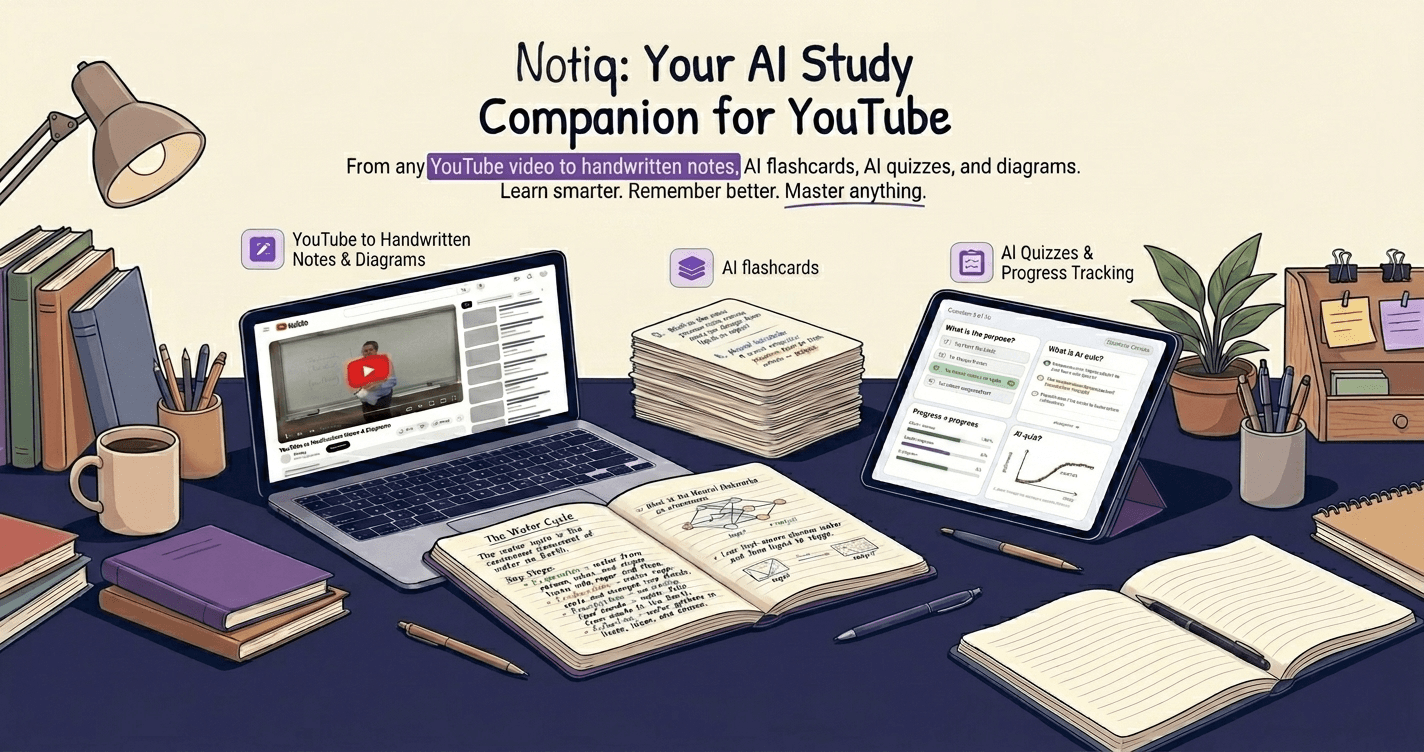
AI-powered tools like Notiq ingest source material — a YouTube lecture, a PDF, a set of notes — and produce flashcard-ready content using language models. The model identifies key concepts, generates question-answer pairs, and often produces cloze-style cards for complex definitions.
The quality has improved substantially. Current AI-generated flashcards are adequate for definitional and factual content, but still weak at:
- Application questions (requiring knowledge of the exam format)
- Causal questions (why X causes Y)
- Cards requiring visual context (which still need image occlusion)
The practical use case for AI generation is as a first draft: import your lecture recording or upload a PDF, let the AI generate 40–80 cards, then review and edit the output. Delete the weak cards (AI systems often generate redundant or surface-level cards), add application and comparison cards manually, and then load the edited deck into whatever spaced repetition system you use.
This hybrid approach reduces card creation time by roughly 60% compared to full manual creation, while maintaining the design quality that passive AI-generation alone cannot guarantee.
Notiq as an AI Flashcard Tool
Notiq is purpose-built for students who learn from YouTube lectures and uploaded documents. It processes video transcripts and generates structured notes plus flashcards. The cards integrate with Notiq's built-in review system or can be exported to Anki format.
For students whose primary learning material is lecture recordings, YouTube content (Khan Academy, MIT OCW, university lectures uploaded to YouTube), or PDFs, Notiq's generation workflow is faster than building cards in Anki or RemNote from scratch.
For students who rely heavily on pre-made community decks (especially the AnKing deck for medical content), Anki remains the clear choice for the review system itself.
Which Tool Should You Actually Use?
Use Anki if:
- You are a medical or nursing student (AnKing deck is the standard)
- You study anatomy, physiology, or any heavily visual science
- You value complete data ownership and offline access
- You are comfortable with some technical setup
- You want access to large community-made decks
Use RemNote if:
- You want notes and flashcards integrated in one place
- You do most of your studying from PDFs and textbooks
- You prefer a clean, modern interface
- You are willing to pay ~$8/month for image occlusion and full sync
- You study subjects without large pre-made community decks
Use an AI tool like Notiq if:
- Most of your source material is YouTube lectures or lecture recordings
- You want flashcards generated automatically from your content
- You are preparing for a specific exam and need cards quickly
- You want notes and flashcards to come from the same AI processing pipeline
Use a combination if:
- You need AI generation speed (Notiq for card creation from videos) plus Anki's FSRS scheduling and community decks (export Notiq cards to Anki format)
Setting Up Your Review Habit
Whichever tool you choose, the review schedule is what determines whether spaced repetition works. Most students abandon their decks within 3 weeks because they let reviews accumulate until the queue is overwhelming.
The rules that prevent this:
-
Set a sustainable daily new card limit. 20 new cards per day is a comfortable starting point. For heavy exam seasons, 30–40 is manageable. Going above 50 typically creates unsustainable review backlogs.
-
Review every day, not every week. Spaced repetition depends on timely review. Skipping a week and catching up in one session defeats the algorithm.
-
Do reviews before adding new cards. Clear your due queue first. If you consistently cannot clear your due queue in the time available, reduce your new cards per day limit.
-
Do not add cards during cramming sessions. If you are 24 hours from an exam, use your existing deck for retrieval practice but do not add new cards that will create review debt after the exam. See how to cram for an exam in 24 hours for the full cramming protocol.
The active recall techniques article covers how to combine spaced repetition with other retrieval practice methods including the Feynman technique and practice testing, which can supplement your card reviews for subjects that require application rather than recall.
The Anki vs RemNote debate has a correct answer for each student — it just depends on what you study, how you learn, and how much you value integration vs. flexibility. AI alternatives like Notiq do not replace either; they change where the most time-consuming step (card creation) happens.
Want to skip the manual card-creation step entirely and get exam-ready flashcards from any YouTube lecture in minutes? Try Notiq free at notiq.study — import a video, get structured notes and flashcards automatically.