SAT prep using Khan Academy is one of the most cost-effective study paths available to any student — Khan Academy's Official SAT Practice is free, College Board-endorsed, and genuinely good. But most students underuse it. They complete practice questions, see the score, and move on without extracting the diagnostic information that makes the difference between a mediocre improvement and a 150+ point gain.
This guide covers how to use Khan Academy for SAT prep properly, how to layer in targeted YouTube content for the concepts that need visual explanation, and how to apply the active recall and note-taking strategies that turn passive video watching into durable learning.
Why Khan Academy Is the Right Starting Point
Khan Academy's Official SAT Practice has a formal partnership with College Board, the organisation that creates the SAT. This means the practice questions are drawn from or modelled on real SAT content — not approximations created by a third-party test prep company.
The platform links to your College Board account and uses your PSAT score data (if you have it) to identify your specific weak areas and generate a personalised practice schedule. If you have not taken the PSAT, you can take a full diagnostic practice test on Khan Academy to establish your baseline.
The free offering includes:
- 8 full-length official practice tests (the same tests available on the College Board website)
- Thousands of practice questions organised by skill and difficulty
- Video explanations for every question category
- A personalised practice dashboard that tracks your progress and adapts the question difficulty
- A study plan generator that works backwards from your target test date
For most students, this is more content than they could complete even with months of preparation. The constraint is not available material — it is using the available material correctly.
What Does a Good SAT Prep Plan Actually Look Like?
The most common mistake in SAT prep is treating it as a content problem rather than a skill problem. Students study SAT "topics" — verb tense rules, linear equations, reading comprehension strategies — without building the specific rapid-recognition and problem-solving skills the SAT actually tests.
The SAT is a timed test that rewards pattern recognition and procedural fluency. The underlying math and grammar concepts are not advanced — most SAT math content is covered by end of 10th grade. What the SAT tests is whether you can execute correctly under time pressure and recognise question types fast enough to allocate your time well.
This means SAT prep has two phases that are genuinely different:
Phase 1: Diagnostic and concept repair. Identify which specific skills are weakest. Learn or relearn the underlying concept. Practice that skill in isolation until you can do it correctly without looking at examples.
Phase 2: Full test simulation and pattern drilling. Take timed practice tests under realistic conditions. Review every wrong answer and near-miss. Build speed through pattern recognition on question types you already understand.
Most students do Phase 2 too early (before their conceptual gaps are fixed) or skip Phase 1 entirely (because working on weaknesses is uncomfortable). Both errors produce diminishing returns from practice tests.
How to Start: The Diagnostic
Step 1: Create a Khan Academy account and connect it to your College Board account. If you have PSAT data, the platform will import it automatically.
Step 2: If no PSAT data is available, take one full practice test (Khan Academy's Practice Test 1) under real conditions — 2 hours and 14 minutes of active test time, phone away, dedicated workspace. Do not simulate a "partial test." Partial diagnostic data leads to misidentifying your weaknesses.
Step 3: Review your score report. Khan Academy breaks your results down by skill category within each section (Reading and Writing: Craft and Structure, Information and Ideas, Standard English Conventions, Expression of Ideas; Math: Algebra, Advanced Math, Problem-Solving and Data Analysis, Geometry and Trigonometry).
Identify your three lowest-performing skill categories. These are your Phase 1 priorities.
Phase 1: Concept Repair With Khan Academy and YouTube
For each of your weak skill categories, Khan Academy's practice dashboard will assign targeted exercises. Work through these. But for skills that require conceptual understanding — not just procedural drilling — add YouTube explanations to your workflow.
Reading and Writing Section
The Reading and Writing section of the current SAT (the digital format introduced in 2024) is different from the old paper SAT. It is structured as 54 short passages, each paired with one or two questions. The skill categories that trip up most students:
Craft and Structure questions ask about word choice, text structure, purpose, and how ideas develop. These require understanding authorial intent, not just content recall. Khan Academy's video explanations are good here, but for students who find the abstract reasoning difficult, Justin Sung's channel has strong videos on reading comprehension strategy transfer.
Standard English Conventions questions test grammar and usage: sentence structure, subject-verb agreement, punctuation, modifier placement. These are learnable rules — not judgment calls. Khan Academy's grammar lessons are thorough. Supplement with how to take notes from a YouTube lecture applied to the grammar explanation videos: write the rule in your own words, write two examples, write the most common mistake pattern.
Information and Ideas questions require locating and interpreting evidence from passages and data graphics. Practice with the Khan Academy exercises, but also practise reading real data graphics from sources like Our World in Data or news articles. The skill transfers.
Math Section
The Math section (two modules, no calculator on the first) tests a narrower range of concepts than most students expect. The most commonly tested areas:
Algebra: linear equations, systems of equations, linear functions, inequalities. Students who struggle here typically have procedural gaps — they know the method but make errors under time pressure. Fix: Khan Academy's algebra practice until you hit 90%+ accuracy, then timed practice to build speed.
Advanced Math: quadratic equations, polynomial functions, exponential equations. These require fluency with algebraic manipulation. Khan Academy's videos explain the methods clearly. For students who want more depth on the "why" behind these rules, 3Blue1Brown's Algebra 1 series on YouTube offers strong visual intuition for function behaviour.
Problem-Solving and Data Analysis: ratios, percentages, proportions, units, data interpretation. These questions are often straightforward conceptually but deceptive in how they are worded. Practice with the specific Khan Academy exercises in this category — the wording patterns repeat.
Geometry and Trigonometry: volume, area, right triangles, trigonometry ratios. These require knowing which formula to apply and extracting relevant information from the figure. Khan Academy's geometry unit covers the necessary content. Image-occlusion flashcards for formula diagrams are highly effective here — see how to make flashcards that actually stick for the technique.
Taking Notes From Khan Academy Videos
Khan Academy videos are short and concept-specific — most run 5–10 minutes. This makes them ideal for targeted concept learning, but it also makes them easy to watch passively without retaining anything.
Apply the same note-taking discipline you would use for a longer lecture:
-
Before the video: write a question the video should answer. "How do I solve a system of equations using substitution?" This primes your attention for the specific content.
-
During the video: write the core rule or method in your own words. Write one worked example, showing each step. Pause and rewind if needed — short videos should be watched carefully, not quickly.
-
After the video: close the browser. Write down the rule and work through one practice problem from memory. Then open Khan Academy and do 5 practice problems on that skill before moving on.
For the active recall studying principle: the 5 practice problems you do immediately after watching are retrieval practice, not just exercise completion. Do them without looking at your notes. Check only after you have committed to an answer.
For students who want to build a comprehensive notes archive from their Khan Academy and YouTube studying, see the YouTube to notes complete guide for how to structure video-sourced notes for long-term reference.
Phase 2: Timed Practice Tests and Diagnostic Review
Once you have worked through the concept repair phase — and you should not rush this; spending 3–4 weeks here will pay off significantly in Phase 2 — begin taking full timed practice tests.
The Timed Practice Protocol
Take each test under real conditions:
- Find a quiet room. No phone on the desk. No background music.
- Use the College Board's official Bluebook app (the digital SAT testing platform) rather than paper versions of the test. The digital format has different pacing characteristics than paper.
- Time each module accurately. The current digital SAT timing is 32 minutes for each Reading and Writing module and 35 minutes for each Math module.
- No breaks between modules except the scheduled 10-minute break between sections.
After the test, score it immediately. Do not sit with unscored tests — the correct/incorrect information is only useful when the memory of your decision-making is fresh.
The Diagnostic Review Discipline
For every wrong answer and every "I guessed and got lucky" answer, complete a three-step review:
Step 1: Identify what the question was actually testing. Not just the topic — the specific skill. "This was an algebra question" is not useful. "This tested recognising when a linear equation has no solution" is useful.
Step 2: Identify exactly where your reasoning failed. Did you misread the question? Apply the wrong method? Make an arithmetic error? Run out of time and guess? Each failure mode requires a different fix.
Step 3: Find the Khan Academy exercise set or video that addresses that specific skill. Do 5–10 practice problems on it before your next full test.
Students who complete this three-step review for every missed question typically see significant score improvement within 4–6 full practice tests. Students who complete practice tests without this discipline often plateau or improve very slowly.
Structuring a 10-Week SAT Prep Schedule
For students with approximately 10 weeks before their test date:
Weeks 1–2: Diagnostic and baseline. Complete Practice Test 1. Review your results thoroughly. Identify your top 3 weak skill areas in each section. Begin Khan Academy's personalised practice for those skills.
Weeks 3–5: Concept repair. Work through Khan Academy's targeted exercises and videos for your weak skill areas. Use the YouTube supplement strategy described above. Build flashcards for rules, formulas, and grammar patterns using the active recall approach. Target 30–45 minutes of focused practice per day.
Weeks 6–8: Full practice tests with diagnostic review. Take Practice Test 2 (week 6), Practice Test 3 (week 7), Practice Test 4 (week 8). Apply the full diagnostic review protocol after each test. Return to Khan Academy exercises for skills that remain weak.
Weeks 9–10: Targeted drilling and final tests. Focus entirely on your remaining weak spots. Take Practice Test 5 at the end of week 9. Week 10: light review only. No new content introduction. Review your flashcards and formula list. Practise one timed module per day for familiarity.
For the cramming scenario — if you have significantly less than 10 weeks — see how to cram for an exam in 24 hours for the prioritisation framework that applies to any time-constrained preparation.
What Khan Academy Alone Cannot Do
Khan Academy is comprehensive and free, but there are gaps worth knowing about:
Pacing and test strategy. Khan Academy does not teach you which questions to skip and return to, how to allocate time across modules, or how to use the built-in Bluebook calculator strategically. These are skills that come from full timed practice tests and deliberate time-tracking.
Advanced problem recognition. Students aiming for 1500+ need to recognise problem types at a glance and execute with zero procedural hesitation. This level of fluency comes from high-volume pattern drilling beyond what Khan Academy alone provides. Supplement with the free problem sets at Art of Problem Solving (AoPS) for the upper end of the math difficulty range.
Reading passage strategy for dense texts. Khan Academy's reading explanations are good for individual questions but do not explicitly teach passage reading strategy. For students who struggle with timing on the Reading and Writing section, reading more broadly — quality journalism, nonfiction books — builds the background knowledge and reading speed that transfers to SAT passages.
YouTube Channels Worth Using for SAT Prep
Beyond Khan Academy's own YouTube channel:
Sal Khan (Khan Academy official channel): comprehensive concept explanations. Most SAT students are already using this.
SupertutorTV: higher-difficulty SAT problems, strategy explanations for 1400+ students, and detailed breakdowns of tricky question types.
Mario's Math Tutoring: efficient walkthrough of algebra, functions, and geometry concepts at the SAT difficulty level. His formula videos are useful for rapid reference.
Prepscholar (PrepScholar SAT): strategy-focused content including how to approach specific question patterns.
When watching any of these channels, apply the note-taking and active recall methods described above. A YouTube video watched passively is entertainment. A YouTube video watched with question-first attention, active note-taking, and immediate practice problems is instruction. See how to take notes from a YouTube lecture for the full technique.
The Role of AI Tools in SAT Prep
AI-powered study tools have become increasingly useful for SAT prep, primarily in three ways:
Generating practice questions. Tools like Notiq can generate additional practice questions at specified difficulty levels and in specific skill categories. These are useful for drilling weak spots when you have exhausted the Khan Academy question bank for a particular skill.
Explaining errors. If you worked a problem wrong and the Khan Academy explanation did not clarify why, feeding the problem and your incorrect work to an AI assistant often produces a more tailored explanation.
Creating formula and rule flashcards. For the memory-heavy parts of SAT prep — grammar rules, geometry formulas, algebra procedures — AI tools can generate well-designed flashcard sets. These work best when you then review and edit them, applying the minimum information principle described in how to make flashcards that actually stick.
The limitation: AI tools cannot replicate the diagnostic intelligence that comes from reviewing your own specific error patterns across many practice problems. The Khan Academy personalised dashboard does this for you, which is why it remains the core tool even alongside AI supplements. For a broader view of AI tools that support self-directed learning, see the self-learner's toolkit 2026.
Is Free Prep Enough to Get a Good Score?
Yes. The evidence from the Khan Academy x College Board data is clear: students who complete 20 hours of official Khan Academy practice improve their SAT score by an average of 115 points compared to their PSAT baseline. Students who complete 40+ hours of practice see even larger improvements.
The paid SAT prep industry has products that are sometimes marginally better for specific use cases — particularly for students targeting 1550+ who benefit from high-difficulty content that goes beyond the standard Khan Academy question bank. But for the vast majority of students, the constraint is not the quality of the free material. It is whether they apply the diagnostic review discipline and retrieval practice habits described in this guide.
Free + discipline beats paid + passive review, every time. The active recall studying article covers the underlying principle in more depth if you want the research context.
Khan Academy gives you the material. Targeted YouTube supplements fill the explanatory gaps. Active recall and diagnostic review turn practice into genuine improvement. The combination is as good as any paid prep course for most score ranges — and it costs nothing but focused time.
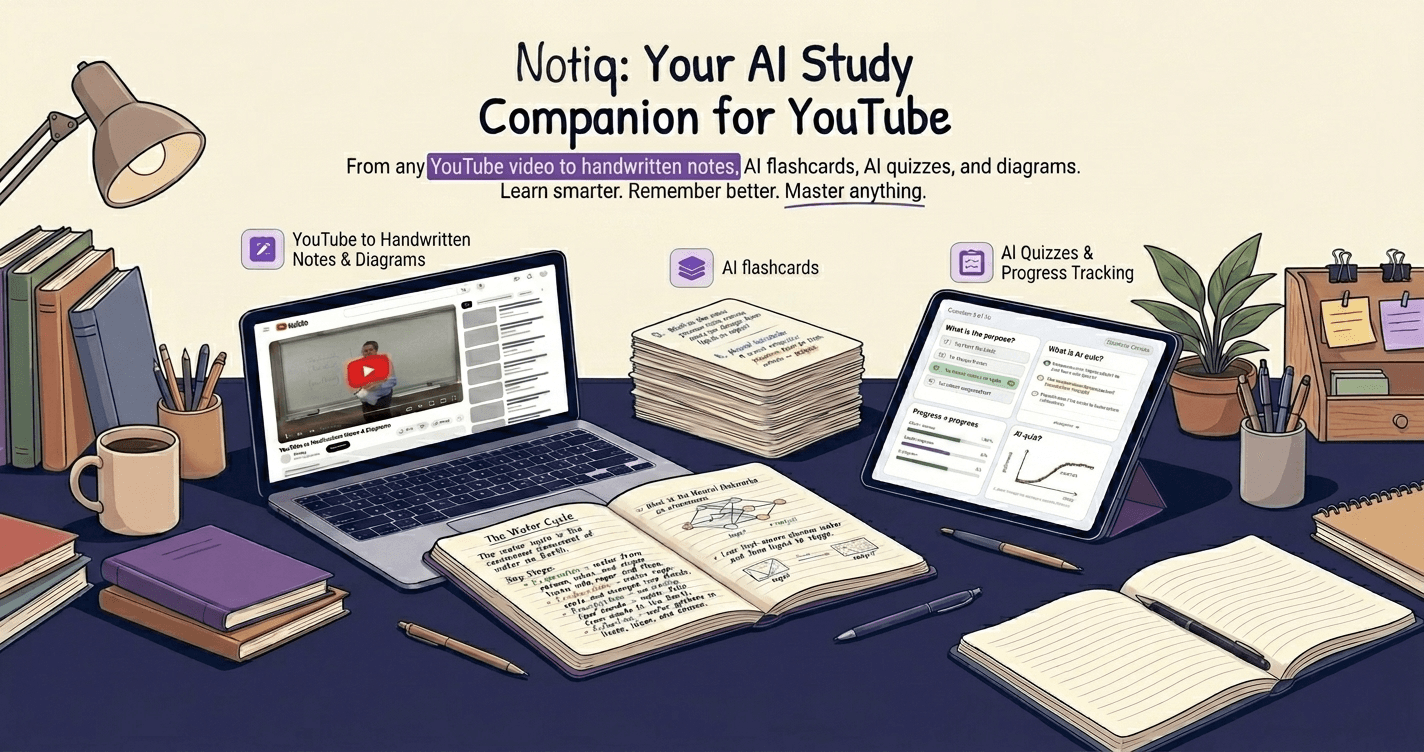
Want AI-generated SAT practice flashcards from your Khan Academy and YouTube study sessions? Try Notiq free at notiq.study — import any educational video and get structured notes and testable cards automatically.