Learning how to cram for an exam is a skill most students develop out of necessity — but almost everyone does it wrong. They re-read notes, highlight passages, and rewatch lectures feeling productive while absorbing almost nothing that sticks past morning.
This guide gives you a 24-hour playbook that actually works, built on three decades of cognitive science research. You will not enjoy every part of it. It requires more mental effort than passive review. That difficulty is exactly the point.
Why Most Cramming Fails
The problem with standard cramming is not the time constraint — it is the method. Re-reading feels like learning because the content becomes familiar. Familiarity is not recall.
Psychologist Robert Bjork at UCLA coined the phrase desirable difficulties: study strategies that feel harder in the moment produce far more durable memory. The implication is uncomfortable: if your study session feels easy and smooth, you are probably not learning much.
The most common cramming mistakes:
- Re-reading notes from start to finish
- Watching lectures at 1x speed as if novelty will appear
- Highlighting everything without testing what was retained
- Studying the same material in the same order every time
- Pulling all-nighters that slash REM sleep — the phase where memory consolidation happens
Each of these mistakes ignores the same core principle: the brain consolidates what it is forced to retrieve, not what it merely encounters.
The Science You Need to Know
Three research programs define what actually works:
Karpicke on retrieval practice. Jeffrey Karpicke at Purdue University ran a landmark 2011 study published in Science showing that students who tested themselves after studying a passage retained 50% more of the material one week later than students who re-studied the same passage. The act of retrieving information from memory strengthens the memory trace in a way that re-exposure does not. Karpicke calls this the "testing effect" — though "retrieval practice effect" is more precise because it does not require formal tests.
Bjork on desirable difficulties. Robert Bjork's research established that interleaving topics (mixing problems from different subjects rather than blocking them by type), using spaced practice, and reducing feedback frequency all feel harder in the moment but produce better long-term retention. Within a 24-hour cram session, interleaving is especially valuable: instead of studying all of Chapter 1 then all of Chapter 2, alternate between topics every 20–30 minutes.
Sweller on cognitive load. John Sweller's cognitive load theory distinguishes between intrinsic load (the inherent complexity of the material), extraneous load (unnecessary complexity introduced by poor presentation), and germane load (the productive mental work of schema formation). When you are cramming under time pressure, your working memory is already operating near capacity. Minimising extraneous load — using clean, structured notes rather than messy transcripts, breaking complex topics into smaller chunks, using diagrams for process-heavy content — frees up the cognitive resources you need to actually understand.
These three frameworks point at the same design principles: test yourself early and often, mix topics, manage your mental bandwidth, and sleep.
Hour-by-Hour 24-Hour Plan
This schedule assumes an exam at approximately 24 hours from when you start. Adjust proportions if your exam is earlier, but do not cut the sleep block.
Hours 1–2: Triage and Raw Material
Before you study anything, map the territory. Get every resource in front of you: lecture slides, textbook chapters, past papers, any AI-generated notes you have.
Now triage ruthlessly. Go through each resource and mark items as:
- High yield: likely on the exam, tested in past papers, explicitly flagged by the lecturer
- Medium: important concepts but less likely to appear as direct questions
- Low: interesting but unlikely to appear
You are not studying yet. You are deciding what to study. This phase should take no more than 45 minutes.
If you have access to past exam papers, they are your most valuable asset. Work backwards from what the exam actually tests to what you need to cover. See also how to make flashcards that actually stick for how to convert your triage into testable cards.
Hours 3–6: First Pass — Active Reading, Not Passive Re-reading
Go through your high-yield material one time. But do not just read — interrogate.
Use the question-generation technique: as you read each section, pause and write a question that the section answers. Write it on a separate sheet or in a flashcard app. Do not answer it yet. Keep moving.
You are building a question bank as you go. This serves two functions. First, it forces you to actively process each section rather than letting your eyes slide over familiar words. Second, it creates the test you will use for retrieval practice in the next phase.
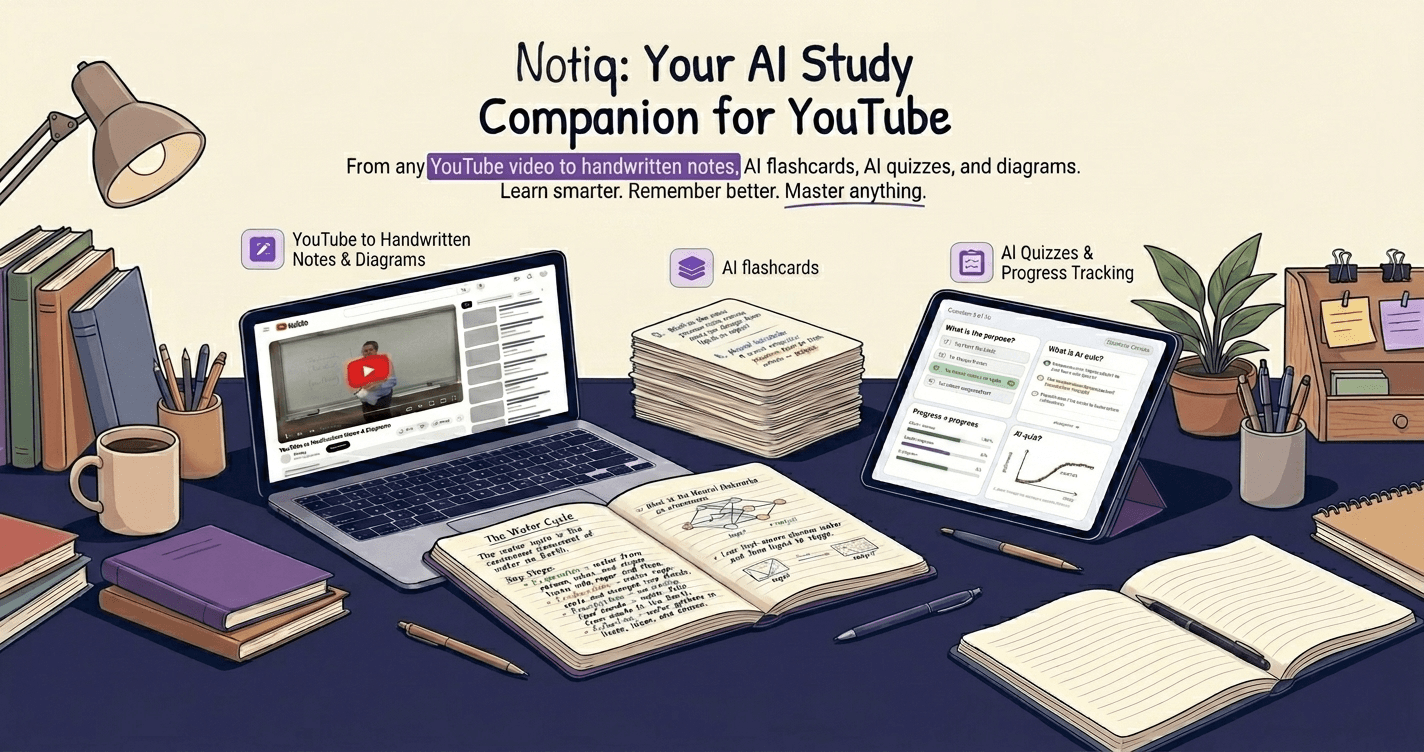
Aim to produce 30–50 questions across your high-yield material. If you are using Notiq to generate notes from lecture recordings, the auto-generated flashcards give you a starting question bank that you can supplement and refine. See our guide on AI study notes for how to use AI-generated material effectively.
Hours 7–10: Retrieval Practice — The Most Important Phase
Close everything. Pull out your question bank. Answer every question from memory, in writing.
Do not peek. Do not search. Do not half-remember and move on. Write the best answer you can, then check.
When you check, mark each answer:
- Got it: correct and complete
- Partial: something right but gaps
- Missed: wrong or blank
Set aside the "got it" cards. You will return to them only at the end. Spend the rest of this phase drilling the partial and missed items. Answer them again. Check again. Repeat until you have moved them to "got it."
This process feels difficult and uncomfortable. You will feel stupid about things you thought you knew. That feeling is the sound of your brain building a stronger retrieval path. Per Karpicke's research, this effortful retrieval is what separates material you will remember tomorrow from material that disappears at 3am.
For science-heavy topics with lots of interconnected terms, active recall techniques covers additional strategies including the Feynman technique and elaborative interrogation.
Hours 11–14: Interleaved Review and Gap-Filling
Return to your medium-yield material, but interleave it with your high-yield flashcards.
Every 20 minutes, switch. Study a new medium-yield topic for 20 minutes, then drill 10 high-yield flashcards, then return to a different medium-yield topic. The switching costs feel wasteful — they are not. Bjork's research on interleaving consistently shows better final-test performance despite (because of) the discomfort.
Use this phase to also tackle the questions you consistently miss. If you have been getting a particular concept wrong across multiple retrieval attempts, it is not a memory problem — it is a comprehension problem. Go back to the source material. Work one example through slowly. Then close it and explain the concept out loud as if teaching it to someone else (the "blank page technique").
For topics that require understanding rather than recall — mathematical proofs, code logic, causal chains in history — the note-taking methods compared guide covers diagram-based approaches that can clarify structure quickly.
Hours 15–17: Past Paper Sprint
Take one full past paper (or set of past exam questions) under exam conditions. Set a timer. No notes.
After the timer, grade yourself honestly. Do not feel good about correct answers — focus entirely on what you missed. Each missed item is a retrieval failure that points directly at a gap.
Add those gaps back into your flashcard stack as new questions. The past paper is diagnostic, not practice. Its value is in the correction, not the attempt.
If past papers are not available, use the AI-generated exam questions in Notiq, or write five questions per major topic from scratch. The act of writing the question requires you to think about what a fair and challenging test of the concept would look like — which itself deepens understanding.
Hours 18–20: Final Review Cycle
One final pass through all your "partial" and "missed" cards from earlier in the day. You should be moving most of them to "got it" by now.
Spend the last 30 minutes of this phase reviewing your own summaries — not the original material. If you did the active reading phase correctly, your summaries capture the most important points in your own words. Reading your own summaries is one of the few passive review activities that is genuinely useful, because you encoded the material yourself and the language matches your mental model.
Hours 21–24: Sleep
This is non-negotiable. Sleep is not recovery time that can be traded for more study. It is the phase where memory consolidation happens. The hippocampus replays the day's learning and transfers it to cortical long-term storage during slow-wave and REM sleep.
Cutting your sleep from 7 hours to 4 hours does not just make you tired — it meaningfully impairs the consolidation of everything you studied. You will walk into the exam having done the work but having failed to cement it.
Go to sleep at the same time you normally do. Avoid screens for 30 minutes before. Keep the room cool and dark. Set an alarm that gives you 7 hours minimum.
What to Do in the Morning
Wake up with at least 90 minutes before you need to leave. Eat something with protein — blood glucose stability reduces cognitive variability during the exam.
Spend 20 minutes doing one final retrieval pass on your "partial" cards only. Do not review material you already know solidly — you are just inducing unnecessary anxiety. Focus on the specific items that were still shaky last night.
Do not cram in the hour before the exam. Your working memory is finite. Loading it with new information right before the exam increases extraneous cognitive load and creates interference with what is already consolidated.
Does Cramming Work at All?
Honestly: for some situations, yes.
If you need to retain information for 48 hours — which covers most single-subject exams — a focused 24-hour session using retrieval practice and interleaving can be surprisingly effective. Karpicke's research shows that retrieval-based review produces better 1-week retention than re-reading even when total study time is equal.
What cramming cannot do is substitute for semester-long spaced practice. The flashcards that stick article covers how to set up a spaced repetition system that avoids the need to cram in the first place. The active recall techniques guide covers how to build these habits into weekly study cycles so that cramming becomes a finishing move rather than the entire strategy.
The honest framing: 24-hour cramming done correctly can be more effective than a week of passive re-reading done incorrectly. That is the bar. You can clear it.
Common Mistakes to Avoid on the Day
Starting with the hardest material. Interleave from the beginning. The hardest material is not best served by a cold, stressed brain — warm up with something you understand before cycling back to the difficult sections.
Using social pressure to motivate. Study groups during cram sessions are almost always counterproductive. Social studying optimises for the social experience, not the learning. Do retrieval practice alone, then use others to test you, not to study alongside.
Switching topics when stuck. Desirable difficulty means you should push through confusion for a defined period (10–15 minutes) before switching. Switching the moment you feel resistance trains your brain to escape effort rather than process it.
Forgetting context. If an exam question asks you to apply a concept to a novel scenario, familiarity with isolated definitions will not help. When reviewing flashcards, add a follow-up: "Now explain why this matters" or "Give an example different from the one in the lecture." Context encoding is what enables transfer.
The Role of AI Study Tools in Cramming
When you have 24 hours, you do not have time to manually extract flashcards from 15 hours of lecture material. This is where AI-powered note generation earns its place.
Tools like Notiq can process a lecture recording or transcript and produce structured notes, concept definitions, and flashcard-ready question-answer pairs in minutes. That raw material — already organised, already formatted — is what you then apply retrieval practice to.
The key is not to use the AI as a substitute for the retrieval work. Use it to compress the triage and raw-material phase from 3 hours to 45 minutes, then spend the time you saved on active recall and past papers. The cognitive science is clear: it is the retrieval practice that builds the memory, not the quality of the notes sitting in front of you.
For more on integrating AI into a study workflow, see the AI study notes complete guide. For the science behind spaced repetition tools, see flashcards and spaced repetition science.
If you have never used spaced repetition software before and want to understand the Anki vs RemNote comparison, anki vs remnote and AI alternatives covers the practical setup decisions.
The 24-hour cram session is not the ideal way to prepare for an exam. But done with the right method, it is far from hopeless. Retrieval practice, interleaving, and a full night of sleep will do more for your score than any amount of re-reading or passive review.
Ready to turn your lecture notes and YouTube videos into exam-ready flashcards automatically? Try Notiq free at notiq.study — import a lecture, get structured notes and testable flashcards in under two minutes.