YouTube has the best free education on earth. That is not hyperbole. You can learn calculus from MIT professors, study machine learning from the researchers who built the field, and understand evolutionary biology from working scientists — all without paying tuition or moving cities.
The problem is not access. It is navigation. YouTube's recommendation algorithm optimizes for watch time, not learning quality. The best educational channels are often not the ones that surface first.
This guide collects the best YouTube channels for learning across major subjects, with notes on what each channel does well, who it is for, and how to integrate it into a structured learning system.
Here is one of the best to start with — 3Blue1Brown, whose approach to mathematics defines what educational video can be:
For guidance on how to study systematically with YouTube content, see the full guide on how to learn anything from YouTube and the self-learner's toolkit for 2026.
Mathematics
3Blue1Brown is the benchmark for mathematical explanation on YouTube. Grant Sanderson uses custom animations (built with his open-source Manim library) to convey mathematical intuition visually. The "Essence of Linear Algebra" and "Essence of Calculus" series explain topics at an intuitive level that most textbooks never reach. The neural network series is the clearest visual introduction to backpropagation available. Watch these before or alongside a formal course, not as a replacement.
- Best for: building intuition for calculus, linear algebra, probability, and neural networks
- Not a substitute for: working through problems — Sanderson explains but rarely drills
MIT OpenCourseWare (Mathematics) has recordings of actual MIT courses: 18.01 (Single Variable Calculus), 18.02 (Multivariable), 18.06 (Linear Algebra with Gilbert Strang), and graduate courses in real analysis and abstract algebra. Gilbert Strang's linear algebra lectures are particularly celebrated — he is to linear algebra what Feynman was to physics.
- Best for: complete course-level coverage with problem sets and exams
- Note: the 18.06 recordings are older but still excellent; the material does not expire
blackpenredpen specializes in calculus and differential equations, working through hundreds of problems on video. The style is informal and fast — he solves problems in real time. This is drill content: watch it when you know the theory and need to see technique.
Professor Leonard produces long-form (often 3-4 hour) lecture recordings covering algebra, pre-calculus, calculus, and differential equations. His style is methodical and warm. The calculus series is widely used as a primary resource by students whose instructors are unclear.
Computer Science and Programming
MIT OpenCourseWare (Computer Science) again earns a top position. 6.001/6.00x (Introduction to Computer Science), 6.006 (Algorithms), 6.034 (Artificial Intelligence), 6.046 (Design and Analysis of Algorithms), and many others. For full notes on the AI course, see the MIT 6.034 course summary.
Stanford Engineering Everywhere has recordings of CS106A/B (programming), CS107 (computer organization), CS161 (algorithms), and the complete machine learning and deep learning courses. The Andrew Ng ML course notes cover the flagship ML course.
Andrej Karpathy is a former OpenAI and Tesla research director who produces hands-on neural network tutorials. His "Neural Networks: Zero to Hero" series builds a character-level language model from scratch, then a full GPT. No shortcuts, no black boxes — he implements every component in raw Python/PyTorch. Dense but exceptional for anyone serious about deep learning.
- Best for: practitioners who want to understand transformers and LLMs from first principles
- Prerequisites: Python proficiency, some linear algebra
Fireship produces short (under 10 minutes) videos on web development, programming languages, and developer tools. The style is fast, opinionated, and well-produced. Not for deep learning, but excellent for breadth: understanding what a technology is, when to use it, and what alternatives exist.
The Coding Train (Daniel Shiffman) covers creative coding, algorithms, and programming concepts with an unusually enthusiastic teaching style. Good for programming beginners and for topics like genetic algorithms, cellular automata, and simulations.
Computerphile covers computer science concepts in 10-20 minute interviews with academics and practitioners. Topics range from SQL injection to quantum computing to font rendering. High information density, low production overhead — just a professor at a whiteboard.
Physics
MIT OpenCourseWare (Physics) includes Walter Lewin's legendary 8.01 (Mechanics) and 8.02 (Electricity and Magnetism) lectures. Lewin became famous for his demonstrations and his theatrical teaching style. His 8.01 lectures are consistently cited as among the best physics teaching ever recorded.
PBS Space Time covers astrophysics, cosmology, and theoretical physics at a graduate-adjacent level. The channel assumes you have taken undergraduate physics and want to go deeper. Topics include general relativity, quantum field theory, entropy, and the structure of the universe. Well-researched, with linked papers in the descriptions.
- Best for: physics undergraduates and enthusiasts with strong background
- Not for: total beginners — start with Lewin
Veritasium (Derek Muller) covers physics and science more broadly, with a focus on misconceptions and counterintuitive phenomena. The research quality is high — Muller has a PhD in physics education. Videos are designed to expose and correct wrong intuitions, which makes them excellent for deep understanding even if the topic surface area is broad.
MinutePhysics does short (2-5 minute) animated explanations of physics concepts. Best used as introductions or as quick refreshers, not as primary learning resources.
Biology and Medicine
Khan Academy (Biology) remains the most complete free coverage of high school and early undergraduate biology: cell biology, genetics, evolution, ecology, biochemistry. The production quality is not glamorous but the explanations are consistently clear.
HHMI BioInteractive produces high-quality biology education videos from the Howard Hughes Medical Institute, a major funder of biomedical research. The animations of molecular processes (DNA replication, protein synthesis, immune response) are exceptionally clear and scientifically accurate.
Crash Course (Biology/Chemistry) covers biology, chemistry, anatomy, and ecology at a high-school-to-intro-college level. Fast, entertaining, and good for survey-level understanding. Not sufficient for exam preparation in most university courses but excellent for building initial mental models.
Dr. Najeeb Lectures is the gold standard for medical students covering clinical medicine and basic sciences. Over 800 hours of content covering anatomy, physiology, pharmacology, pathology, and clinical subjects. The style is whiteboard-based and methodical. Expensive subscription, but used by medical students worldwide.
History and Social Sciences
Crash Course (History) produced by John Green and the Crash Course team covers world history, US history, European history, and more. The tone is accessible and the production quality is high. Best used as context-setting before deeper reading.
History of the Earth covers deep time — geology, paleontology, evolutionary biology — from the formation of the solar system to the present. Each video is 20-30 minutes and well-researched. Excellent for understanding the deep background to biology and Earth science.
Economics Explained covers macroeconomics, international trade, monetary policy, and financial markets at an accessible level. The channel avoids partisan framing and focuses on explaining mechanisms. Good for building economic intuition without a formal economics background.
TED and TEDx have quality variance, but the flagship TED talks from leading researchers, practitioners, and thinkers are consistently high value. The signal-to-noise ratio in TEDx is much lower — stick to the main TED channel and use the topic filters.
Language Learning
Comprehensible Input channels — the most evidence-backed approach to language learning through YouTube is comprehensible input: watching content in your target language that is just above your current level. Channels dedicated to this include:
- Español con Juan for Spanish
- Easy French / Français avec Pierre for French
- Easy German for German
- Comprehensible Japanese for Japanese
These channels specifically design content at different CEFR levels, making them far more efficient than watching regular TV in your target language.
How to Actually Learn from These Channels
A list of channels is not a curriculum. The difference between watching educational YouTube and building real knowledge is structure.
Three practices that separate effective self-learners from passive consumers:
Build a curriculum before you start watching. Decide in advance which channel covers which part of your learning goal, and in what order. YouTube's recommendation algorithm will pull you sideways. If you have a list of 20 specific videos to watch in order, you are less vulnerable to that.
Take notes that force recall. Do not just watch. If you can reconstruct the key points of a lecture from memory 24 hours later, you have learned something. If you cannot, you watched a video. For systematic note-taking from YouTube lectures, see our guide on taking notes from YouTube lectures and the overview of AI study notes.
Use the problem sets. Channels like MIT OCW come with problem sets, exams, and solutions. Use them. Watching a lecture is passive; solving a problem is active. The cognitive science on this is clear: retrieval practice beats re-watching. See why most students take notes wrong for the evidence behind this.
Which Channels Are Worth Paying For?
Most of the best content on this list is free. But a few paid resources are worth mentioning because they are systematically better than YouTube:
Brilliant (brilliant.org) covers mathematics, science, and computer science through interactive problems. The difference from YouTube: you have to do things, not just watch them. The spaced repetition is built in. Best used alongside YouTube lectures for the same topic.
Khan Academy (free) is so comprehensive for K-12 and early undergraduate mathematics and science that it deserves special mention as a free structured resource that rivals paid alternatives.
Finance and Economics
Plain Bagel covers personal finance, investing, and economic concepts with an emphasis on evidence and skepticism about financial advice industry claims. The creator is a Canadian CFA charterholder. Videos debunk common personal finance myths alongside explaining the fundamentals of portfolio theory, market efficiency, and retirement planning.
Ben Felix (PWL Capital) is similar in quality and approach. His videos on factor investing, asset allocation, and portfolio construction cite primary academic research and are among the most rigorous free personal finance content available.
Ray Dalio's Economic Machine — the "How the Economic Machine Works" video from Dalio's Bridgewater Foundation is 31 minutes long and remains the clearest single explanation of macroeconomic cycles and credit mechanisms available for free. A one-watch that rewards re-watching.
Engineering and Applied Science
Practical Engineering (Grady Hillman) covers civil and structural engineering through physical demonstrations and clear explanations. Episodes have covered everything from bridge design to water treatment to the California delta. Accurate, well-sourced, and directly tied to real infrastructure.
Real Engineering covers aerospace, mechanical, and electrical engineering topics with a focus on understanding how complex systems work. Video quality is high and the research is thorough.
Scott Manley covers spaceflight, astronomy, and science news with a depth that reflects his background as a research astronomer. Best for space enthusiasts who want more than popular science coverage.
How to Evaluate a Channel Before Investing Serious Time in It
Given the volume of educational YouTube content, a quick evaluation before committing to a channel or series saves time:
Check the credentials of the creator. Not all educational content requires a PhD, but for science, mathematics, medicine, and law — areas where errors are dangerous or expensive — look for actual expertise. Read the about page.
Watch one video on a topic you know well. This is the fastest calibration. If a chemistry video contains errors you can spot, the same channel's biology content probably has errors you cannot spot.
Check the comments section on a technical video. Subject-matter experts in the comments pointing out errors are a signal worth heeding. Creators who address corrections in pinned comments demonstrate intellectual honesty.
Look for primary sources in the description. Channels that link to original papers, official data, or primary sources take accuracy seriously. Channels that link to their own merchandise are telling you something different.
What Is Missing from This List?
Deliberately excluded: channels that are technically in education but primarily optimized for engagement over accuracy. The YouTube economics incentivize dramatization, and some popular "educational" channels have accuracy problems that are hard to spot if you are learning the topic for the first time.
Channels on this list were included based on: academic credibility (creator is a researcher or expert practitioner), track record of corrections and accuracy, and whether the content is structured for learning versus primarily for entertainment.
For the specific skill of taking notes from these channels efficiently, see our guide on how to take notes from YouTube lectures. For a broader study system, the self-learner's toolkit covers how to tie channels, notes, and review into a coherent workflow.
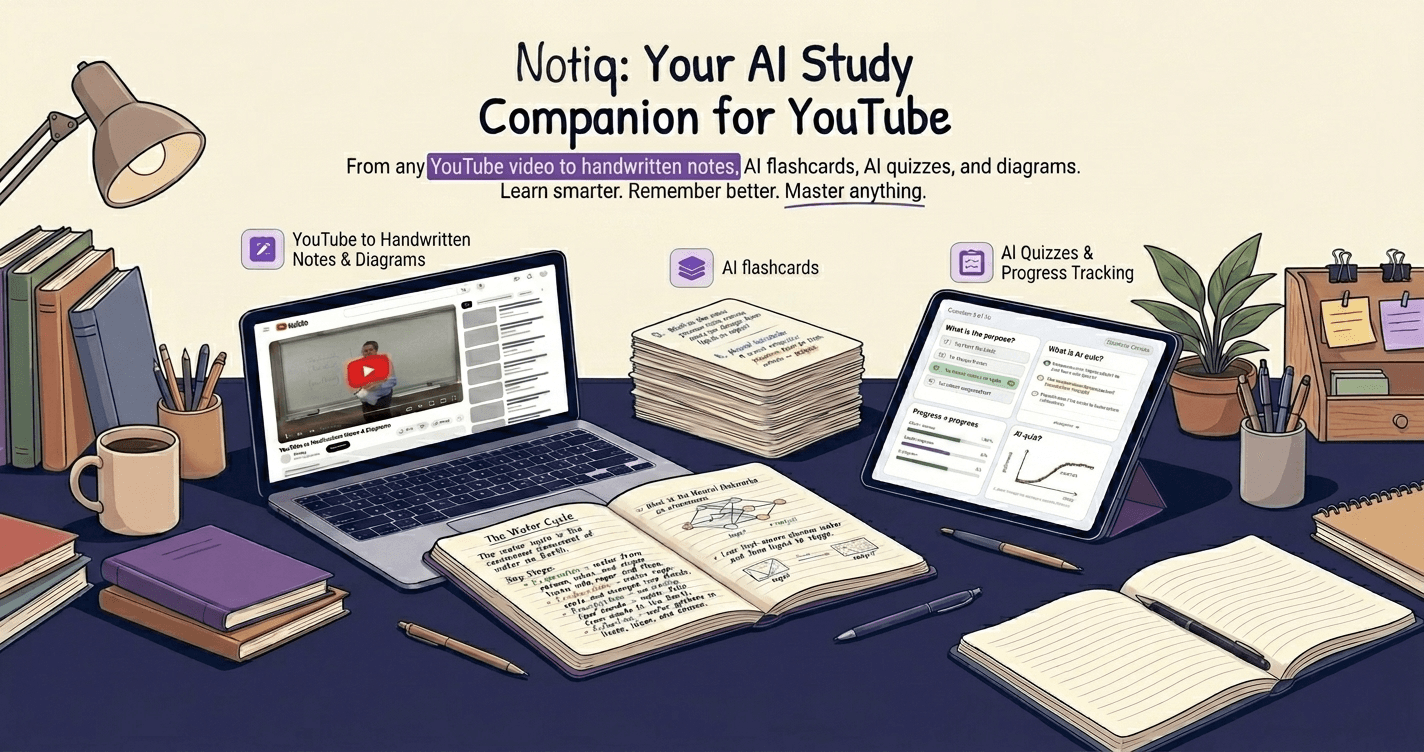
If you study from multiple channels on this list, tools that turn YouTube transcripts into structured notes become genuinely valuable. Notiq handles the transcript-to-notes pipeline so you spend your time reviewing, not transcribing. Try it at notiq.study.