Most people who use YouTube to learn have some version of the same problem: they watch things, feel like they are making progress, and then six weeks later remember almost nothing with any precision.
This is not a willpower problem. It is an architecture problem. Watching is not learning — it is exposure. Learning happens in the gap between watching and being able to recall and use information. Building a personal knowledge base from YouTube content is about designing that gap intelligently.
This guide covers the full workflow: how to capture content from video, how to process it into structured notes, how to connect notes to each other, and how to maintain the review practice that actually moves information into long-term memory.
Why Most YouTube Learning Does Not Stick
Before getting into the system, it is worth understanding why passive YouTube consumption produces so little durable knowledge.
The problem is what psychologists call the fluency illusion. Video content is well-produced, clearly explained, and easy to follow. As you watch, the information flows through your working memory smoothly. This creates a feeling of comprehension that can be confused with learning.
But comprehension and retention are different things. Comprehension is understanding something while it is in front of you. Retention is being able to reconstruct it from memory when you need it. The transition from one to the other requires active effort — usually in the form of trying to recall, explain, or apply the information before you look at it again.
A personal knowledge base forces that active effort at multiple points: when you process a video into notes, when you review your notes, and when you create connections between ideas. Each of these moments of active engagement is what actually encodes information.
Step 1: Build a Capture Workflow You Will Actually Use
The capture step is where most knowledge base projects fail. The perfect is the enemy of the good: if your capture process requires too many steps, you will not do it consistently, and an inconsistent knowledge base is not useful.
The goal of capture is a single, opinionated process for every video you watch with the intent to learn. Not a different process for each type of video, not an improvised process each time — one workflow.
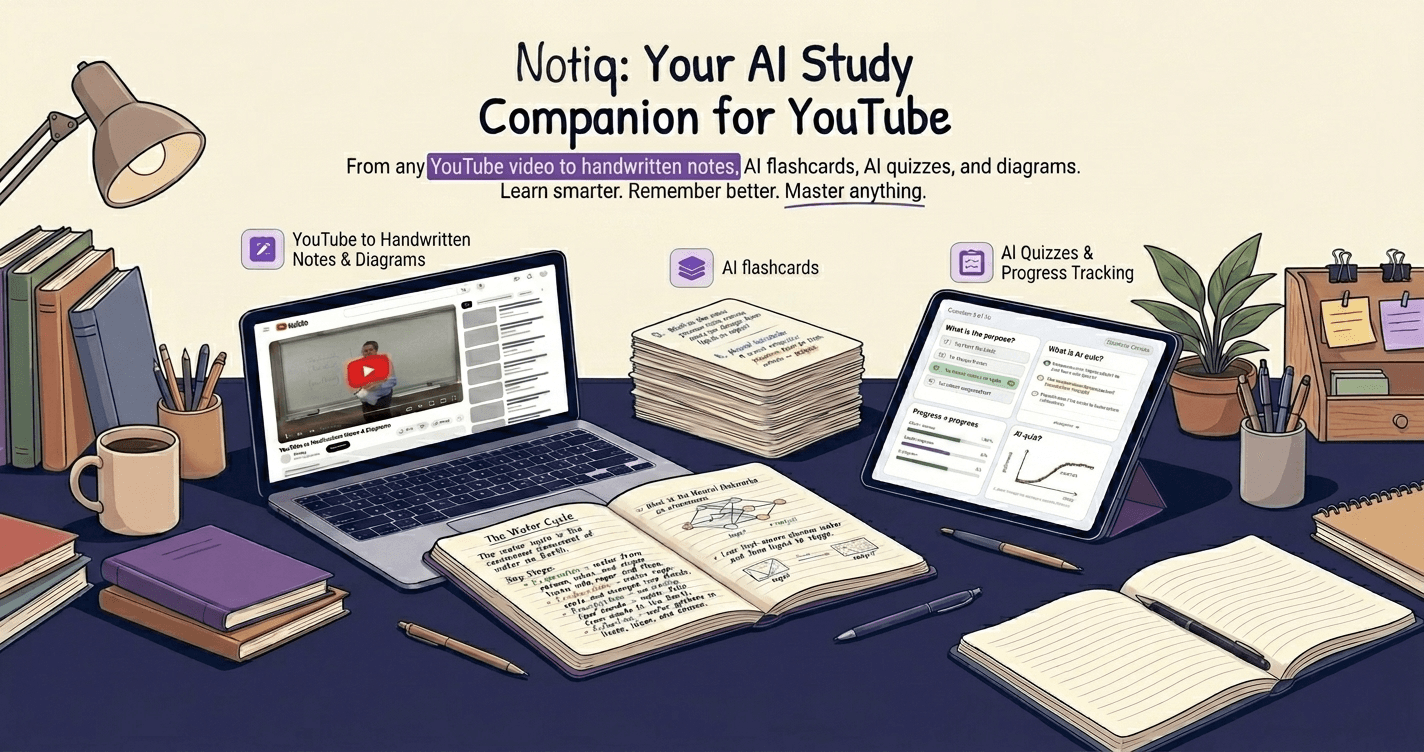
For YouTube-first learners, the simplest capture process is: paste URL → automated notes → review and edit. Tools like Notiq handle the transcription and structuring step automatically, so the capture workflow is a single action followed by a light editing pass. The YouTube-to-notes complete guide walks through this in detail.
For manual workflows, the most effective approach for long videos is to watch once at 1.25x speed without notes, then watch a second time and take notes. The first pass lets you follow the argument without losing the thread by writing. The second pass is faster because you know what is important.
Whichever process you choose, it needs to produce a note with at minimum:
- A title that identifies the video
- The date you processed it
- 3–7 main points, in your own words
- Any terms or concepts defined that you did not know before
- One or two questions the content raised that you want to investigate further
Step 2: Structure Notes for Retrieval, Not Reading
The most common mistake in building a knowledge base is writing notes that read like good summaries but cannot be used for retrieval practice.
A note that says "Backpropagation is the algorithm used to train neural networks by computing gradients with respect to the loss function" is a summary. It reads well. If you look at it the day you wrote it, it will seem familiar.
A note that works for retrieval asks you to reconstruct: "What is the algorithm that computes gradients with respect to the loss function in neural network training?" or "Describe backpropagation in terms of the chain rule."
Structure your notes with this distinction in mind:
- Key concepts should be defined clearly but concisely — enough to trigger recall, not enough to allow passive reading as a substitute for remembering
- Questions should be explicit — turn at least three key points per video into question-answer pairs that can become flashcards
- Your own observations are the most valuable part — what surprised you, what you disagreed with, what you already knew and this confirmed, what you want to investigate
Notes written in your own words, even imperfectly, encode better than clean copies of the source material. This is documented clearly in the research on generative processing — the act of translating a concept into your own language is itself a form of retrieval practice.
Step 3: Connect Notes to Each Other
A flat folder of individual video notes is a library. A connected set of notes where each one links to related ideas is a knowledge base.
The difference matters because most learning is relational. Understanding something deeply usually means understanding how it connects to other things: how this concept is an extension of that one, how these two ideas appear to contradict but are actually about different levels of abstraction, how this approach from one domain could apply to a problem in another.
The simplest version of connection: at the end of every note, add a section called "Related" and list 2–3 other notes in your knowledge base that are relevant. Do not overthink this — proximity in subject matter, shared terminology, or conceptual similarity are all sufficient reasons to link.
The Zettelkasten version: every note gets a permanent identifier and a place in a concept hierarchy. New notes explicitly reference older ones and explain the relationship. Over time, the connections between notes carry as much information as the notes themselves. The Zettelkasten from YouTube guide covers this method in depth if you want to go further.
The tool question: Obsidian is the most powerful tool for maintaining a linked knowledge base from YouTube content. Its bidirectional links and graph view make connections visible and navigable. The Obsidian vs Notiq comparison covers the trade-offs between a purpose-built linking tool and a YouTube-first note tool in detail.
Step 4: Build a Review System That Runs Itself
A knowledge base you never review is not a learning system. It is a storage system. The review step is what differentiates the two.
Review has two modes, and both matter:
Scheduled flashcard review handles individual facts, definitions, and concepts. This is where spaced repetition scheduling earns its reputation — reviewing a fact at the right interval (just before you would have forgotten it) is significantly more efficient than reviewing it on a fixed schedule. Anki, RemNote, and Notiq's built-in review system all implement this algorithm.
The key habit is consistency over volume. Five minutes of review every day is more effective than an hour of review once a week. The spacing is the point.
Concept-level review handles the higher-level understanding that flashcards do not reach. This means periodically revisiting your notes on a topic and asking: Can I explain this from memory? Do my notes still accurately represent what I know? Are there connections I missed?
One useful practice: pick a note from 2–3 months ago each week, try to explain the main idea out loud or in writing without looking at the note, then compare your explanation to the original. The gap between what you expected to remember and what you actually remember is useful signal about where your knowledge base needs reinforcing.
What Should Go Into Your YouTube Knowledge Base?
Not everything you watch on YouTube deserves a place in your knowledge base. Being selective is part of what makes a knowledge base useful — a system that captures everything becomes too noisy to navigate.
Good candidates for your knowledge base:
- Content where you are building cumulative expertise (a domain you will return to repeatedly)
- Lectures and courses where each video builds on previous ones
- Content from creators you trust enough to reference later
- Videos that change your mental model of something — not just information, but perspective
Poor candidates:
- News and current events (low retention value, high volume)
- Entertainment content you happen to be watching while learning
- Tutorials where the value is procedural (you follow along once) rather than conceptual
- Content you are watching out of curiosity with no particular future use
The discipline of deciding "is this worth a knowledge base entry?" before you watch is itself useful — it forces a clear purpose for the viewing session.
How to Organize Your Knowledge Base as It Grows
In the early stages (under 50 notes), organization matters less than consistency. Pick a simple folder structure based on your main learning areas and do not overthink it.
As the knowledge base grows, two organizational principles become important:
Topic clusters over strict hierarchy. A strict folder hierarchy (Computer Science > Machine Learning > Neural Networks > Backpropagation) feels tidy but becomes brittle when notes span multiple categories. A looser system with tags and links handles cross-cutting concerns better.
Inbox-first processing. New notes go into an inbox, unprocessed. At the end of each week, you process the inbox: file notes into the right place, add connections to existing notes, create flashcards from key points. This prevents the knowledge base from becoming a guilt-inducing dump of half-processed captures.
The note-taking methods comparison covers how different structural approaches fit different types of content and learning goals. For a thorough treatment of the Zettelkasten method and the research behind slip-box note systems, Sönke Ahrens' work at soenkeahrens.de is the primary reference that most practitioners cite.
Can AI Speed Up the Knowledge Base Workflow?
Yes, for specific parts of it.
AI accelerates capture and first-pass structure. The transcription, initial headers, and key concept extraction that used to take 30–45 minutes per lecture can now happen automatically. This removes the main friction point for most learners and means processing 3–4 lectures per week is a realistic daily habit rather than a weekend project.
AI does not replace your own synthesis. The connections you make between notes, your own observations and disagreements, the questions a video raises for you — these require human judgment. AI can suggest related content; it cannot do the relational thinking that makes knowledge personal and lasting.
AI-generated flashcards are a useful starting point but should be reviewed and edited. The cards generated from a video tend toward factual recall. Good study decks mix factual recall with concept explanation and application. Edit the deck before you rely on it.
The AI study notes complete guide covers the specific workflows where AI adds the most value in a knowledge base context.
What Does a Mature YouTube Knowledge Base Look Like?
After six to twelve months of consistent practice — one to three videos processed per week, daily flashcard review, weekly linking — your knowledge base should be doing several things:
Surfacing non-obvious connections. When you process a new video, you should regularly find that it connects to something you captured months ago. These unexpected connections are the payoff of the linking work.
Reducing re-learning time. When you return to a topic you studied six months ago, your notes should let you rebuild the mental model quickly rather than starting from scratch. The review habit is what keeps those notes accurate.
Giving you useful references during projects. "I remember I took notes on this" followed by a successful search and retrieval is the functional test of a knowledge base.
The system works when it becomes a reliable external memory — something you trust enough to reference, accurate enough to be useful, organized enough to be searchable.
Start building your YouTube knowledge base with Notiq. Paste a URL, get structured notes and flashcards in under two minutes. Free to try at notiq.study.