Obsidian has a passionate user base for good reasons. It is a local-first, privacy-respecting, infinitely customizable note-taking and knowledge graph tool with a plugin ecosystem that can do almost anything you want. If you want full control over your notes, complete ownership of your data, and a powerful system for connecting ideas, Obsidian is genuinely excellent.
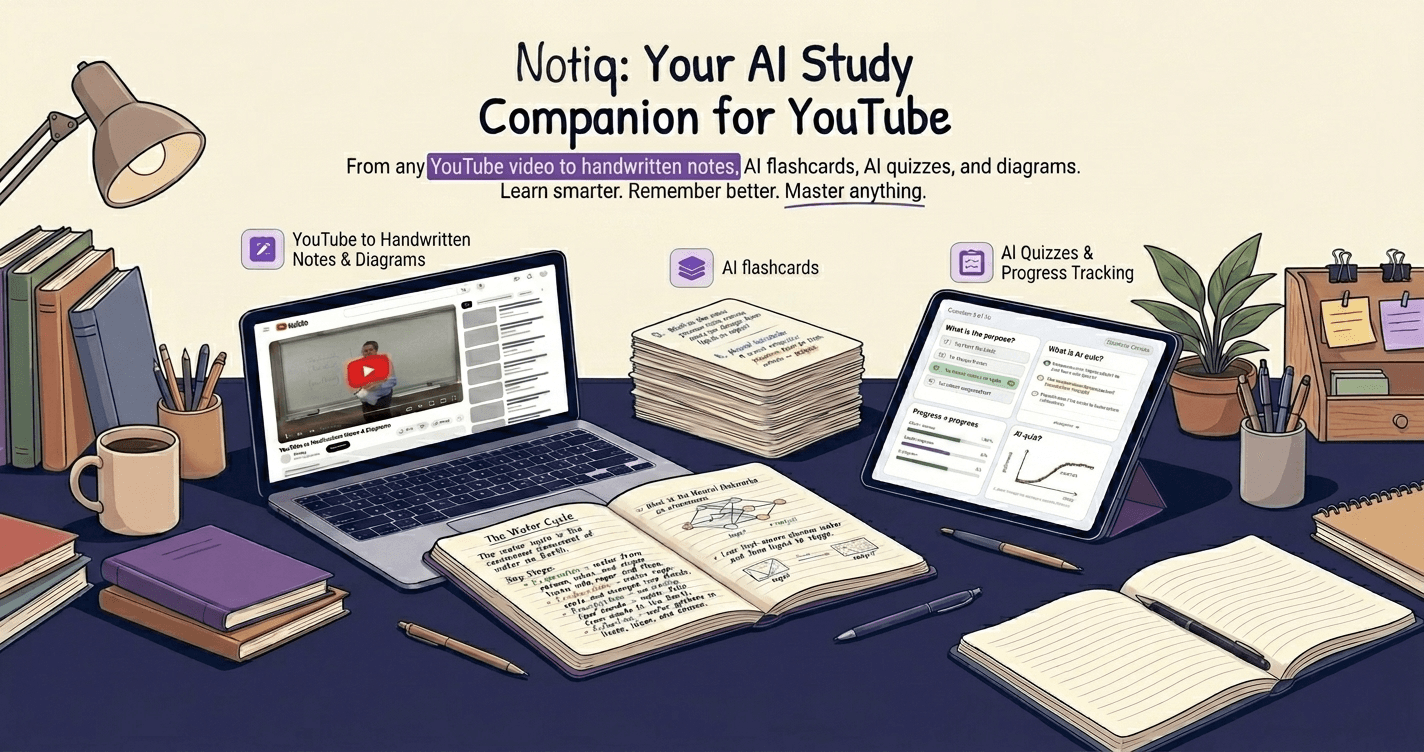
Notiq is narrower. It is built for one specific thing: taking a YouTube URL and producing structured study notes and flashcards from it, fast. It does not try to be a general-purpose knowledge management system.
This comparison is honest about where each tool wins. We are writing it, so we have an obvious conflict of interest — which is why we are going to be direct about the cases where Obsidian is clearly the better choice.
What Obsidian Actually Is
Obsidian stores notes as plain Markdown files on your local machine (or in a sync service you control). Every note can link to every other note using [[wiki-style links]]. Over time, a collection of notes becomes a graph where you can visually see the relationships between ideas.
This architecture is based on the Zettelkasten note-taking method developed by German sociologist Niklas Luhmann, who attributed much of his prolific academic output to his note system. The how to build a Zettelkasten from YouTube guide covers this method in depth.
Key features:
- Local-first storage — your notes are plain text files, owned entirely by you
- Bidirectional links — backlinks show you every note that references a given concept
- Graph view — visual map of connections between notes
- Plugin ecosystem — over 1,000 community plugins covering templating, spaced repetition, task management, Kanban boards, and much more
- Completely free for local use; optional paid sync and publish services
Obsidian's full documentation and the community plugin directory are available at obsidian.md.
What Obsidian Is Used For
Obsidian is most powerful for building what the PKM (personal knowledge management) community calls a "second brain" — a long-running, interconnected body of notes that grows over years and becomes genuinely searchable and navigable.
Academic researchers, writers, and serious self-learners use it to maintain a knowledge base where noting something new automatically reveals connections to older notes. The graph view, over a large note collection, can surface non-obvious relationships.
It is also used as a straightforward note editor by people who simply prefer Markdown in a good interface and value local storage.
Where Does Obsidian Fall Short?
Obsidian requires significant setup investment. Out of the box, it is a blank Markdown editor. Building a system that actually works — good templates, consistent linking conventions, a tagging scheme, a review workflow — takes weeks, and for many people the system-building becomes an end in itself rather than a means to learning.
There is no YouTube integration. Processing a YouTube lecture in Obsidian means either:
- Manually watching, pausing, and typing notes in a template you have designed
- Using a third-party tool to get a transcript, then pasting it in and processing it with the AI plugin (if you have set one up)
- Using a community plugin like Smart Connections + an LLM to summarize pasted content
None of these are zero-friction. For students who learn primarily through YouTube video, the capture step in Obsidian is a real bottleneck.
Obsidian's spaced repetition requires a community plugin (the Spaced Repetition plugin by Stephen Mwangi) and manual card creation through a specific syntax. It works, but it is not as smooth as a purpose-built flashcard tool.
Where Does Notiq Fall Short?
Notiq does not have a knowledge graph. Notes are organized as a flat or folder-based collection without bidirectional links between them. If you are the kind of learner who thinks in networks of connected ideas and values discovering relationships between notes you wrote months apart, Notiq does not serve that need.
Notiq is narrower by design. The YouTube-to-notes pipeline is Notiq's primary strength. It is not a general-purpose knowledge base, and using it as one would be trying to use the wrong tool.
Local-first storage is an Obsidian advantage that Notiq does not match. If data ownership and offline access are priorities, Obsidian wins clearly.
Plugin ecosystem. Notiq does not have one. Obsidian's plugin system lets you extend the tool in almost any direction. Notiq is what it is.
YouTube Note-Taking: How Does Each Tool Actually Compare?
This is the question most relevant to students:
Scenario: You have a 90-minute MIT OpenCourseWare lecture to process. You want structured notes, key concept definitions, and a set of review flashcards.
In Obsidian:
- Open YouTube, start watching
- Pause repeatedly to type notes in your template
- Or: use a transcript tool → copy transcript → paste into Obsidian → use AI plugin to structure (requires setup) → create flashcards manually with SR plugin syntax
Total time for a 90-minute lecture: 45–90 minutes of note-taking work, plus setup time if you have not already built the pipeline. See the complete YouTube-to-notes guide for what a good manual workflow looks like.
In Notiq:
- Paste the YouTube URL
- Wait roughly 90 seconds
- Review the generated notes (edit, add your own observations)
- Flashcards are already created
For students processing multiple lectures per week, the time difference is substantial. See also the AI study notes guide for a broader view of where AI fits in the note-taking workflow.
Is Obsidian Better for Long-Term Knowledge Management?
Yes, honestly. If you are building a knowledge base that you intend to maintain for years — adding notes from books, articles, research papers, lectures, your own original thinking — Obsidian's architecture is better suited to that goal.
The backlink graph becomes genuinely valuable at scale. A note you wrote about behavioral economics two years ago will automatically appear as a related note when you write something about user interface design that touches the same cognitive biases. That emergent connection is hard to replicate in a tool that does not have bidirectional linking.
For this use case, consider a hybrid approach: use Notiq to capture and process YouTube videos quickly, then move key insights into Obsidian as permanent notes linked to your existing knowledge graph. The build a knowledge base from YouTube guide covers exactly this kind of multi-tool workflow.
Which Learner Profile Fits Each Tool?
Obsidian is likely the better choice if:
- You are a serious, long-term self-learner building a knowledge base over years
- You value local-first data ownership and full control over your notes
- You enjoy (rather than tolerate) system design and configuration
- Your learning sources are diverse — books, papers, articles, video, your own writing
- You want bidirectional linking and emergent graph connections
- You are studying in a field where connecting ideas across disciplines matters (research, writing, philosophy, interdisciplinary work)
Notiq is likely the better choice if:
- Your primary learning source is YouTube lectures and tutorials
- You want structured notes and flashcards without manual setup
- You are preparing for exams and need a fast capture-to-review pipeline
- You do not want to invest weeks building a system before you can use it
- You prefer a designed experience over maximum configurability
- The handwritten notebook aesthetic helps you engage with study material
Both tools together makes sense if:
- You want Notiq's speed for the initial capture and first-pass notes
- And Obsidian's knowledge graph for permanent notes and long-term synthesis
- Many serious learners run exactly this combination
What About the 10 Free AI Tools for Students?
Obsidian's core app is free. The Smart Connections plugin and similar AI extensions are free or low-cost. Notiq's Free plan gives you 2 lifetime note sets on videos up to 20 minutes, in Summary mode with watermarked PDF/PNG export — it is a trial allowance rather than a monthly reset. Notiq Lite (12/month) raises the cap to 30 note sets per month, unlocks videos up to five hours, adds hand-drawn diagram extraction from the source video and full 10-20 page lecture notebooks, and adds worked-solution mode for exam-walkthrough videos.
The 10 free AI tools for students guide covers free tier availability in detail for both tools and the broader landscape.
Should You Switch From Obsidian to Notiq?
This is probably the wrong framing. The question is not which one to use exclusively — it is which one handles which part of your workflow.
If you have already invested in an Obsidian vault and your system is working, do not switch. Instead, consider adding Notiq for the YouTube capture step and piping the generated notes into Obsidian as starting points for permanent notes.
If you are starting fresh and your primary learning source is YouTube, Notiq requires far less setup to be immediately useful. You can always add Obsidian later when the need for a linked knowledge graph emerges.
If you are starting fresh and your learning is more text-based, or you know you want the knowledge graph from the start, Obsidian is worth the setup investment.
What About Mobile and Sync?
For students who study across devices, this is a practical concern.
Obsidian's sync is handled either by Obsidian Sync (a paid service at $8/month), iCloud, Dropbox, or any other cloud storage you configure. The free tier uses local storage only — if you want your vault on multiple devices, you pay for sync or set it up manually via a third-party service. The mobile apps (iOS and Android) are functional but historically less polished than the desktop app. Plugin support on mobile is more limited.
Notiq is web-first and syncs by default. Any device with a browser has access to your full note history. For students who review flashcards on their phone during commutes, this is a meaningful advantage.
If your study workflow is primarily at a desk, Obsidian's sync limitations are a minor friction. If you rely on mobile for review sessions, Notiq's cloud-native architecture is more convenient.
How Steep Is the Obsidian Learning Curve, Really?
It is real, and it is worth being specific about what the learning curve actually entails.
Getting Obsidian installed and writing your first note takes five minutes. The UI is minimal and the basic operation — create notes, link them with [[double brackets]] — is immediately accessible.
The difficulty is in building a system that works for your specific use case. What goes in a note? How do you name notes? What are your folder conventions? How do you handle literature notes versus permanent notes? When do you use tags versus links? How do you structure your review workflow?
These are not questions Obsidian answers for you. The community has produced extensive documentation — particularly the workflows described by practitioners of the Zettelkasten method and PKM systems — but the system-building is yours to do.
For people who find system design engaging, this is a feature. For people who want to start learning immediately without investing in infrastructure, it is a real cost.
Notiq does not have this ramp. You paste a URL and notes appear. The tradeoff is that the system is less configurable — you get what Notiq gives you, not what you design.
What Do Heavy Users of Each Tool Say?
From the communities around both tools, a few consistent patterns emerge:
Obsidian users most often cite the knowledge graph and the sense of building something lasting. The people who use Obsidian most enthusiastically tend to be long-term learners, researchers, and writers who maintain their vault for years. They value ownership of their data and the ability to customize every aspect of their workflow. The common complaint is time spent on the system itself rather than on the work.
Notiq users most often cite speed and the specific value of the YouTube-to-notes pipeline. Students in technical courses with many hours of lecture video per week find that the automation removes the single biggest bottleneck in their study process. The common limitation noted is that Notiq does not replace the need for a separate organization system if you are managing a large body of notes across many subjects.
Neither profile is wrong — they describe genuinely different use cases.
The Honest Verdict
Obsidian is the better long-term knowledge management system. It has more depth, more flexibility, a better architecture for connecting ideas, and full data ownership. It is harder to set up and slower to get value from, but the ceiling is higher.
Notiq is the better tool for the specific job of processing YouTube videos into structured study notes and flashcards. It is faster, more focused, and requires no setup. It does not try to compete with Obsidian on knowledge graph features because it is not trying to be a knowledge graph tool.
Pick based on your actual use case, not on which tool sounds more impressive. For how Notiq compares to Google's source-grounded research assistant instead, see NotebookLM vs Notiq.
Try the Notiq YouTube-to-notes workflow for free. No vault setup, no plugins, no templates to build. Start at notiq.study.