Every student knows the feeling: you press play on a three-hour university lecture, and ten minutes later you are pausing every thirty seconds to scribble something down. By the end, your notes are a mess and you have barely made it past the introduction.
That is exactly the problem Notiq was built to solve.
The Real Problem with Studying from YouTube
YouTube is now a primary learning channel for students at every level. The lectures from MIT, Stanford, Khan Academy, and hundreds of university departments are freely available and often better taught than the equivalent in-person class. A medical student can watch a flawless pathophysiology walkthrough. An engineering student can follow derivations from professors who have refined their explanations over decades of teaching.
The access problem is solved. The retention problem is not.
Watching a lecture passively — even a great one — produces very little lasting learning. The research on this is not ambiguous. Passive exposure to information without active encoding produces recall rates in the low single digits after a week. Students who watch lectures without stopping to process, summarize, or test themselves are largely wasting their time, however engaging the video feels in the moment.
The traditional fix is note-taking. Stop the video, write things down, build a set of notes you can review later. This works — if you actually do it, and if your notes are good enough to study from. Both conditions are harder to meet than they sound. Taking good notes from video requires constant interruption of playback, and most students end up either transcribing too much or capturing too little. The result is a set of notes that is either unmanageable or too sparse to be useful.
This is the gap Notiq is designed to fill.
Why Handwritten-Style Notes Specifically
The choice to make Notiq's output look and feel like handwritten notes is not a style decision. It is rooted in how students actually study.
The landmark study here is Mueller and Oppenheimer (2014), published in Psychological Science. They ran a series of experiments comparing students who took notes by hand against students who took notes on a laptop. The laptop users captured more content — they typed faster and transcribed more of the lecture verbatim. The handwriters captured less, but retained significantly more on conceptual questions tested a week later. The reason is processing: because you cannot write fast enough to transcribe, handwriting forces you to compress and paraphrase, which is itself a form of active encoding. Laptop typists largely transcribed and processed little.
The practical implication is not "throw away your laptop." It is that the format and friction of your notes affects how deeply you process the content. Notes that look like a scanned, annotated page — with highlighted key terms, written-out definitions, and a structured layout — cue a different relationship to the material than a wall of typed text.
Notiq's design — cream paper backgrounds, handwritten-style fonts, yellow highlighter marks on key terms — is an attempt to reproduce that relationship in an automatically generated output. The goal is notes that feel studied-in, not notes that feel produced by a machine.
For the full evidence on why this matters, see handwritten vs. typed notes — what the research says.
What Notiq Actually Does
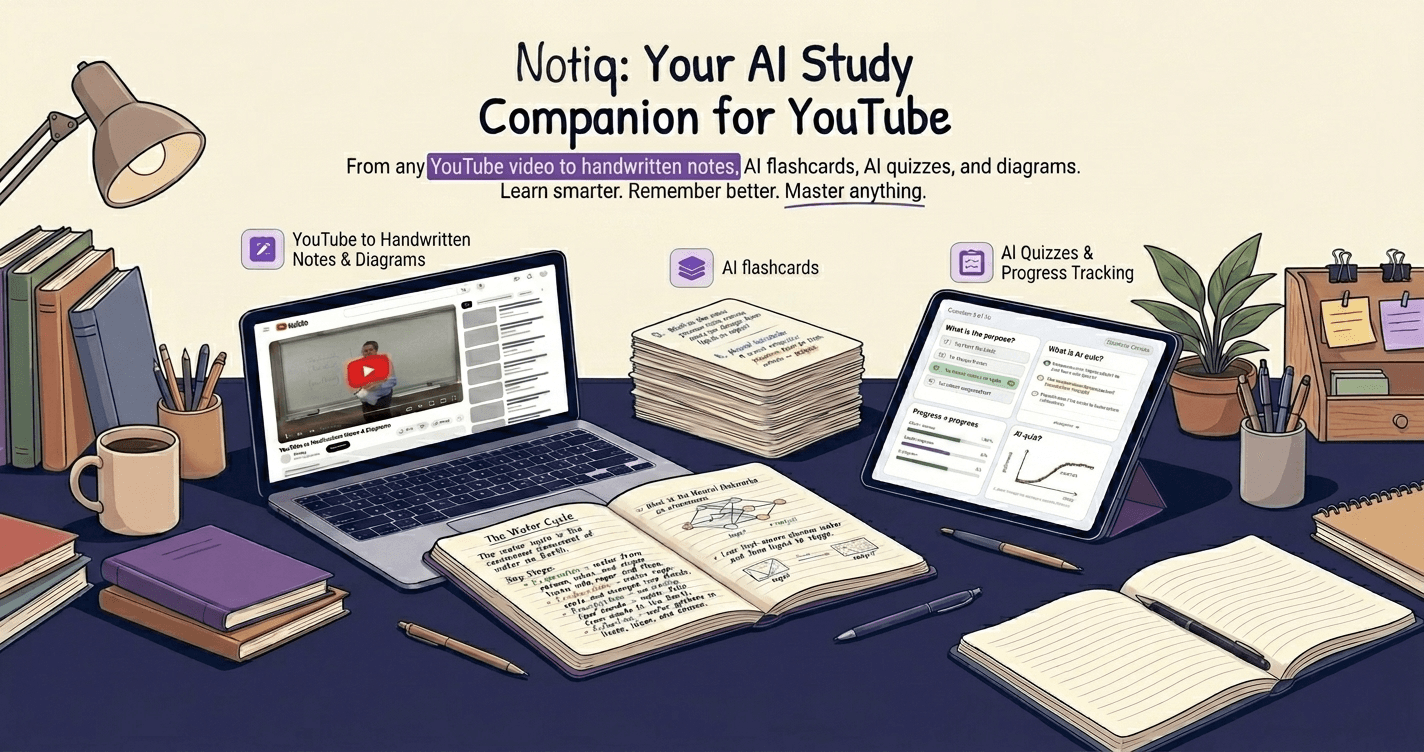
When you paste a YouTube URL into Notiq, the pipeline runs four distinct steps automatically.
Transcript extraction. Notiq pulls the video's captions directly from YouTube where they exist, or runs the audio through Whisper for accuracy on videos with auto-generated captions. The raw transcript is timestamped and cleaned before any further processing.
Chapter segmentation. The transcript is split into logical sections based on topic shifts — not arbitrary time blocks, but genuine thematic boundaries identified by the language model. A 90-minute lecture might produce eight or twelve chapters depending on how the content is structured.
Study material generation. Each chapter goes through a structured generation pass that produces: chapter notes (summarized in the handwritten-style format), key concept cards with definitions, exam questions targeting both recall and application, and flashcard pairs ready for review. For video content that includes equations or mathematical derivations, Notiq renders the math using KaTeX, so the output shows properly typeset notation rather than garbled LaTeX strings.
Visual diagram extraction. For lectures with diagrams, charts, or annotated slides, Notiq extracts relevant frames and includes them in the notes alongside the text content. This matters for anything visual — biology diagrams, circuit schematics, data visualizations, geometric proofs. The diagrams are not regenerated; they are lifted directly from the lecture so you are studying from the same visual the instructor used.
The output also supports 19 languages. If you are studying in French, Japanese, or Portuguese, you can generate the entire note set in your native language regardless of what language the lecture was delivered in. This is not a post-hoc translation — the notes are generated in the target language from the start.
The whole process takes between 30 and 90 seconds depending on video length.
Who Notiq Is Built For
Notiq was designed primarily for students preparing for high-stakes exams — university undergraduates, medical and law students, and engineering candidates who have a finite body of lecture content to master and a specific deadline to meet.
These students share a common problem: their lecture load is too high to process all of it by hand, but passive watching does not produce the retention they need. A second-year medical student might have four to six hours of new lecture content per day. A bar exam candidate might be working through 60 to 80 hours of review video. The note-taking bottleneck is not willpower — it is time.
Notiq also works well for self-learners following structured YouTube curricula — MIT OpenCourseWare sequences, Andrej Karpathy's machine learning lectures, the Khan Academy calculus series — where the video content is genuinely course-quality and worth retaining in depth. If you are working through a technical learning path and want to build a real knowledge base rather than a YouTube watch history, Notiq does the first-pass structuring work that makes the material reviewable.
It is less suited for casual watching, entertainment, or content that is primarily visual without spoken explanation. If there is no substantive spoken content, there is nothing to extract.
How Notiq Fits into a Study Workflow
Notiq produces raw study material. What you do with it afterward determines whether you actually retain anything.
The intended workflow pairs Notiq's output with active review — not passive re-reading. The flashcard pairs Notiq generates are designed to be imported into a spaced repetition system: Anki is the most widely used, and the flashcard format is compatible with standard Anki import. If you are already using Anki for your medical or language studies, the Notiq flashcards slot directly into that workflow without reformatting.
The chapter notes are structured to work alongside tools like Notion or Obsidian if you are building a longer-term knowledge base. The output is clean markdown, so it pastes into any text editor without reformatting. Students who use the Cornell method can use Notiq's chapter notes as the note column and add their own cue questions on top — which takes about five minutes per chapter and produces a significantly more useful study document than either approach alone. For more on that workflow, see the Cornell method with AI.
The exam questions are particularly useful for pre-exam review. Notiq generates both factual recall questions and applied scenario questions — the second type is what most students under-prepare for. Running through the exam questions blind, before looking at the notes, is a retrieval practice exercise that consistently outperforms re-reading in the research literature.
What Notiq cannot do: it cannot make you engage with material you are not paying attention to. If you use the generated notes as a substitute for watching the lecture at all, you are getting a compressed summary with no underlying understanding to back it up. Notiq is most effective when used after watching a lecture, as the structured output that makes what you just watched reviewable and testable. For a detailed treatment of how to use AI tools without undermining your own learning, see using AI without cheating yourself.
What Is Free vs. Pro
Notiq offers two free study note sets — no credit card required. Free notes include all the core features: chapter notes, flashcards, exam questions, and diagram extraction.
Pro removes the limit on note sets, adds priority processing (relevant if you are generating notes for a whole course in one session), and unlocks longer video support for lectures over two hours. Pro also includes access to multi-language output across all 19 supported languages, which is restricted to English on the free tier.
The intent is that two free note sets is enough to evaluate whether the output quality is actually useful for your specific courses and study style — which is the only thing that matters.
What Is Coming Next
There are several features in active development. Collaborative notes — shared, annotatable note sets for study groups — is the most requested feature. A browser extension that generates notes directly from the YouTube page without leaving the browser is in testing. Spaced repetition built into the Notiq interface itself, rather than requiring Anki export, is further out but on the roadmap.
One thing that is not on the roadmap: Notiq will not automate the cognitive work of actually learning. The tools that try to do that produce the illusion of studying rather than studying. The goal is to reduce the mechanical overhead — transcription, formatting, flashcard generation — so that the time you do spend with the material is higher-value.
Try It and Tell Us What Is Wrong
The best way to evaluate Notiq is to run the lecture that is currently giving you trouble. Not a test case — the actual lecture from the actual course you are preparing for. That is the only meaningful test.
Create a free account at notiq.study, paste the URL, and see whether the output is something you would actually study from. If the chapter segmentation is off, or the exam questions are too shallow, or the diagrams are being missed — that is the kind of specific feedback that improves the product. The feedback form is on every generated note set.
For a broader look at how to take notes effectively from video content, how to take notes from a YouTube lecture covers the full workflow — including what to do with your notes after you generate them.
There is no configuration, no learning curve, and no credit card. Start with the lecture that is giving you trouble right now.