In 2023, most AI study tools were still toys. They could summarize a paragraph if you pasted it in. They were impressive demos but not real workflow changes.
In 2025, the picture is different. Students are using AI to generate structured notes from lecture recordings, create personalized flashcard decks, get instant explanations of confusing concepts, and simulate exam questions. The tools have crossed the threshold from interesting to genuinely useful.
But there are important caveats — and most students are not thinking clearly about them.
What AI Actually Does for a Student
Automate the transcription and structuring of lectures
The single biggest time sink in traditional studying is mechanical note-taking: listening carefully enough to catch every point, deciding what to write down, formatting it legibly, and doing this across hours of content every week.
AI handles this well. Given a lecture transcript, a modern language model can identify the logical structure, extract key claims, define terminology, and organize everything into chapters with bullet points. What used to take 40 minutes per lecture can now take 60 seconds.
Generate practice questions that match the content
Generating good exam questions is hard because it requires understanding what the examiner is likely to ask. AI language models have been trained on millions of past exam papers and can generate questions that closely mimic the style and difficulty of real assessments.
More importantly, they generate questions specific to the content you just studied, not generic questions about the topic. A question about the specific algorithm explained in lecture 7 is more useful than a generic question about algorithms.
Explain concepts at the right level on demand
When a concept in your notes does not make sense, you used to have two options: re-watch the relevant segment or search for a different explanation online. Both take time.
Asking an AI model to explain backpropagation at a high school level, or to explain it again using a cooking analogy, or to relate it to something you already know — this is genuinely fast and often effective. The key is that AI can generate multiple framings of the same idea without effort, and different framings reach different learners.
Support spaced retrieval scheduling
The science of spaced repetition is well-established: reviewing material at increasing intervals dramatically improves long-term retention. The challenge is that creating and maintaining a spaced repetition schedule manually is tedious.
AI tools can generate flashcard decks from your notes and schedule reviews based on your performance. This is not new — Anki has done it for years — but AI makes the card creation instant instead of a project. You move from "I should make flashcards" to "flashcards exist and are ready" without the friction step that causes most students to skip it.
Translate and localize explanations
For students studying in a second language, AI provides something previous generations did not have: instant, accurate translation of technical explanations into their native language, and then back again. A student in Seoul studying an MIT OpenCourseWare lecture in English can ask for a Korean-language explanation of any concept without losing the technical precision that gets mangled by general-purpose translation. This is a genuine equity shift in access to educational content.
The New Skill: AI Literacy for Studying
Getting real value from AI study tools is not automatic. There is a specific skill involved — call it AI literacy for learning — and most students have not developed it yet.
The core of this skill is knowing which parts of the learning process to delegate and which to protect. Cognitive scientists distinguish between cognitive overhead and cognitive work. Cognitive overhead is mental effort that does not improve your mastery: formatting notes, searching for a definition, scheduling reviews. Cognitive work is mental effort that encodes information: working through a problem you cannot solve, generating an explanation in your own words, reconstructing the logic of an argument from memory.
AI should absorb cognitive overhead. It should not absorb cognitive work.
The generation effect — a robust finding in cognitive psychology — holds that information you produce yourself is retained better than information you read passively. This is not a minor effect. Students who explain a concept in their own words, even imperfectly, encode it more durably than students who read a clean, correct explanation from an AI. This means that using AI to generate an explanation you then read is not the same as generating the explanation yourself. The AI version is still useful as a check and as a scaffold — but it should follow your attempt, not replace it.
The practical implication: before consulting AI on any concept, try to state what you know or believe first. This takes an extra 90 seconds and produces meaningfully better encoding. Students who build this habit — brain-dump first, then verify with AI — get substantially more from AI tools than students who let the AI go first every time.
For a full framework on this, see our piece on using AI for studying without cheating yourself.
What AI Does Not Replace
The testing effect
The most replicated finding in the science of learning is that retrieval practice — being tested on material, or testing yourself on it — dramatically outperforms re-reading for long-term retention. Jeffrey Karpicke and Henry Roediger's 2008 research in Science showed that students who practiced retrieval retained about 80% of material after a week, while students who restudied retained about 35%. That is not a small difference.
AI-generated notes, however beautifully structured, produce the feeling of familiarity without the retrieval effort. Reading a clean AI summary activates recognition memory, not recall memory. Recognition is what fires when you see a multiple-choice option and think "yes, I know that." Recall is what you need to write an essay or solve a problem from scratch. The exam measures recall. The AI summary trains recognition.
The fix is straightforward: after using AI to generate your notes or flashcards, close the notes and test yourself. Do not consult the material until you have made an attempt. The discomfort of trying to retrieve something you are not sure you know is exactly the mechanism that encodes it.
Spaced retrieval over time
Sleep consolidates memories. Spacing practice over multiple days — rather than concentrating it in a single session — produces stronger long-term retention. These are not AI features. No tool changes the underlying biology of how the brain consolidates learning.
Robert Bjork's work on "desirable difficulties" identifies spacing as one of the most reliable interventions for durable learning: studying the same material across three sessions on different days outperforms three hours in a single session, even though the second feels less productive in the moment. AI can schedule your reviews. The reviews themselves still need to happen across days.
Writing to think
There is a specific cognitive process that happens when you write something from scratch: you discover what you do not know. You cannot write a sentence about a concept you have not understood. Reading, by contrast, fills in gaps automatically — you can read a sentence you would not have been able to write.
Mueller and Oppenheimer's 2014 study showed that students who took longhand notes, constrained by writing speed to process and rephrase rather than transcribe, outperformed laptop note-takers on conceptual questions — even when the laptop notes were more complete verbatim records. The processing that happens during compression is the mechanism. AI-generated summaries skip this step by design.
Writing-to-think is irreplaceable for complex subjects. Whether it is writing a paragraph summarizing what you understood from a lecture or working through a proof step by step, the act of producing — not reading — is what makes the learning durable. Use AI to give you the structure. Do the writing yourself.
The social dimension of learning
Study groups, tutorials, debates with classmates — these develop skills that AI interaction does not: the ability to defend your understanding under questioning, to explain ideas clearly to someone who is confused, to be wrong in front of others and recover. Explaining a concept to another human who can push back is harder and more valuable than explaining it to a chatbot. AI does not simulate the pressure of real-time social accountability, and that pressure is part of how knowledge becomes robust.
Workflow Patterns That Compound: A Worked Example
Theory is only useful if it translates into practice. Here is a concrete AI-augmented study session for a hard subject — assume a second-year undergraduate working through a lecture on the chain rule in multivariable calculus.
Before watching (5 minutes): Open the course notes or syllabus. Ask AI: "What are the three things a student typically finds hardest about the multivariable chain rule?" You are not using the AI to replace your learning — you are loading a cognitive frame so you know what to watch for.
During the lecture (real-time, no AI): Watch with the goal of understanding, not perfect transcription. Note timestamps where something is unclear. Write in fragments. Do not try to be complete.
Immediately after (10 minutes, brain-dump first): Before opening any AI tool, write for 5 minutes: what was the main claim of the lecture, what are the steps of the chain rule, where did you get confused? This retrieval attempt activates the testing effect even when the material is still warm.
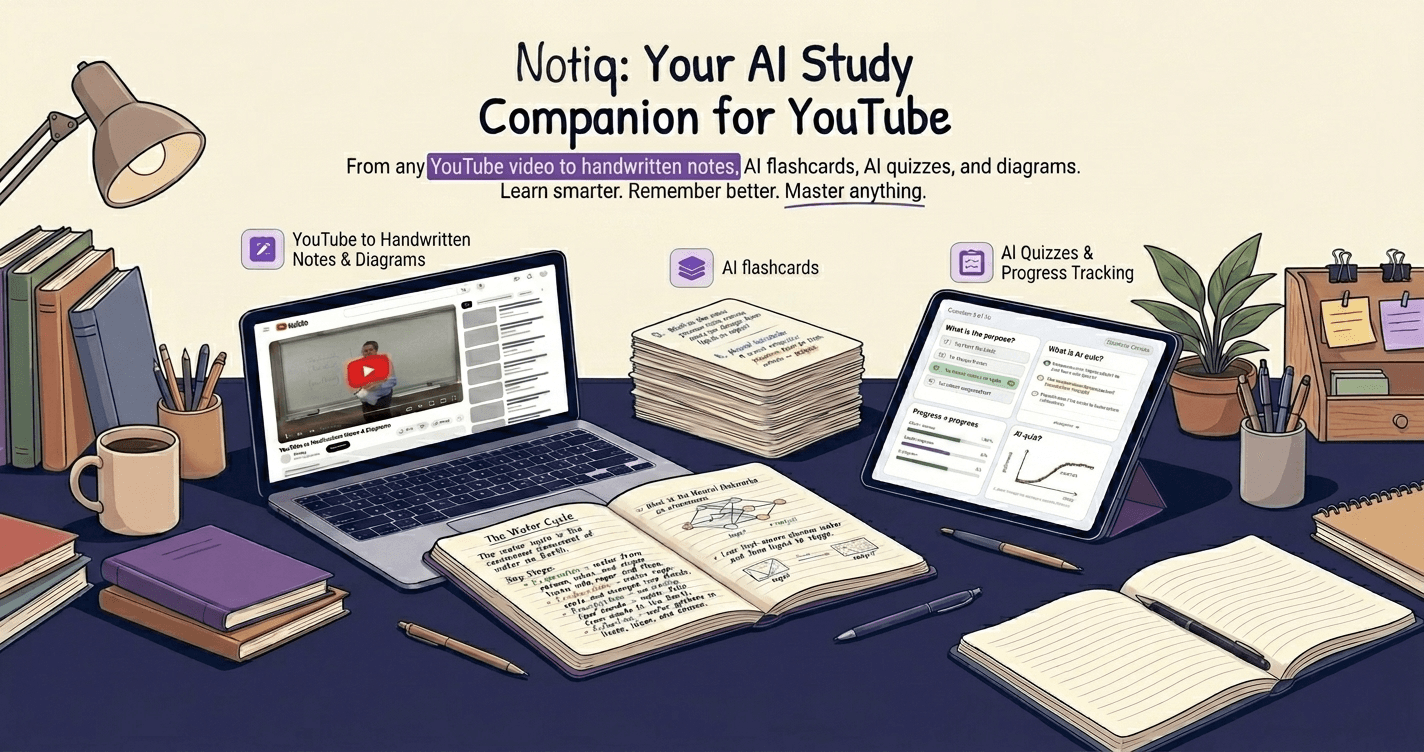
AI processing (5 minutes): Paste your rough notes into Notiq or an AI assistant. Ask for a structured summary and 8–10 exam-style questions. Compare the AI's summary to your brain-dump. Mark every concept the AI captured that you did not — these are your gaps.
Active engagement with gaps (20 minutes): For each gap, ask AI to explain it in two ways: first technically, then with an analogy. Then close everything and try to write the explanation yourself. If you cannot reproduce it, you have not understood it yet. Ask again. Try again.
End of session (5 minutes): Add the AI-generated flashcards for this lecture to your spaced repetition queue. Schedule your first review for 24 hours from now.
This session is 45 minutes of real cognitive work, not passive reading. The AI handles transcription, structuring, and flashcard creation. You handle the retrieval, the self-explanation, and the gap-filling. The combination is faster than traditional studying and more effective than either approach alone.
For more on how these methods layer with note-taking systems, see our Cornell method with AI guide and active recall techniques.
The Risks
Illusion of competence
This is the most common and the most dangerous failure mode. Students who read AI-generated summaries consistently feel more prepared than they are. The material is familiar, the notes are clean, the session felt productive. Then the open-book practice exam reveals that they cannot reproduce any of it without the notes in front of them.
The illusion arises because fluency and recall feel similar from the inside. Both feel like "knowing something." The difference only becomes visible under retrieval conditions — exactly the conditions of an actual exam. Students who build workflows around AI reading without retrieval practice will underperform relative to their effort, and they often do not understand why.
The single most reliable diagnostic: can you explain the key ideas from this lecture to someone else, out loud, without looking at anything? If not, you do not know it yet.
Prompt-dependence
A subtler risk: students who use AI heavily for studying can develop dependence on prompted recall. They can retrieve information when a question is asked but struggle to generate the question themselves. This matters because real-world application of knowledge usually requires knowing what question to ask, not just answering one that has been posed.
Building some unprompted practice into your workflow — mind-mapping without prompts, free-writing summaries without a question to respond to — counteracts this tendency. See our piece on AI vs human notes for a more detailed treatment of where prompted and unprompted recall diverge.
Hallucination on niche material
Language models do not know when they do not know something. In introductory coursework on well-documented topics, AI accuracy is high. In advanced or rapidly-evolving fields — cutting-edge machine learning, recent legal developments, niche historical debates — AI makes errors with the same confident tone it uses when it is correct.
Students who use AI for studying need to develop verification habits, especially for technical details, specific dates, and any claim where precision matters. AI is a scaffold. Lecture notes, textbooks, and original papers are ground truth. When the two conflict, always resolve in favour of the primary source.
Where This Goes in the Next Two to Three Years
The current generation of AI study tools processes text. The next generation will process everything.
Multi-modal understanding is already arriving. Tools that can watch a lecture video, process the visuals, diagrams, and mathematical notation alongside the audio, and generate notes that reference the visual content ("at 14:30, the professor draws a graph showing...") are emerging now and will be widespread within 18 months. For subjects like physics, chemistry, and mathematics — where the visual content is often the substance — this is a significant capability upgrade.
Personalised explanation models will become more practical. Today's AI gives you the same explanation it gives everyone. Near-future AI will know your prior knowledge gaps, your preferred analogies, your performance history on similar concepts, and generate explanations calibrated to your specific cognitive profile. This is closer to a good tutor than a good textbook.
Deep integration into note-taking applications is the third shift. AI study tools will not be standalone products that you paste content into. They will be embedded into the tools you already use — your note app, your video player, your e-reader — with real-time processing, contextual question generation, and spaced repetition scheduling that runs in the background. The friction between capturing content and learning from it will shrink considerably.
What will not change is the underlying neuroscience of memory consolidation. Multi-modal AI cannot replace retrieval practice. Personalised explanations do not substitute for writing to think. Better integrations do not encode information on your behalf. The tools get more capable; the human mechanisms of durable learning remain what they are.
The Principle That Governs All of It
Every debate about AI and studying collapses to one question: who is doing the cognitive work?
AI is excellent at ingestion and structure. It can process a two-hour lecture faster than you can, organize it more clearly than you would, generate practice questions you would not have thought to write, and build a flashcard deck from material that would otherwise sit unreviewed in a notebook. All of that is genuinely valuable.
Human cognition is irreplaceable for encoding. The testing effect, spaced retrieval, elaborative processing, sleep consolidation — none of these can be outsourced. They require your brain to do difficult, effortful work on the material over time.
The students who will benefit most from AI study tools are the ones who use AI to remove every obstacle between themselves and the effortful cognitive work — and then do the effortful cognitive work. The students who will be hurt by AI study tools are the ones who use AI to remove the effortful cognitive work itself.
The tool is not the problem. The workflow is.
For a practical framework on building a workflow that uses AI's strengths without losing the retrieval practice that actually encodes learning, see our complete guide on how to use AI for studying without cheating yourself. And for a side-by-side look at where AI-generated notes fall short of human processing, AI vs human notes covers the research directly.
Notiq is designed with this principle in mind. The AI generates the structure so you do not have to. The flashcards and exam questions make retrieval practice easy to do. What you do with that is still up to you.