Let us get something out of the way immediately: Notion AI is not a bad product. It is a well-built, genuinely useful AI layer on top of one of the most popular productivity tools in the world. If someone tells you to use Notiq instead of Notion for everything, they are overselling it.
The real question is narrower: for a student or self-learner whose primary source of content is YouTube video, which tool gives you a faster and more reliable path from "I just watched a lecture" to "I have structured notes and can actually recall this"?
That is the question this comparison answers honestly.
What Notion AI Actually Does
Notion has been the dominant all-in-one productivity and knowledge management tool since roughly 2021. It handles documents, databases, project management, wikis, and personal notes in a single workspace. Teams use it to run companies. Individuals use it to manage everything from book lists to job applications to research notes.
Notion AI, introduced in 2023 and substantially improved since, adds an AI writing and summarization layer on top. From within any Notion page, you can ask AI to:
- Summarize the current document
- Expand a bullet point into a paragraph
- Translate text to another language
- Generate action items from meeting notes
- Answer questions about the content on the current page
- Draft new content based on a prompt
It also has an AI-powered search feature that lets you ask questions across your entire workspace.
Where Notion AI is genuinely strong: Documents and collaborative workspaces. If you are working on a team project, writing a research paper, managing a wiki, or building a knowledge base from text sources, Notion AI is excellent. The database features (filtered views, rollup properties, linked databases) are powerful and have no real equivalent in Notiq.
Notion's official documentation is at notion.so and gives a clear picture of the full feature set.
What Notiq Does
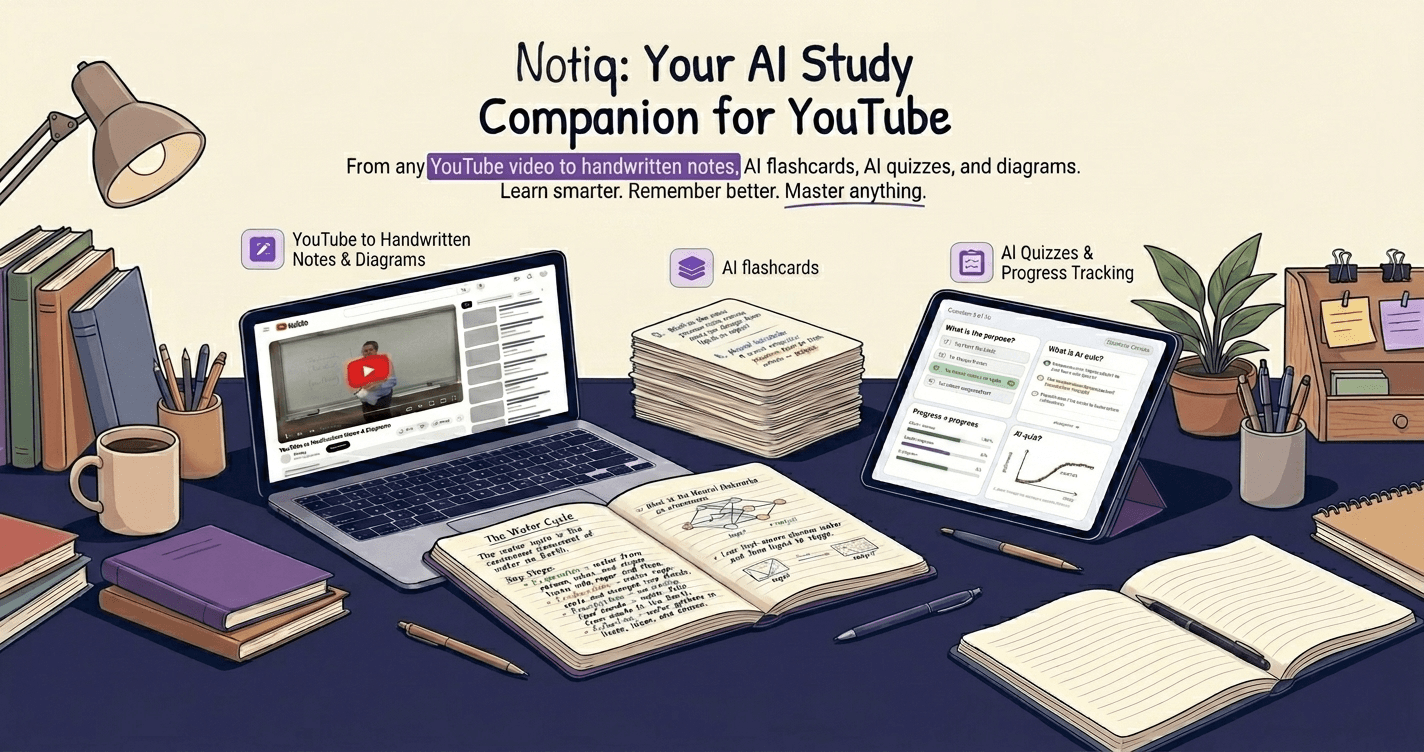
Notiq is purpose-built for a different workflow: learning from YouTube video. You give it a YouTube URL, it processes the lecture or tutorial, and generates structured study notes — with section headers, key concept definitions, and a flashcard deck ready for spaced repetition review.
The design principle is that the most time-consuming part of YouTube-based learning is the synthesis step: watching the video, deciding what matters, structuring it into something you can review. Notiq automates that synthesis, which typically takes 30 to 60 minutes per lecture, down to under two minutes.
Where Notiq is genuinely strong: Any workflow where the source material is video. Technical courses, lecture recordings, tutorial series, documentary-style content — anything where you would otherwise pause, rewind, type, and lose the thread.
How Does the YouTube Workflow Compare?
This is the key question for students.
In Notion AI: There is no native YouTube integration. You would need to either manually transcribe/copy a transcript into a Notion page and then ask AI to summarize it, or use a third-party tool to get the transcript first. Neither workflow is seamless. Notion AI can then process the pasted text well, but the capture step requires manual work.
In Notiq: You paste a YouTube URL and the tool handles transcription, structure, and flashcard generation in a single step. There is no intermediate manual step.
For YouTube-heavy learners, this is a meaningful gap. If you are watching 3–5 hours of educational video per week, the difference between a two-click process and a five-to-ten-step process compounds significantly.
See the complete YouTube-to-notes workflow guide for a step-by-step breakdown of what this looks like in practice.
How Does Note Structure Compare?
Notion AI generates prose by default. You can ask it to use bullet points or headers, but it takes prompting. The output tends to be paragraph-form summaries that read well but are less immediately useful for exam review than structured outlines.
Notion's real strength is its database and relational features. A Notion workspace where you tag notes by course, topic, and concept and then filter across them is genuinely powerful — but building that system requires upfront design time that many students do not invest.
Notiq generates structured notes by default: a header hierarchy, key concepts called out explicitly, and defined terms. The output is designed for revision rather than reading. The handwritten-style aesthetic is also worth noting — the interface is designed to feel less like a productivity app and more like a physical notebook, which some learners find less intimidating.
Flashcards and Spaced Repetition — Where Does Each Tool Land?
Notion AI does not have a built-in spaced repetition system. You can use Notion to store flashcard-style content (a database with a question field and answer field is easy to set up), but there is no scheduling algorithm. You would need to export to Anki or use a third-party Notion-to-Anki integration.
Notiq generates flashcards as part of the note-creation step and has built-in spaced repetition scheduling. This keeps the workflow in one place. For students whose primary need is exam preparation from video sources, this is a significant practical advantage.
The complete AI study notes guide covers the research on why spaced repetition scheduling matters and which tools implement it most effectively.
What About Pricing?
Notion has a free tier that is functional for individual use. Notion AI is an add-on that costs $8/month per user (as of 2026) on top of the base plan. For teams, costs scale with user count.
Notiq pricing is listed at notiq.study — there is a free tier with limits on the number of videos processed per month, and paid plans for heavier use.
Neither tool is expensive relative to what they replace, but Notion AI's cost is additive if you are already paying for Notion.
Which Should You Actually Choose?
Here is the honest answer by use case:
Use Notion AI if:
- Your primary content source is text (articles, papers, documentation, meeting notes)
- You work collaboratively with others and need shared workspaces
- You manage projects, databases, or wikis alongside your notes
- You need highly customizable structure and are willing to invest time in setup
- You are already in the Notion ecosystem and switching costs are high
Use Notiq if:
- You primarily learn from YouTube — lectures, tutorials, course content
- You want flashcards and spaced repetition without a separate tool
- You prefer a simple, frictionless setup over maximum customizability
- You are studying for exams and want structured, revision-ready notes fast
Use both if:
- You use YouTube for learning content but Notion for project management and collaboration
- Different study workflows call for different tools — there is no rule that says you pick one
The self-learner's toolkit guide covers how Notiq and Notion fit into a broader stack with Anki, Readwise, and other tools.
What Does Notion AI Do Better Than Notiq?
Several things worth naming:
General-purpose writing assistance. Notion AI's drafting and editing capabilities are more flexible. If you need to write summaries, reports, or structured documents from scratch, Notion AI is the better writing assistant.
Collaborative workspaces. Notiq is a personal learning tool. Notion is built for teams. If you are part of a study group, research team, or class that shares notes, Notion's sharing and permission model is far more developed.
Database and relational structure. The ability to create linked databases — tagging every note with metadata, building filtered views, rolling up information across pages — is genuinely powerful for long-term knowledge management. Notiq does not have this.
Integration ecosystem. Notion connects to hundreds of other tools. Notiq is more narrowly focused.
What Does Notiq Do Better Than Notion AI?
Also worth naming:
YouTube-native workflow. No manual steps, no transcript copying, no prompting required.
Structured output by default. Notes come out in a revision-ready format without needing to engineer the prompt.
Flashcard generation. From video to review-ready deck in under two minutes.
Simplicity. Notion's power comes with complexity. Notiq's narrower scope means less time spent on setup and system design.
See also: 10 free AI tools for students for a broader look at where both of these tools fit in the 2026 AI study landscape, and NotebookLM vs Notiq for how Notiq compares to Google's source-grounded research assistant specifically.
How Do the Two Tools Handle Mobile and Cross-Device Use?
This is a practical consideration that does not often appear in comparison articles but matters for students who study across devices.
Notion has well-maintained iOS and Android apps that are functionally equivalent to the web app for reading and editing. Notion AI is available in the mobile apps. The sync is fast and reliable. This makes Notion a strong choice for students who do a lot of reading and review on their phones or tablets.
Notiq is primarily a web-first tool. The workflow of pasting a YouTube URL and generating notes is better suited to a desktop or laptop environment. Review sessions (going through flashcards) work on mobile, but the initial capture step is most comfortable at a keyboard.
If a significant portion of your study time happens on mobile — commuting, study breaks, waiting rooms — Notion has an edge on cross-device experience.
What Happens When You Try to Import or Export Your Data?
Data portability matters more than most people realize when they are setting up a tool. The question is: if you decide to switch in a year, how painful is it?
Notion exports to Markdown, CSV (for databases), and PDF. The Markdown export is functional but not perfect — the conversion from Notion's block-based format to plain Markdown loses some formatting. For most purposes, the export is good enough.
Notiq exports notes in Markdown format and can export flashcard decks to Anki's native format. This means your flashcards are not locked in — you can migrate to Anki proper if you want more control over your spaced repetition system.
Both tools are reasonably open in their export capabilities. Neither is completely lock-in-free, but neither is predatory about it either.
Should You Use Both Tools in Combination?
This is worth considering seriously. The tools are not mutually exclusive, and many serious students use them for different parts of their workflow.
A practical combination: use Notiq for initial capture and note generation from YouTube videos, then paste key insights into Notion as structured reference documents. This gives you the speed of Notiq's YouTube pipeline and the organizational power of Notion's database features for managing a larger body of material.
The main cost is the extra step of moving content between tools. Whether that friction is worth the benefit depends on how much of your work is YouTube-based versus text-based. For YouTube-heavy workflows, it is usually not worth it — Notiq's all-in-one capture-to-flashcard pipeline is more valuable than the organizational features of Notion. For mixed workflows, the combination is sensible.
The Bottom Line
Notion AI is better for general-purpose knowledge work and collaboration. Notiq is better for YouTube-first study workflows with built-in retention features.
If you are a student who spends most of your study time watching lectures and tutorials, Notiq removes the single most time-consuming friction point in that workflow. If you are managing a complex knowledge base across multiple sources with team members, Notion AI has capabilities Notiq does not offer.
They are not direct competitors so much as tools aimed at different primary problems. The choice is about which problem you most need solved.
See what Notiq does for your YouTube workflow. Try it free at notiq.study — no credit card required to start.