JEE preparation is unusual among competitive exams in how much free, high-quality YouTube content exists specifically for it. Physics Wallah — started by Alakh Pandey as a single YouTube channel in 2016 — has taught an estimated six million students and grew into a multi-billion-dollar education company, built entirely on the premise that JEE-quality teaching should not require an expensive coaching institute. The free content available now genuinely rivals what students pay lakhs of rupees for at traditional coaching centers.
The problem is not access. The problem most self-directed JEE aspirants run into is sequencing: which channel for which subject, how much NCERT review versus how much PYQ (previous year questions) practice, and how to avoid the trap of watching hours of content while your problem-solving speed — the thing JEE Advanced actually tests — does not improve.
Understanding What JEE Actually Tests
JEE Main and JEE Advanced test Physics, Chemistry, and Mathematics at a level built on the NCERT class 11–12 syllabus, but the exam questions are application-level — multi-step problems that require combining concepts from different chapters, not the direct recall NCERT exercises test. This gap is exactly where most self-study plans fail: students who have "read" NCERT thoroughly still find JEE-level problems unfamiliar, because reading a textbook chapter and being able to apply it under exam conditions are different skills.
JEE Main qualifies students for NITs and is also the first filter for JEE Advanced, which determines IIT admission. The volume of applicants (well over a million for JEE Main) makes the exam ruthlessly competitive at the margins — a handful of correctly or incorrectly solved problems can move your rank by thousands of places.
Physics Wallah and the Major Free Channels
Physics Wallah (Alakh Pandey) is the starting point for most free JEE prep today. What made the channel work from the beginning was Pandey's teaching style — direct, exam-focused, delivered mostly in Hindi-English mix, with an emphasis on problem-solving technique over abstract theory. The channel has since expanded into a full platform (PW) with dedicated sub-channels for JEE, NEET, and board-specific content, including "PW JEE Wallah" for JEE-specific long-form lecture content covering full NCERT chapters in single sessions.
How to use Physics Wallah's one-shot videos: these are long (often 3+ hours) single-session videos covering an entire NCERT chapter. They work best as a first-pass content review — watch the full session once at 1.25–1.5x speed, taking notes on formulas and worked examples, then immediately follow with NCERT exercise questions on the same chapter before moving on. Do not treat the one-shot video as complete preparation for that chapter; treat it as the fastest path to being ready to start problem-solving on it.
Unacademy and Vedantu JEE channels provide similar free long-form and short-form content, often with faculty who have a coaching-institute background (many ex-Allen, ex-FIITJEE, or ex-Resonance teachers now teach on YouTube). These channels are useful for getting a second explanation style on a topic you found confusing on Physics Wallah — different teachers frame the same concept differently, and sometimes the second framing is the one that clicks.
eSaral and other PYQ-focused channels specialize in walking through previous year JEE questions chapter by chapter, which is a different and complementary skill from content-review videos. Once you have covered a chapter's theory, PYQ-walkthrough videos show you exactly what application-level questions from that chapter look like in the actual exam — closing the theory-to-application gap directly.
A Study Sequence That Avoids the Common Trap
The single most common failure mode in YouTube-based JEE prep is accumulating video-watching hours without a corresponding increase in problems solved independently. Video hours feel productive; they are not the same as exam-ready skill.
Step 1 — NCERT first pass with a Physics Wallah or equivalent one-shot video per chapter. Budget roughly one chapter every 2–3 days across Physics, Chemistry, and Math in parallel (do not finish one subject before starting the next — JEE rewards breadth maintained across all three subjects simultaneously, not sequential mastery).
Step 2 — NCERT exercises, done without looking at the video. Immediately after each chapter's video, close it and work every NCERT exercise question independently. This is the retrieval step that converts passive viewing into actual skill. If you cannot solve an NCERT exercise question after watching the corresponding video, the video did not teach you the chapter — it introduced you to it.
Step 3 — chapter-wise PYQs. Once NCERT exercises feel comfortable, move to chapter-wise previous year questions (available free on most coaching websites and covered in PYQ-walkthrough videos). This is where the real difficulty jump happens, and it is normal to struggle here even after a solid NCERT pass. The gap between NCERT-level and JEE-level difficulty is real and requires dedicated practice to close — it does not close automatically from watching more content.
Step 4 — full mock tests under timed conditions, starting roughly 4–6 months before your exam date and increasing in frequency as the exam approaches. Mock test review is where you find your actual weak areas — not by rewatching content, but by categorizing every wrong answer as a concept gap, a careless error, or a time-management failure, and addressing each category differently.
For the retrieval-practice principle underlying steps 2 and 3, see active recall techniques. For structuring a multi-month schedule that survives real-life disruptions, see how to make a study schedule that actually works.
Where Free YouTube Content Genuinely Falls Short
Being honest about the limits matters more for JEE than for most exams, because the margin for error is so thin.
Personalized feedback on your problem-solving approach is the biggest gap. A video cannot watch you solve a problem and tell you that your approach to a mechanics problem was needlessly complicated, or that you consistently misapply a particular formula in a specific problem type. This is exactly what a good teacher, mentor, or peer study group provides, and no amount of additional video content substitutes for it.
Mock test analysis at scale. Serious JEE aspirants take dozens of full mock tests in the final year of preparation. Reviewing each one thoroughly — not just checking the score, but categorizing every error — is time-consuming, and most self-directed students under-invest in this step relative to watching more content, which feels more productive in the moment but produces less rank improvement.
All-India percentile calibration. Free content cannot tell you where you genuinely stand relative to the national applicant pool. Paid test series (from Allen, FIITJEE, Resonance, or online platforms) that provide all-India ranking on mock tests give you the calibration that free chapter-wise PYQs cannot.
The realistic strategy: use free YouTube content for the bulk of your content review and initial problem practice — it genuinely covers this well — and budget for at least one paid test series in your final 6 months for calibrated mock exams and all-India ranking feedback.
Taking Notes During Long-Format JEE Videos
Physics Wallah's one-shot videos run for hours, which makes note-taking discipline especially important — passive watching for 3 hours produces almost no retention regardless of how good the teaching is.
Write formulas and worked example structures by hand as you watch, not typed. For physics and math especially, the physical act of writing out a derivation or a worked problem step by step engages the procedural memory that a JEE exam actually draws on. Pause after each worked example and attempt a similar problem before continuing — do not wait until the video ends to test yourself, because a 3-hour video contains far more material than you can accurately self-assess after the fact.
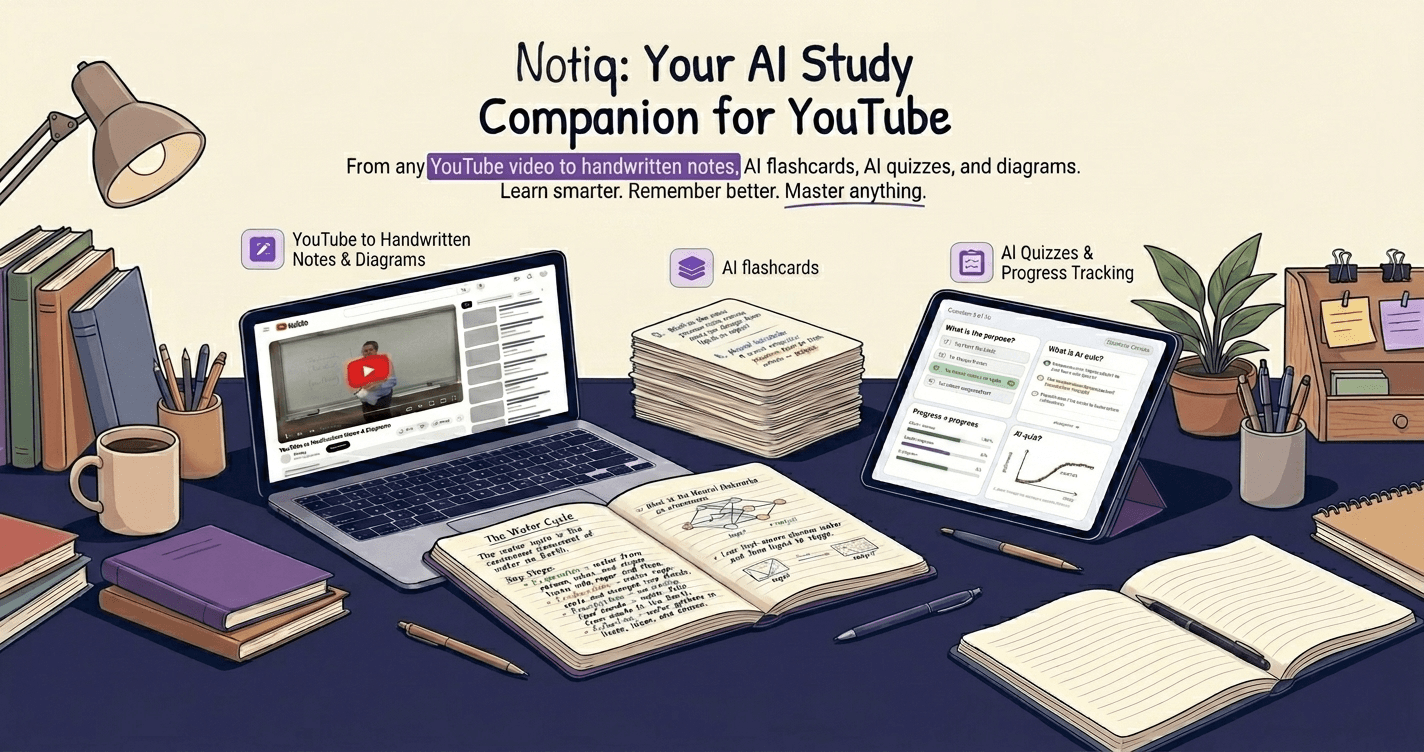
If you are processing long lecture videos and want the chapter structure, key formulas, and a starting flashcard deck generated automatically rather than built by hand from scratch, Notiq turns a YouTube lecture link into structured notes and flashcards in under a minute — useful for quickly building a formula-reference sheet from a long one-shot video before you start problem practice on that chapter.
For other exam-specific guides built around the same free-content-plus-retrieval-practice structure, see how to study for the MCAT using YouTube and AP exam prep using YouTube and AI notes. If you are also considering (or your syllabus overlaps with) medical entrance exams, NEET preparation using YouTube covers the same Physics Wallah ecosystem applied to NEET's Biology-heavy weighting.
The free JEE prep ecosystem on YouTube, led by Physics Wallah and a handful of other serious channels, has genuinely changed who can compete for a top rank. What it has not changed is the amount of deliberate, independent problem-solving practice a top rank actually requires — that part was never going to be free, in the sense that no video can do it for you.
Want your JEE lecture videos turned into structured revision notes automatically? Try Notiq free at notiq.study — paste any physics, chemistry, or math lecture link and get organized notes and flashcards in minutes.