Advanced Placement exams are a specific kind of test: a fixed, published curriculum (the College Board sets the exact topics for every AP course), a fixed exam date in May, and a 1–5 score that most colleges will accept for credit at a 3 or above. Because the curriculum is standardized and published, AP exams are unusually well-suited to free YouTube-based prep — the content you need to know is a known quantity, not a moving target.
Khan Academy formalized this by building official, College Board–partnered AP courses for most of the major AP subjects, structured around four-week review plans with daily practice sessions. For subjects Khan Academy does not cover — the AP humanities courses in particular — a small number of specialist YouTube channels fill the gap just as thoroughly.
Khan Academy's Official AP Courses
Khan Academy offers College Board–aligned AP courses across four groups: Math (Calculus AB, Calculus BC, Statistics), Science (Biology, Chemistry, Environmental Science, Physics 1, Physics 2), Social Studies (US History, US Government and Politics, World History), and Economics (Macroeconomics, Microeconomics), plus Computer Science. Every course is free and structured into units that map directly onto the official College Board course framework — the same structure your AP teacher's syllabus is built from.
Why the direct College Board alignment matters: unlike a generic subject-review channel, Khan Academy's AP courses do not just cover "biology" or "US history" broadly — they cover the specific subset of content, and specific skill categories, that the actual AP exam tests, in the same unit breakdown the exam's score report uses. When you finish a unit on Khan Academy, you have finished the corresponding unit on your exam's blueprint, not just watched a loosely related video.
How to use it: Khan Academy's own recommended structure — a four-week review plan with short daily sessions — works well as a final review pass in the month before the exam, layered on top of your regular class coverage during the year. Do not save Khan Academy exclusively for the final month if you can help it; using it throughout the year to reinforce topics as your class covers them prevents the panic-compress that a single four-week review has to fight against.
What to Use for the AP Humanities Courses
Khan Academy's course lineup is strongest in STEM and social science; it does not currently offer full dedicated courses for AP English Language, AP English Literature, AP Psychology, AP Human Geography, AP European History, or several other humanities and language APs. Heimler's History, run by former AP teacher Steve Heimler, is the standout free resource for this gap — the channel covers AP US History, AP World History, AP European History, AP Human Geography, and AP Government and Politics with unit-by-unit review videos built explicitly around the College Board's own course frameworks, the same structure Khan Academy uses where it does have coverage.
What makes Heimler's History work as exam prep specifically: the videos are built as review, not first-time instruction — they assume you have already covered the material in class and are designed to consolidate and organize it before the exam, with an emphasis on the specific historical thinking skills (causation, comparison, continuity and change) that AP history exams grade on, not just factual recall.
For AP Psychology, AP Human Geography, and other courses without a single dominant free channel: search for the specific unit name plus "AP review" — most AP subjects now have at least a handful of teacher-created review channels covering the College Board's published unit breakdown, even where no single channel has built out full-course coverage the way Heimler's History or Khan Academy has.
A Study Plan That Works Across the School Year
During the school year: use Khan Academy (or the relevant humanities channel) as reinforcement immediately after each unit your class covers, not as a separate parallel curriculum. Watching the corresponding review video within a few days of finishing a unit in class — while the material is still fresh — is far more effective than saving all video review for a cram session months later, because you are reinforcing an already-partially-formed memory rather than building one from scratch under time pressure.
Starting in March–April (6–8 weeks before the May exam): shift into full review mode. Work through Khan Academy's four-week AP review plan (or an equivalent structured pass through Heimler's History's full unit list for humanities APs) unit by unit, in order, using the class's original unit sequence rather than jumping around.
Final 2–3 weeks: stop reviewing content in video form as your primary activity and shift almost entirely to full-length practice exams under timed conditions, using released College Board free-response questions and multiple-choice sets. AP exams are unusually well-documented — the College Board publishes real past free-response questions and scoring guidelines for most subjects — and working through these under real timing is more predictive of your actual score than any additional amount of video review at this stage.
For the retrieval-practice principle that makes review sessions actually stick rather than just feeling productive, see active recall techniques. For a compressed final push in the days immediately before the exam, how to cram for an exam in 24 hours covers a science-backed approach — useful as a last-mile tool, not a substitute for the months of steady review above.
Turning AP Review Videos into Flashcards Instead of Just Watching Them
AP exams reward two different skills depending on the course: fast, accurate factual recall (most STEM and social science multiple-choice sections) and structured argument-writing under time pressure (free-response sections, especially in history and English). Video review alone builds neither reliably — you need to convert what you watch into something you actively retrieve.
For fact-heavy content (biology terminology, historical dates and causes, economics definitions), flashcards built from your review videos and drilled with spaced repetition close the recall gap. See how to make flashcards that actually stick for card-design principles, and the science behind AI-generated flashcards for why spaced review specifically (not just "reviewing a lot") is what produces durable recall by exam day.
For free-response and essay-based sections, flashcards do less work — what actually helps is writing full practice responses against real prompts and comparing them to the College Board's published scoring guidelines, which spell out exactly what graders are rewarding at each score level.
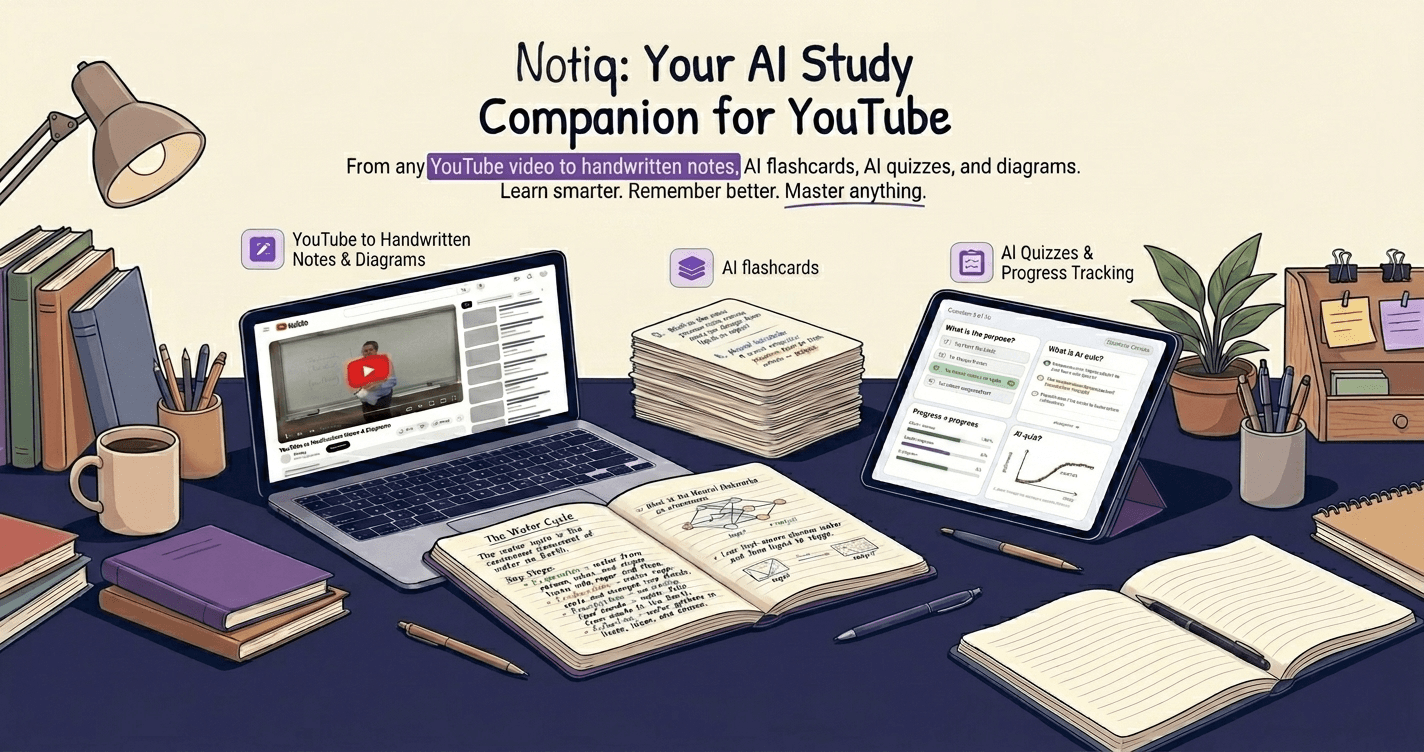
If you are working through a stack of Khan Academy or Heimler's History review videos and want structured notes and a starting flashcard deck generated automatically as you go, rather than pausing to write everything down by hand, Notiq turns any YouTube review video into organized chapter notes and flashcard-ready question-answer pairs in under a minute — a fast way to build your spaced-repetition deck from video content without the manual transcription step.
Is Free YouTube Content Enough for a 4 or 5?
For most AP subjects, yes — genuinely. The exams are curriculum-aligned by design, the College Board publishes real past exam questions with scoring guidelines, and Khan Academy plus a small set of specialist channels cover the full published curriculum for nearly every AP course. Students who work through the material consistently across the school year, then run a disciplined final review using real released free-response questions, regularly earn 4s and 5s without paid tutoring or courses.
Where free content is not enough on its own: courses that are heavily writing-skill-dependent (AP English Language and Literature especially) benefit from actual human feedback on your essays — a teacher, a well-calibrated peer, or a formal writing tutor — because no video can grade your specific argument structure the way the AP exam's graders will. Budget for at least a few rounds of real feedback on practice essays if your target course has a substantial free-response writing component.
For other standardized-exam guides using the same approach, see how to study for the MCAT using YouTube and JEE preparation using YouTube. For AP Psychology and AP History specifically, best YouTube channels for psychology and best YouTube channels for history go deeper on the channel-by-channel breakdown than this guide covers.
The AP program's published, standardized curriculum is exactly what makes free YouTube-based prep unusually effective for it — the content you need is a known, public quantity, and Khan Academy plus Heimler's History cover nearly all of it for free.
Want your AP review videos turned into organized notes and flashcards automatically? Try Notiq free at notiq.study — paste any Khan Academy or review-channel video link and get structured notes plus exam-ready flashcards in minutes.