Ask ten students what "note-taking method" means and most will name one of two things: Cornell notes, or bullet points. That's not because only two methods exist. It's because most lists of note-taking methods stop at three or four and call it a day.
There are more than a dozen documented, widely-used note-taking systems, each built for a different kind of content. A method built for a linear 50-minute lecture is the wrong tool for a dense research paper. A method built for connecting ideas across a semester is the wrong tool for a single exam-prep session. Picking the wrong one doesn't just waste time — it produces notes that look complete but don't actually help you when you need to recall the material.
This is the exhaustive version: 12 real, recognized note-taking methods, what each one is actually for, and a concrete example of each in use. If you only want the deep comparison of the four most common systems — Cornell, Zettelkasten, outline, and mapping — see note-taking methods compared. This post is the wider net: everything else worth knowing, plus those four in brief.
1. The Cornell Method
What it is: Developed by Walter Pauk at Cornell University in the 1950s, this splits the page into three zones: a wide note-taking column on the right, a narrow cue column on the left (filled in after class with questions and keywords), and a summary box at the bottom (a few sentences in your own words, written after the fact).
When to use it: Live lectures, especially content-heavy ones with a clear structure — science, history, law, economics. Anything where content arrives linearly and you can't control the pace.
Example: During a biology lecture on cellular respiration, the right column captures the stages (glycolysis, Krebs cycle, electron transport chain) as the professor covers them. After class, the left column gets cues like "Where does glycolysis occur?" and the bottom gets a two-sentence summary of how the three stages connect to produce ATP.
We've written a full guide on this system, including how AI can auto-generate the cue column and summary: the Cornell method with AI.
2. Zettelkasten
What it is: German for "slip box," this method was developed by sociologist Niklas Luhmann, who used a physical version of it to write over 70 books. Notes are atomic (one idea per note), written in your own words, and linked to other related notes — the value comes from the network, not any single note.
When to use it: Research, long-form writing, and building a personal knowledge base you'll draw on for months or years. It's a synthesis tool, not a capture tool.
Example: A note titled "Retrieval practice beats re-reading for long-term retention" links to a separate note on spaced repetition intervals, another on why testing feels harder than re-reading (and why that difficulty is the point), and a third on how this applies to language learning specifically.
3. The Outline Method
What it is: The most common note-taking format in the world — hierarchical bullet points, with main topics flush left and supporting details indented beneath them. It mirrors the logical structure of most textbooks and structured lectures directly.
When to use it: Reading textbooks, or any lecture organized around a clear topic → subtopic → detail hierarchy. It's fast, requires no setup, and works in any note app without modification.
Example:
Photosynthesis
  Light-dependent reactions
    Occur in thylakoid membrane
    Produce ATP and NADPH
  Light-independent reactions (Calvin cycle)
    Occur in stroma
    Use ATP and NADPH to fix CO2
4. Mind Mapping
What it is: A visual, non-linear method where a central concept sits in the middle of the page and related ideas branch outward, with sub-branches for further detail. Popularized by Tony Buzan in the 1970s.
When to use it: Brainstorming, exploring relationships between ideas, and any content where the connections between concepts matter more than a strict sequence. It's weaker for dense factual content because it doesn't scale well past a single page.
Example: A central node labeled "World War I Causes" branches into "Militarism," "Alliances," "Imperialism," and "Nationalism," each of which branches further into specific events and countries. For a deeper look at when this format helps and when it doesn't, see mind maps for visual learners.
5. The Charting Method
What it is: A table with columns you define in advance, where each row represents one item and each column captures one attribute. It's essentially a spreadsheet built for comparison.
When to use it: Content that's naturally comparative — historical periods, chemical compounds, literary characters, competing theories, or anything with several instances sharing the same attributes.
Example: Studying the branches of the U.S. government, you'd set up columns for "Branch," "Key powers," "Checks on other branches," and "Term length," then fill in one row per branch. When exam time comes, the format itself is already a self-test: cover a column and try to fill it in from memory.
6. The Sentence Method
What it is: Every new thought or fact gets written as a new, numbered line or sentence, in the order it's presented, with no formatting hierarchy. It's essentially the outline method without the indentation.
When to use it: Fast-moving lectures where the speaker jumps between topics too quickly for you to judge what's a main point and what's a sub-point in real time. You capture everything linearly and organize it later.
Example: A guest lecture with no slides and no clear structure gets captured as a numbered list — "1. Discusses three failed startups before this one. 2. Says the biggest mistake was hiring too fast. 3. Recommends reading 'The Hard Thing About Hard Things.'" — then reorganized into themes afterward.
7. The Boxing Method (Split-Page)
What it is: The page is divided into boxes, each containing one self-contained chunk of related content — a concept, a diagram, a worked example. Popular for tablet and stylus note-taking, where drawing a box is as easy as drawing a line.
When to use it: Visual or diagram-heavy subjects — chemistry mechanisms, anatomy, circuit diagrams — where content naturally clusters into discrete, self-contained units rather than flowing as continuous prose.
Example: In an organic chemistry lecture, each reaction mechanism gets its own box: reactants, arrow-pushing, and product, boxed off from the next mechanism so the two don't visually blur together on the page.
8. Flow-Based Notes
What it is: A freeform, non-linear method — popularized by writer and learner Scott Young — where you draw arrows, boxes, and short phrases to capture the flow of ideas and how they connect, rather than transcribing sentences. The core rule is to write only in your own words and never verbatim.
When to use it: Conceptual, idea-dense lectures — philosophy, theoretical physics, advanced math proofs — where the connections between ideas are the actual content, and verbatim transcription would miss the point entirely.
Example: In a lecture on the Central Limit Theorem, instead of writing the formal definition word for word, you'd draw a small diagram: "many samples → sample means → distribution of means → normal, regardless of original shape" with arrows connecting each step, plus a one-line note on why that's surprising.
9. SQ3R
What it is: Survey, Question, Read, Recite, Review — developed by Francis P. Robinson in the 1940s. It's technically a reading-comprehension method rather than a note format, but it dictates how and when you take notes: you survey the chapter first, turn headings into questions, read to answer them, recite the answers in your own words, and review later.
When to use it: Dense textbook chapters, especially in unfamiliar subjects where you need a scaffold before diving into the details. It pairs naturally with the outline or Cornell format for the actual note content.
Example: Before reading a chapter on the endocrine system, you survey the headings ("Hormone Types," "The Pituitary Gland," "Feedback Loops") and turn them into questions ("What are the types of hormones?"). You read to answer each question, take Cornell-style notes as you go, then recite each answer aloud before moving to the next section.
10. Sketchnoting (Visual Note-Taking)
What it is: Combines text with simple icons, arrows, boxes, and hand-drawn visual hierarchy — popularized in Mike Rohde's "The Sketchnote Handbook." The drawings don't need artistic skill; a stick figure or a simple arrow works. The point is that visual encoding creates a second, distinct memory trace alongside the verbal one.
When to use it: Conference talks, workshops, or any content where you want notes that are fast to scan later and where dual-coding (pairing an image with a concept) genuinely helps recall. Less practical for content requiring precise, quotable detail.
Example: A talk on the water cycle gets sketched as a simple loop diagram — a sun, an arrow labeled "evaporation" rising to a cloud, an arrow labeled "condensation," and an arrow labeled "precipitation" falling back down — with two or three words of text per step instead of full sentences.
11. Question-Evidence-Conclusion (QEC)
What it is: A three-column or three-section format used heavily in science education: a research question or claim, the evidence or data that bears on it, and the conclusion drawn from that evidence. It forces an explicit separation between what was observed and what was inferred from it.
When to use it: Lab-based courses and any content structured as claims backed by evidence — scientific studies, legal case analysis, or debate prep.
Example: Studying a psychology experiment, the question is "Does sleep deprivation impair memory consolidation?", the evidence section lists the study's design and results, and the conclusion section states what the researchers argued the results show — with a separate line for your own assessment of whether the evidence actually supports that conclusion.
12. The Interactive Notebook Method
What it is: Common in K-12 classrooms but useful for anyone: the notebook is split into a right-hand "input" page (traditional notes, in whatever format) and a left-hand "output" page directly across from it, where you process that content in your own way — a diagram, a summary, a practice problem, a set of self-generated questions.
When to use it: Any course where you want a built-in, structured space for active processing rather than treating that processing as a separate, easy-to-skip step. The physical adjacency of input and output pages makes review faster, since everything about one topic lives in one two-page spread.
Example: The right page holds standard notes on the causes of the French Revolution; the left page, filled in later, holds a hand-drawn timeline and three self-quiz questions written from memory.
So Which Method Should You Actually Use?
None of these methods is universally correct, and using the "best" one for the wrong content produces worse notes than using a mediocre one for the right content. As a rough guide:
- Live, structured lectures: Cornell or the outline method.
- Fast, disorganized lectures: the sentence method, cleaned up afterward.
- Research, long-term knowledge, writing: Zettelkasten.
- Comparative content (compounds, periods, theories): charting.
- Conceptual, idea-dense material: flow-based notes or mind mapping.
- Diagram-heavy or visual subjects: boxing or sketchnoting.
- Dense, unfamiliar textbook chapters: SQ3R, with Cornell or outline notes underneath it.
- Evidence-based or lab content: QEC.
- Anything where you want processing built in, not bolted on: the interactive notebook method.
Most students who take notes well aren't loyal to one system — they switch based on the content in front of them, the way a mechanic switches tools based on the bolt. If you want the deeper comparison of the four methods most students actually have to choose between day to day, note-taking methods compared walks through Cornell, Zettelkasten, outline, and mapping in more depth, including which one holds up best under AI-assisted workflows.
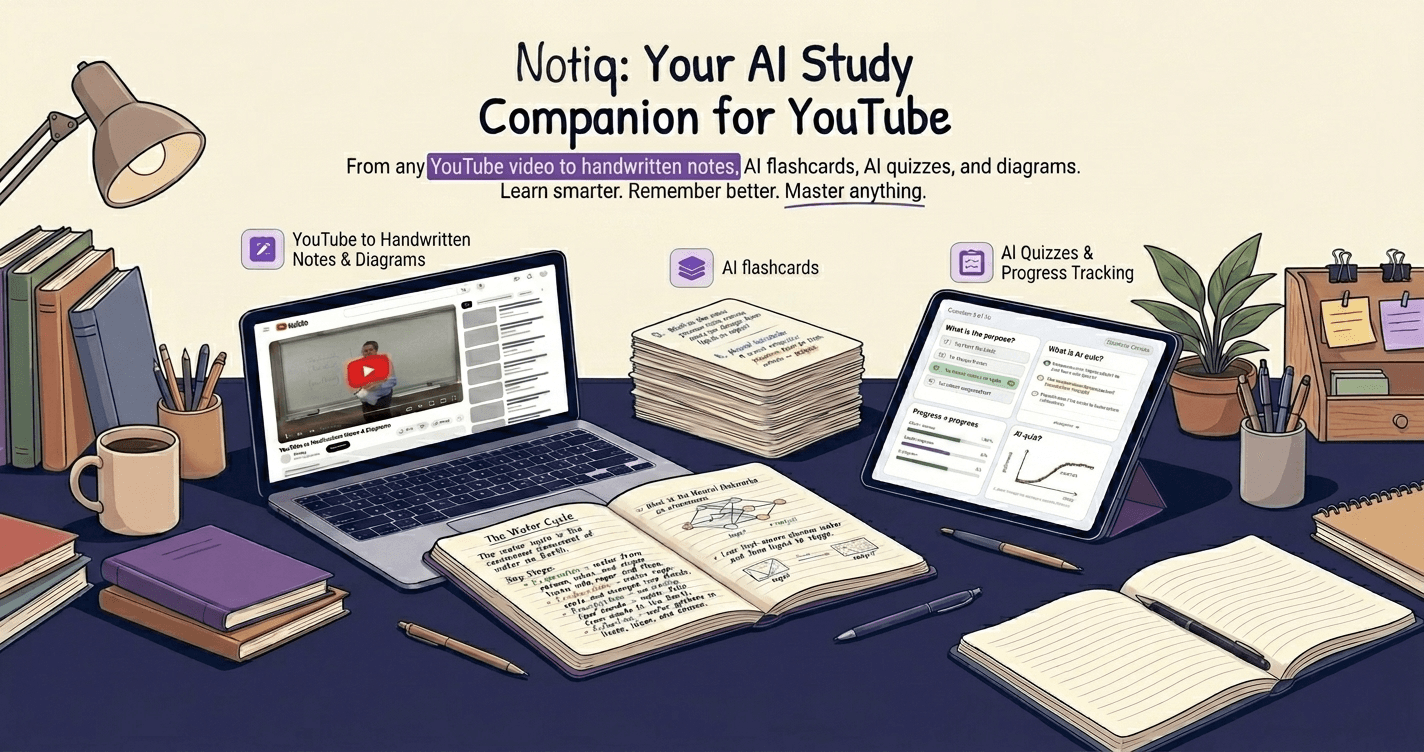
Notiq generates structured notes — Cornell-style, outline, or summary — from any YouTube video, lecture recording, or document automatically, so you can spend your attention on choosing the right method for the content rather than on the mechanics of formatting it. Try Notiq free at notiq.study.