History YouTube has a specific split worth understanding before you pick channels: exam-review content built directly around a published curriculum (Heimler's History, aligned to College Board AP frameworks), broad survey content designed to give you the full shape of a subject quickly (Crash Course), and entertainment-first content that builds genuine interest and context without being designed as study material at all (OverSimplified). Using the wrong type for your actual goal — watching OverSimplified as your primary AP US History review, for instance — produces engagement without the exam-specific preparation you actually need.
This guide sorts the major history channels by what they are actually built for, so you can match the channel to your actual goal rather than just picking whatever is most entertaining.
For AP History exam prep specifically, see AP exam prep using YouTube and AI notes, which covers how Heimler's History fits into a broader AP study timeline alongside Khan Academy's other AP courses.
Heimler's History — The AP-Specific Standard
Heimler's History, created by former AP teacher Steve Heimler, is the standout resource specifically for AP US History, AP World History, AP European History, AP Human Geography, and AP Government and Politics. The channel's defining feature is direct alignment to the College Board's published course frameworks — Heimler's unit-by-unit review videos are built explicitly around the same historical thinking skills (causation, comparison, continuity and change over time, contextualization) that AP history exams grade on, not just factual recall of dates and names.
What separates Heimler's History from a general survey channel: the videos assume you have already been taught the material in class and are designed as consolidation and review, with heavy emphasis on how to actually construct the kind of argument an AP free-response question rewards — not just "what happened" but "how do you write a causation essay about why it happened that AP graders will score well."
Who it is for: any student taking one of the five AP courses the channel covers, and — more broadly — anyone who wants history content organized around argument and analysis rather than pure narrative. The Heimler Review Guide (a companion product to the channel) extends this into a comprehensive written review resource for the same five courses.
Crash Course — The Broadest Free Survey
Crash Course (started by John and Hank Green) covers World History and US History in fast-paced, roughly 10-15 minute episodes with high production quality, consistent humor, and a genuine attempt to connect events across a broad timeline rather than treating each episode as an isolated topic. As of its current run, Crash Course has accumulated well over a decade of content and is one of the most-watched educational channel families on YouTube.
Why Crash Course works well as a first pass: its fast pace and connective narrative style are well suited to giving you the overall shape of a historical period before you study any part of it in depth — watching the relevant Crash Course episode before a unit begins in your actual course means you arrive already knowing the broad narrative and major names, which makes the detailed classroom or textbook treatment land better.
The limitation to be aware of: Crash Course's pace means individual causation and analysis — exactly the skill AP history exams grade most heavily — gets less attention than pure narrative coverage. Crash Course is an excellent survey layer; it is not, on its own, sufficient AP exam preparation the way Heimler's History's exam-specific framing is.
OverSimplified — Genuinely Entertaining Context, Not a Study Resource
OverSimplified covers major historical conflicts — both World Wars, the Cold War, various revolutions, and a number of lesser-known conflicts — using an animated, comedic "real talk" narration style that has made it one of the most-watched history channels among younger audiences specifically because it does not feel like studying at all.
Where OverSimplified genuinely helps: building initial interest and a rough narrative map of a conflict before you study it seriously elsewhere. Watching an OverSimplified video on World War I before your class covers it gives you character names, rough chronology, and enough narrative hooks that the detailed classroom treatment has something to attach to — similar in function to how Crash Course episodes work as a preview, but with even less formal structure and correspondingly less use as an actual review tool.
Where it falls short as study material: OverSimplified is explicitly not built for exam preparation — it simplifies aggressively (as the name states directly) and is not organized around the historical thinking skills or specific content details an AP or college history exam actually tests. Treat it purely as an engagement and context tool, not a review resource, and pair it with Heimler's History or Crash Course for anything you actually need to know for an exam.
Building a History Study Sequence That Uses All Three Correctly
For genuine first-time interest and context: OverSimplified, watched purely for engagement, before a topic is formally studied.
For broad survey coverage as a topic begins: Crash Course's relevant episode, watched close to when your class or self-study plan reaches that unit.
For actual AP exam review: Heimler's History's unit-specific videos, used as a consolidation pass after the material has already been taught, with explicit attention to the historical thinking skill each video is modeling, not just the content.
This sequence uses each channel for what it is actually built for, rather than treating all three as interchangeable "history YouTube" and picking based on entertainment value alone.
Taking Notes on History Videos
History note-taking should capture argument structure, not just facts. For any video — especially Heimler's History's exam-focused content — note not just what happened but why the video frames it as a cause of a particular later event, since that causal reasoning is exactly what an AP free-response question or college history essay requires you to reproduce. A list of dates and names without the causal connections between them is a weak foundation for the kind of analytical writing history exams actually reward.
For the retrieval-practice principle that makes this kind of note review actually stick, see active recall techniques, and for converting video notes into a complete study system, the AI study notes complete guide.
History YouTube gives you real range across purpose — Heimler's History for exam-specific analytical rigor, Crash Course for broad connective survey, OverSimplified for genuine engagement and context. Matching the channel to your actual goal, rather than defaulting to whichever is most entertaining, is what makes free history content into real exam preparation.
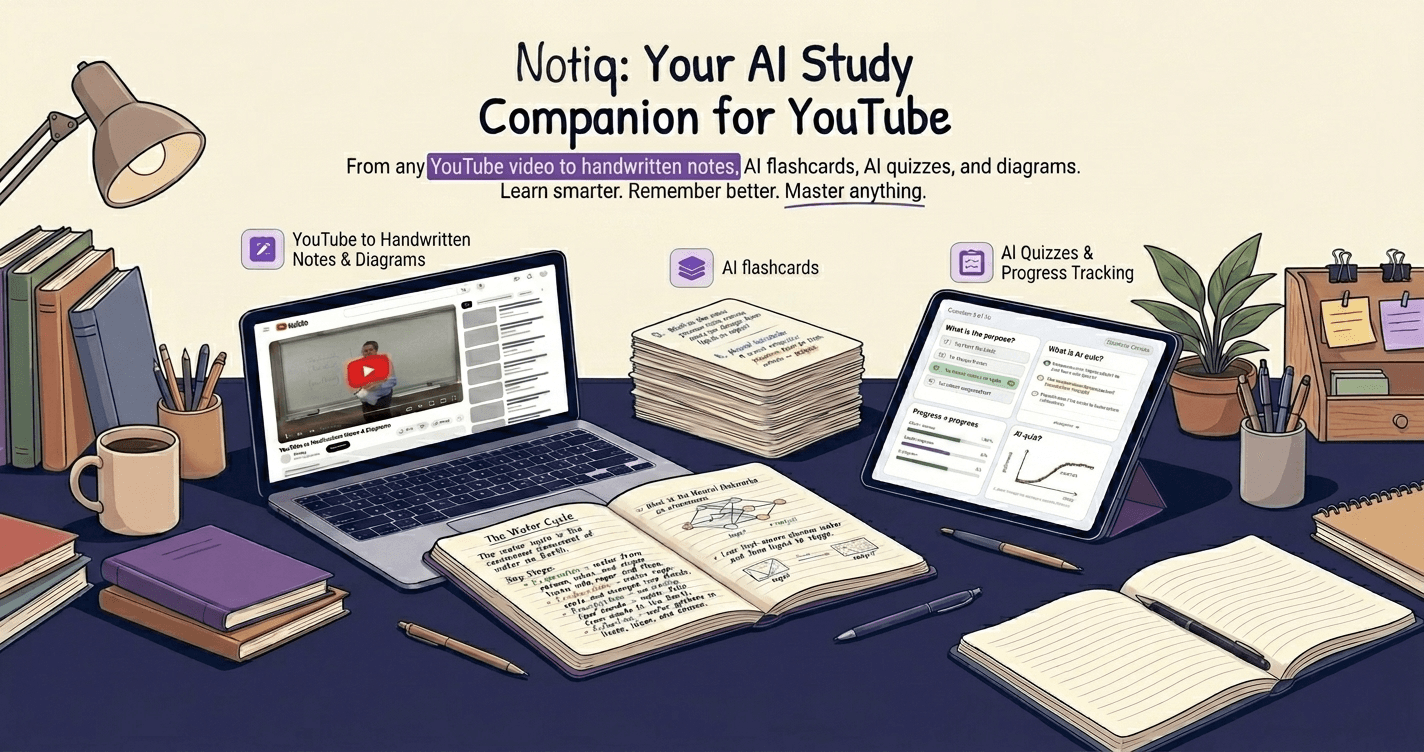
Turn your history review videos into structured notes and flashcards automatically. Try Notiq free at notiq.study — import any YouTube history lecture or review video and get organized notes plus exam-ready flashcards in minutes.